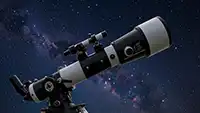



The eyepiece is the part of the telescope that determines the magnification. The eyepiece contains the lens in the telescope before it reaches our eye, and in a refractor like this, it is inserted at the back, and it is what makes it possible to see the image. The reason why the final lenses are not built into the telescope is that by switching between different eyepieces, you have the option to change the magnification and other parameters such as field of view and eye relief.
There are two types of telescopes: lens telescopes and mirror telescopes. In a lens telescope, the light passes through several lenses, which gather the light at the end of the telescope, where the eyepiece can then convert it into an image. In mirror telescopes, there are no lenses but instead several mirrors, but the function is the same in that the mirrors gather the light and again you use the eyepiece to form an image.

In this diagram, we can see the lens telescope (a refractor) at the top and the mirror telescope at the bottom, which in this case is of the Newtonian type. There are several different types of mirror telescopes, but we will not go into that here, as the function is the same.
If we demonstrate this with one of our own telescopes, the light enters the front and is gathered at a point, after which the light rays spread out. And if we looked into the telescope now without an eyepiece inserted, we would not see anything but light with some small nuances. But of course, we use an eyepiece, and in this case, we are using an eyepiece from Baader with a 1.25 inch connection. We will return to the different sizes of connections later in the broadcast.
With the eyepiece inserted, we can then focus the image, which we do by placing the eyepiece precisely in relation to the point where the light is gathered into a single point. And when that happens, the eyepiece catches the light rays and ensures that they come out parallel to each other, and we can now see an image in the telescope.
One last important thing is that because the light rays cross each other, the image you see in a telescope is always upside down. This is not a big problem when using the telescope to look at stars and planets, but when using it in daylight, it is something you have to get used to.
If you look at our refractor, we also have a smaller refractor on top, which we use as a guiding scope for photography, and we also have a smaller finder scope. The finder scope differs from the others in that here all the lenses are built-in, so you cannot replace the rear one with an eyepiece.
We also know this from handheld binoculars, where all the lenses are built-in and therefore will have a fixed magnification. For example, these binoculars give 8 times magnification. A binocular is actually two refractor telescopes that have been put together, but the binoculars have an extra prism inserted that flips the image so it is not upside down.
The most important parameter for an eyepiece is the focal length, as it is what determines the telescope's magnification. The focal length is the distance from the point where the light is gathered into a point to where the light rays become parallel. The focal length is measured in millimeters and is always written on the side of the eyepiece. The telescope's magnification is calculated by taking the telescope's focal length and dividing it by the eyepiece's focal length, which also means that the smaller the focal length of the eyepiece, the greater the magnification.
 Note that the magnification of the moon is the same regardless of the field of view. The only difference is how much you see beyond the moon.

An eyepiece should preferably have an eye relief of 1½ cm, partly because it can feel uncomfortable to get too close to the eyepiece but also to be able to use glasses when looking at the night sky.
Barlow lenses can be a good way to get more out of your eyepieces. These extend the focal length of the telescope and thereby increase the magnification.
 As described earlier, the telescope gathers the light rays at a point here behind the camera, and what the Barlow lens does is move this point further back, which extends the focal length. The increase is written on the side of the lens, and here we have, for example, a Barlow that increases the magnification by a factor of 2.
The Barlow lens is inserted into the telescope, and if we put a 10mm eyepiece into the Barlow lens, we now get the same magnification as if we had inserted a 5mm eyepiece.
Note that Barlow lenses do not improve the telescope's maximum magnification. So you cannot get a better telescope by inserting Barlow lenses, but you can make better use of the eyepieces since a single eyepiece can now provide two different magnifications.
In addition, the telescope's ability to collect light is reduced, so they are best suited for viewing the moon and planets and less suitable for deep sky objects.
In this section, we go through a small selection of some very different eyepieces in the price range under 2,000 kr.

Starting from the left, we have three cheap eyepieces in the 250 kr. class, which are actually three eyepieces that were delivered together with two of our telescopes. In the middle, we have a special eyepiece for planetary observation at only 2.5mm. On the right, we have a quality eyepiece from Baader at 5mm and a wide-angle lens at 21mm.
The first eyepiece came with a very cheap telescope, and the quality is very low. Besides the image quality being poor, the eye relief is also so short that it becomes directly uncomfortable to look through them. The good thing is that the cheap telescopes are often better than the eyepieces that come with them. So you can often get a quite decent telescope by spending 250 kr. on buying a Super Plössl like those we describe below.
The other two of our cheap eyepieces are the 10 and 25 mm ones, and they came with an 8 inch telescope. These are so-called Super Plössl eyepieces, and they are actually of quite good quality. They have a field of view of 52 degrees, which is absolutely usable, and a comfortable eye relief. In general, you can expect good eyepieces to be delivered with most telescopes except for the cheap supermarket telescopes.

This is a so-called modular eyepiece, which means that we can unscrew the first front part. This part can now be used separately or alone as a 2 inch eyepiece. It can also be put together again with the front part with different adapters and thus get different magnifications with the same eyepiece.
There is a rubber piece at the front, which provides a comfortable distance to the eye, and it can be folded back if you wear glasses. In addition, there are two sizes of threads here at the front, which make it possible to screw cameras directly onto eyepieces using a T-Ring.
This is an eyepiece that you can buy when you have gained some experience with other eyepieces. They can be bought separately or as a full series with 7 eyepieces from 5 to 24 mm.
 Normally, 100 degree eyepieces are very expensive, but here some compromises have been made with the quality, so it can be had for under 2000 kr. And it is mainly at the edge of the field of view that the quality is not so good, and in many cases, it is not something you will have problems with.
Here at the end, we have a few concluding comments. One thing we have only briefly touched on is that there are different sizes of the base on the eyepieces. The most common are 1.25 inch and 2 inch. Here on the table, only our 100 degree eyepiece is 2 inch; all the others are 1.25 inch.
Another thing we have not mentioned is that at the bottom of almost all eyepieces there is a thread that makes it possible to screw on filters. The problem with having both a 1.25 inch base like here and 2 inch on this one, of course, means that you need separate filters for each.