
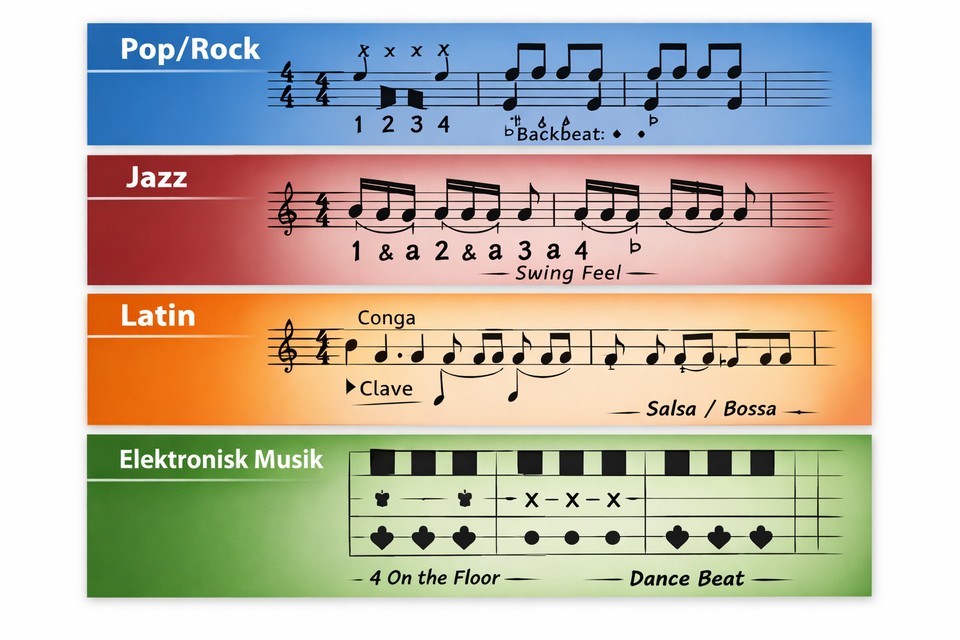


Rhythm is the foundation of all music. Whether you listen to classical, pop, rock, or jazz, it is the rhythm that moves the music forward and makes your feet tap. But what exactly is rhythm, and how do musicians work with pulse, meter, and groove? This article delves into the most important rhythmic concepts and provides examples of their use.
Rhythm is about the placement of sounds and silences in time. It is a pattern created by tones, beats, and silence, which is repeated and varied. Rhythm can be simple and regular or complex and unpredictable, depending on genre and expression.
The pulse is the regular, recurring feeling in the music – what you often instinctively clap or stomp along to. The pulse forms the basis for the rest of the rhythm and determines the music’s tempo (speed).

Music is organized into measures, which are groups of beats. The time signature indicates how many beats are in each measure and how they are grouped.
The example below shows a short rhythmic sequence in 4/4, where bar lines divide the music into measures. Above each measure is a measure number.
Within each measure, the rhythm can be varied with rhythmic figures such as quarter notes, eighth notes, and sixteenth notes. Rests also play an important role and create variation and tension.
The example below shows 2 measures in 4/4:
In measure 2, the notes start on the offbeats (& of 1 and & of 3) and are tied over to the next beat. This gives a clear syncopated feel, because the “normal” accent times (beats 2 and 4) are filled by a note that actually started earlier.
Groove describes how the rhythm makes the music swing and feel alive. It's about the interplay between instruments, especially bass and drums, and small variations in timing that make the music "groove".
Groove is often what makes people dance or nod along – it can't always be written down, but must be felt.

In bands, orchestras, and choirs, it is crucial that everyone follows the same pulse and beat. The drummer or percussion group is often responsible for keeping the rhythm, but all musicians contribute to the overall groove.
Rhythm is the engine of music. By understanding and feeling pulse, beat, groove, and the many rhythmic possibilities, you can both enjoy music more intensely and develop your own musical abilities.