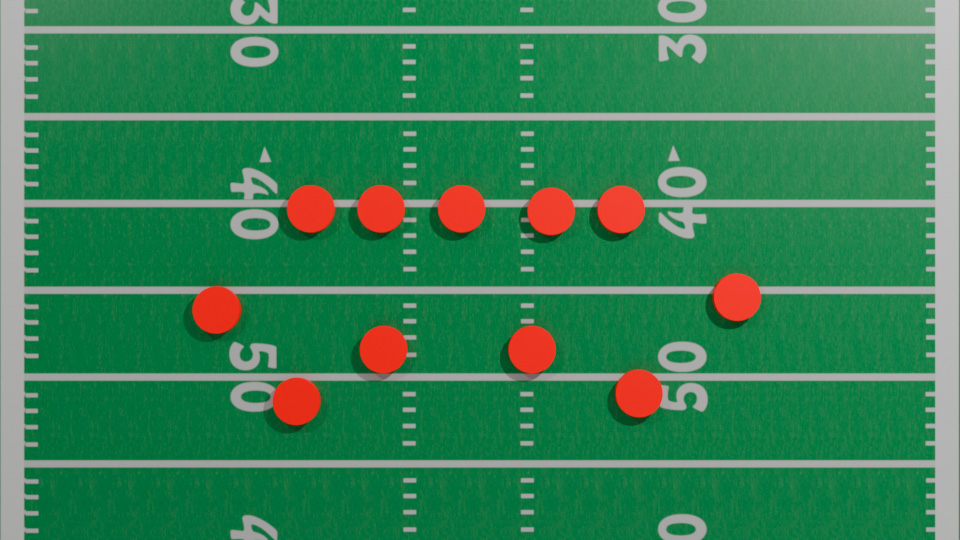


The defense's task is to prevent yards and points. This is done with a combination of fronts (the alignment close to the line of scrimmage), coverages (how you defend passes), pressure/blitz as well as a range of advanced techniques such as stunts, rotations, and disguised coverages. This article gives both beginners and advanced players an overview – with simple SVG diagrams, which can be replaced by your own 3D visualizations.
A front describes the distribution of linemen and linebackers in front of the ball. The choice of front affects run defense (gap control), pass rush, and how easily you can disguise a blitz or drop players into coverage.
Coverage describes how DBs (cornerbacks/safeties) and often linebackers defend against passes. Broadly, there is a distinction between man-to-man, zone, and pattern-match (hybrid, where zones react to routes).
Blitz is when the defense sends extra players at the quarterback. Purpose: shorten his decision time. Risk: fewer in coverage. Vary who comes (LB/CB/S) and from where.
Skilled coordinators mix front and coverage: e.g. 3‑4 front with Cover 2, 4‑2‑5 nickel with Cover 3, or simulated pressure from a 3‑3‑5 Tite front. The goal is to show one picture pre‑snap and play something else post‑snap.
Stunts (also called twists) are coordinated movements between two or more pass rushers. A T/E stunt (tackle-end) lets a defensive tackle go first to draw blocking, after which an edge rusher “loops” into the open gap. The purpose is to create 1-on-0 situations or confusion in the O-line’s “pass-off”.
Simulated pressure still only sends four rushers (like a normal rush), but the four do not always come from the D-line. An LB/DB blitzes, while a lineman drops into coverage. The offense sees blitz pre-snap and adjusts protection, but the defense still keeps seven in coverage. Creepers are related: pressure from an unexpected player without sacrificing coverage.
The defense shows one coverage pre-snap (e.g. two high safeties = Cover 2/4) but rotates post-snap to another (e.g. Cover 3 or robber). A safety can rotate down into the box, while the other goes deep middle. Corner can “cloud” (flat zone) or “press bail” to deep third.
Match are zones that turn into man coverage depending on routes. Examples: Quarters (Cover 4) match with “MOD/MEG” rules (Man On Deep / Man Everywhere he Goes), Palms/2‑read (corner reads no. 2 in/out and “traps” the out route), Rip/Liz match (Cover 3 rules against trips). The advantage is that you can be solid against both deep and underneath – but it requires communication and practice.
Run defense is about assigning gap responsibility (A/B/C). The force player holds the edge and forces the run inside; spill directs the ball carrier to teammates; box closes the inside. Good communication between DL, LB, and safeties is crucial, especially against zone runs (inside/outside) and counter/power.
Bear/46 (five on the line, 3 technique over guards, 1 over center) compresses the inside and closes interior gaps – strong against the run and short yardage. Tite/Mint 3‑3‑5 places three interior DL tight (4i‑0‑4i) to close B gaps in the spread era, with five DBs on the field. Over/Under are shifts in the 4‑3 base (DL shades toward strong/weak side) for better matchups against the strength side or weak‑side cutbacks.