

The First World War was one of the most decisive events in modern history. The war lasted from 1914 to 1918 and involved large parts of the world, but its center lay in Europe. It began as a conflict between great powers and their alliances, but quickly developed into a total war in which millions of soldiers and civilians were affected. For many, the First World War marks the transition from an older world of empires and rigid social hierarchies to a new and more uncertain era marked by revolutions, technological leaps, and political upheavals.
The war is remembered especially for trenches, enormous casualty figures, and new weapons that made the fighting more destructive than before. But it was also important because it changed borders, toppled empires, and left traces that would later shape the entire 20th century. To understand the First World War, one must look both at the long-term causes, the central events during the war itself, and the profound consequences the conflict had for culture, politics, and society.
In the decades before 1914, Europe was marked by rivalry between great powers such as Britain, France, Germany, Russia, and Austria-Hungary. Industrialization had made the countries richer and stronger, but also more competitive. Many states wanted colonies, military strength, and political influence. At the same time, nationalism grew, that is, the idea that people with the same language, culture, or history should unite in their own nations. This idea created both pride and conflict, especially in areas where many peoples lived side by side.
Another important factor was the alliances. Europe was gradually divided into two major blocs. On one side stood the Triple Entente with France, Russia, and Britain. On the other side stood the Central Powers, especially Germany and Austria-Hungary, later supported by the Ottoman Empire and Bulgaria. The alliances were meant to create security, but they also made the situation more dangerous. If one conflict broke out, it could quickly draw many countries into it. Thus, Europe became like a system in which tensions kept growing beneath the surface.
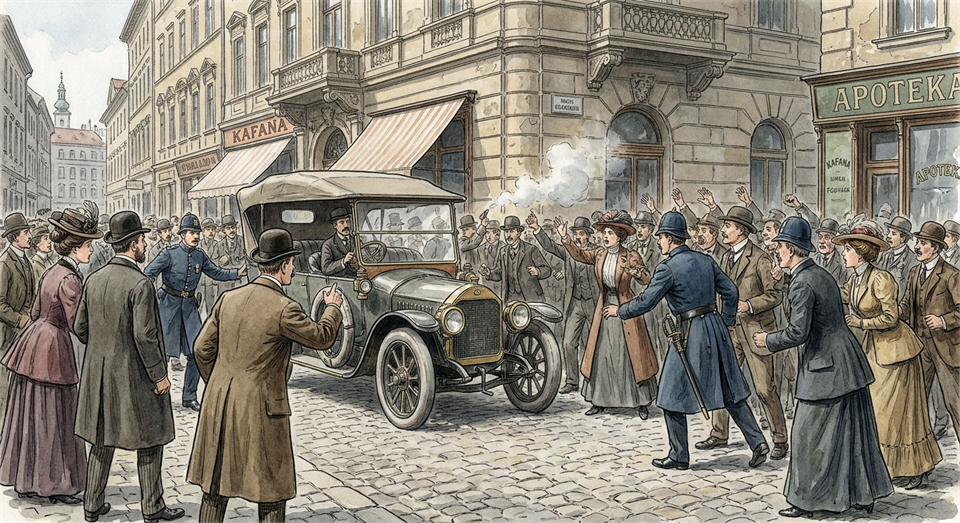
The triggering event came on June 28, 1914, when the Austro-Hungarian heir to the throne Franz Ferdinand was murdered in Sarajevo by Gavrilo Princip, a Bosnian Serb nationalist. The assassination was dramatic, but in itself it would hardly have led to world war if the situation had not already been so tense. Austria-Hungary wanted to punish Serbia, which it believed supported nationalist movements. Germany gave its ally support, while Russia supported Serbia. This was followed by a chain reaction of mobilizations and declarations of war.
Within a few weeks, a regional conflict became a great war. Austria-Hungary declared war on Serbia, Russia mobilized, Germany declared war on Russia and France, and when Germany invaded Belgium to reach France quickly, Britain entered the war. Many believed at the time that the war would be short. Instead, it became long, brutal, and far more destructive than the leaders of the time had imagined.
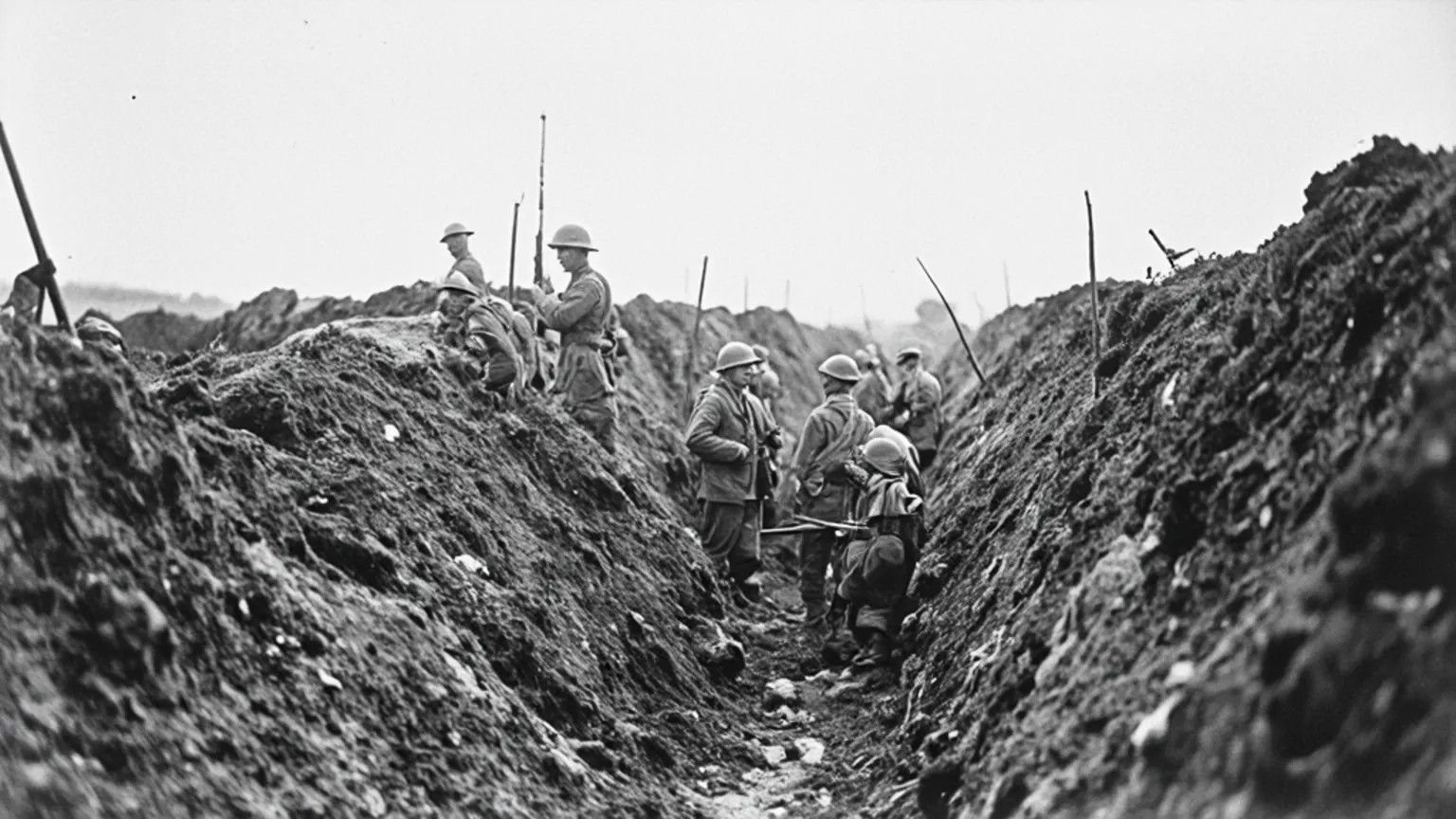
At the beginning, Germany tried to win quickly through the so-called Schlieffen Plan. The idea was to defeat France quickly by marching through Belgium and then turning against Russia, which was assumed to take longer to mobilize. However, the plan failed at the Marne in 1914, where the German forces were stopped. After this, both sides dug themselves into long lines of trenches that came to stretch from the North Sea to Switzerland.
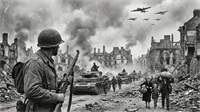
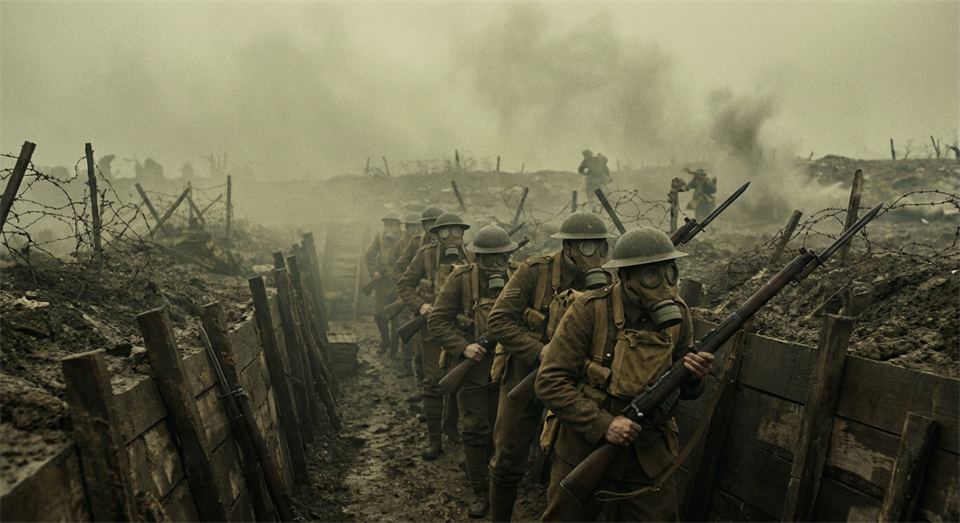
Trench warfare became a symbol of the First World War. The soldiers lived in mud, cold, rats, and constant danger. The front lines often moved only a few kilometers, even after enormous attacks with thousands dead. Battles such as Verdun and the Somme in 1916 showed how deadlocked and bloody the war had become. At the Somme, tens of thousands of British soldiers were killed and wounded in a single day, without the breakthrough coming. The war therefore became not just a struggle between armies, but also a war of attrition in which industrial production, supplies, and human resources became decisive.
Although the Western Front is the best known, the war was far greater than the trenches in France and Belgium. On the Eastern Front, Germany and Austria-Hungary fought against Russia across enormous distances. Here the front was more mobile, and entire cities and regions were thrown into chaos. Russia suffered major defeats, and the military problems contributed to growing dissatisfaction with Tsarist rule. In 1917, this led to revolution, which changed Russia's role in the war and in world history.
The war also spread to the Middle East, Africa, and the seas. The Ottoman Empire took part on the side of the Central Powers, and fighting took place in areas such as Gallipoli, Mesopotamia, and Palestine. At sea, the British navy tried to blockade Germany, while German submarines attacked merchant ships. Thus, the First World War became a truly global conflict, in which colonies, sea routes, and international trade connections played an important role.
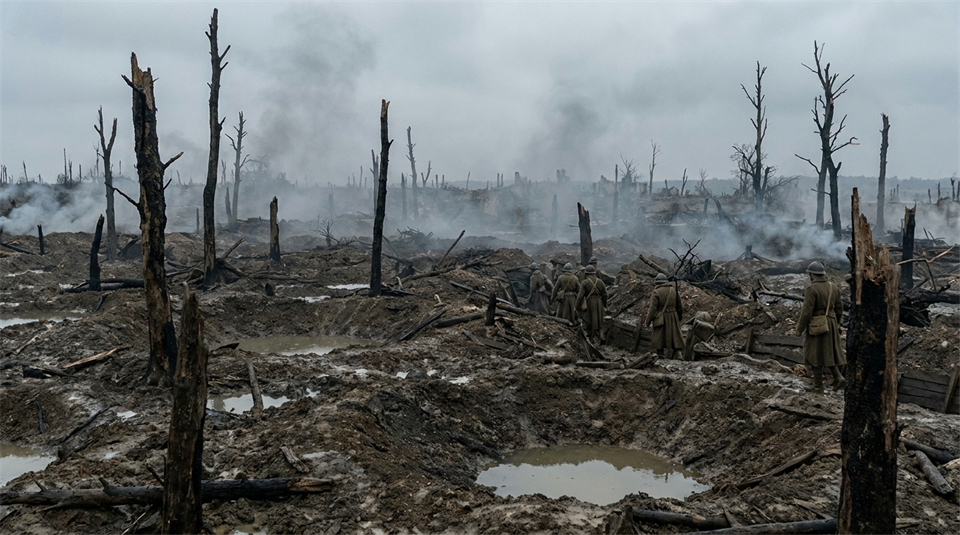
The First World War was a modern industrial war. Many of the weapons were not entirely new, but they were now used on a scale the world had not previously seen. The machine gun made frontal attacks extremely dangerous, because a few soldiers could fire very large amounts of ammunition in a short time. Heavy artillery was used massively and killed or maimed countless soldiers, often without them seeing the enemy. Shells, barbed wire, and mines made the battlefield a deadly landscape.
New types of weapons were also introduced. Poison gas was used for the first time on a large scale in 1915 and created fear, panic, and terrible injuries. Tanks were developed to break through trenches and barbed wire, but at first they were slow and technically unreliable. Aircraft were first used for reconnaissance, but later also for air combat and bombardment. Submarines changed naval warfare dramatically. Taken together, the war showed that technological progress could not only improve life, but also make destruction more efficient.
Behind the great battles and strategic plans stood millions of ordinary people in uniform. Daily life for the soldiers was often marked by waiting, fear, and physical strain. They had to endure in wet trenches, where diseases spread quickly. Many suffered from so-called shell shock, what we today would call psychological trauma after war. Constant shelling, the loss of comrades, and the feeling of powerlessness left deep marks.
Letters from the front show that the soldiers could experience both strong comradeship and deep despair. Some wrote about the hope of coming home, others about the meaninglessness of attacks in which thousands died for a few meters of ground. The war therefore changed not only maps and governments, but also the way people thought about heroism, obedience, and the value of human life.
The First World War was not only the soldiers' war. Entire societies were mobilized. Governments controlled production, rationed food, and used propaganda to keep the population united. Factories produced weapons, ammunition, uniforms, and vehicles in enormous quantities. Women took over many jobs that had previously been carried out mainly by men. They worked in industry, in offices, in agriculture, and in hospitals. The war therefore also became a turning point in several countries' view of women's role in society.
Civilians felt the consequences directly through shortages of goods, rising prices, and grief over fallen family members. In areas close to the front, towns and villages were destroyed, and many people had to flee. Blockades and the war economy made life difficult, especially in the Central Powers. Hunger and malnutrition became serious problems. The war showed that modern conflicts could no longer be kept separate from ordinary social life.
During the war, posters, newspapers, and speeches were used to influence the population. The enemy was often portrayed as inhuman, while one's own soldiers were shown as brave and honorable. The propaganda was meant to strengthen the will to fight, get people to buy war bonds, and accept sacrifices. At the same time, censorship was used to hide defeats or mute criticism. Many people therefore experienced the war through a filter of patriotic messages.
Culturally, the war left deep marks. Poets, painters, and writers reacted to the violence and the losses. Some depicted the war as meaningless and destructive, while others tried to find meaning in the sacrifices. The First World War thus also changed art and literature. The old faith in progress and civilization was shaken, because it was precisely the most developed industrial societies that had thrown themselves into an unprecedented catastrophe.
Two events became especially important in the final phase of the war. One was the Russian Revolution in 1917, which led to Russia withdrawing from the war. This gave Germany the opportunity to move troops to the Western Front. The other was the United States' entry into the war the same year. American soldiers and resources significantly strengthened the Entente. Germany attempted a major offensive in 1918, but it failed, and the Allies then pushed the Central Powers back.
Gradually, the Central Powers collapsed. Austria-Hungary and the Ottoman Empire disintegrated, and dissatisfaction grew in Germany. The emperor abdicated, and on November 11, 1918, the armistice was signed. The fighting stopped, but peace had not yet been created. Europe was left with devastated landscapes, millions dead, and societies in deep crisis.
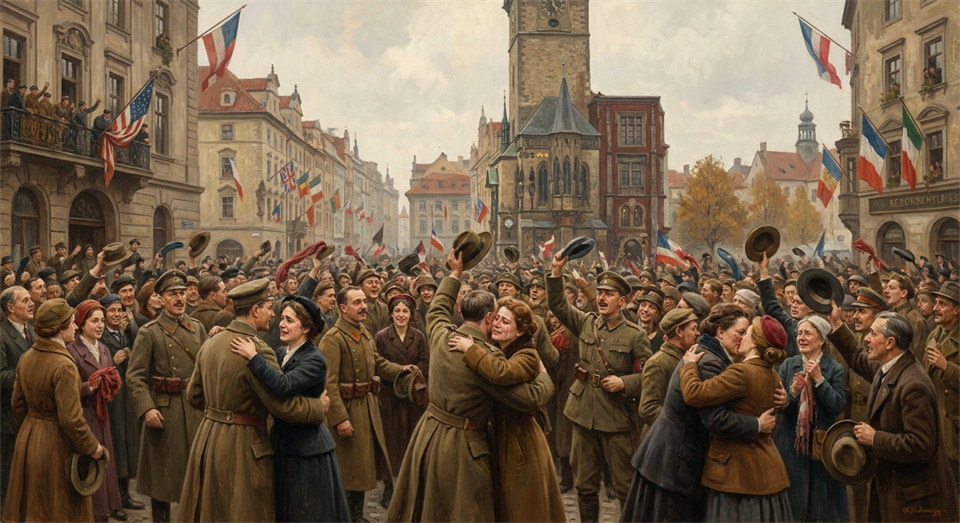
After the war, the victors met to create a new order. The Treaty of Versailles of 1919 imposed harsh conditions on Germany, including territorial losses, military restrictions, and large reparations demands. Many believed that the treaty was necessary to prevent a new war, but others saw it as a humiliation that created bitterness and instability. At the same time, new states were formed in Europe, while old empires such as the German, Austro-Hungarian, Russian, and Ottoman ones disappeared or were radically changed.
The First World War cost millions of people their lives and left even more wounded or traumatized. It weakened faith in the idea that Europe stood for stability and progress. Many historians see the war as the beginning of a troubled period that also included economic crises, political extremism, and eventually the Second World War. Therefore, the First World War cannot be understood only as a concluded conflict, but as an event that opened the door to an entirely new era.
The First World War was more than a military conflict between great powers. It was a collapse of the old European order and a turning point that changed politics, society, culture, and technology. The war showed how dangerous the combination of nationalism, rivalry, and military rearmament could be. At the same time, it showed how modern industry and science could be used for destruction on an unprecedented scale.
Learning about the First World War is important because it helps us understand many of the major events of the 20th century. It also reminds us that major conflicts rarely arise suddenly. They often grow out of tensions, fear, and political f
mistakes that are allowed to develop. Precisely for that reason, the First World War still stands as a central key to understanding the modern world.