

Titan Atlas is one of the most recognizable figures from Greek mythology. Many people immediately associate him with the image of a powerful man carrying the sky or a large globe on his shoulders. The figure appears in everything from ancient sculptures to modern logos, books, and films, and his name lives on in words such as “atlas,” which today is used for collections of maps. Atlas is therefore not only an ancient mythical figure, but also a powerful cultural symbol. He represents strength, punishment, responsibility, and endurance all at once, and that is precisely why he has had an unusually long life in art and cultural history.
For beginners, Atlas can be a little confusing, because he appears both as a divine Titan, a tragic figure, and a symbolic image. In this article, we take a closer look at who Atlas was in the myths, why he was punished, how he has been depicted throughout history, and why he still fascinates people today. The aim is to make the subject easy to understand while also showing how significant Atlas has been in the international cultural heritage.
Atlas belongs to the Titans, who in Greek mythology were an older generation of powerful beings before the Olympian gods such as Zeus, Hera, and Athena came to power. The Titans were the children of Uranus, the sky, and Gaia, the earth, and they played a central role in the early order of the world. Atlas was the son of the Titan Iapetus and is often regarded as the brother of Prometheus, Epimetheus, and Menoetius. Even here, he becomes part of a family that in the myths is associated with rebellion, suffering, and the fate of humankind.
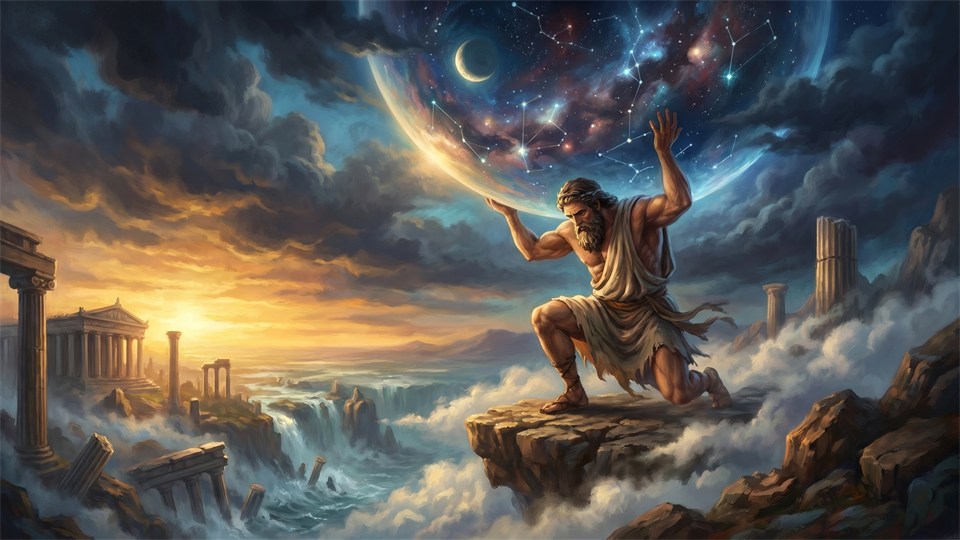
The most important thing about Atlas’s role is that he took part in the Titans’ war against Zeus and the Olympian gods. This conflict, known as the Titanomachy, ended with the defeat of the Titans. While some Titans were cast into Tartarus, Atlas received a special punishment. He was condemned to stand at the edge of the world and bear the sky on his shoulders. It is important to understand that in the oldest myths he does not carry the earth, but the vault of heaven itself. Later art and popular culture have often confused this with a globe, because it is easier to depict and recognize.
Atlas’s punishment is central to his significance. He is not just strong; he is strong under compulsion. For that reason, he has become a symbol of burden and responsibility, but also of endurance. He does not stand as a triumphant hero, but as a figure who must continue under an almost inhuman weight. That makes him different from many other mythological figures associated with triumph or cunning. Atlas is instead the image of hard labor, the eternal task, and the bodily struggle against something greater than oneself.
This idea has made Atlas especially well suited as a motif in art. When artists show him bent beneath the sky, the body becomes a dramatic image of both physical and psychological strain. The figure can be read as a story of punishment, but also as a more universal image of human life. Many people know the feeling of carrying responsibility, pressure, or expectations, and that is why Atlas is easy to understand, even for modern audiences without deep knowledge of Greek religion.
One of the most famous stories about Atlas concerns the hero Heracles. As part of his twelve labors, Heracles had to fetch the golden apples from the garden of the Hesperides. In some versions of the myth, Atlas was connected to this place, and Heracles therefore asked for his help. Atlas agreed to fetch the apples if Heracles would meanwhile take over the burden and hold up the sky. This creates a compelling situation in which the great hero himself experiences the weight that Atlas normally bears.
When Atlas returned with the apples, in some versions he did not want to take the burden back. Heracles, however, used his cunning and asked Atlas to take over the sky again briefly so that he could adjust his position. When Atlas did so, Heracles took the apples and left. This episode is important because it shows Atlas as more than a passive punished figure. He has will, personality, and perhaps even a desire for freedom. At the same time, the story emphasizes how enormous his task really is, because even Heracles can bear it only temporarily.
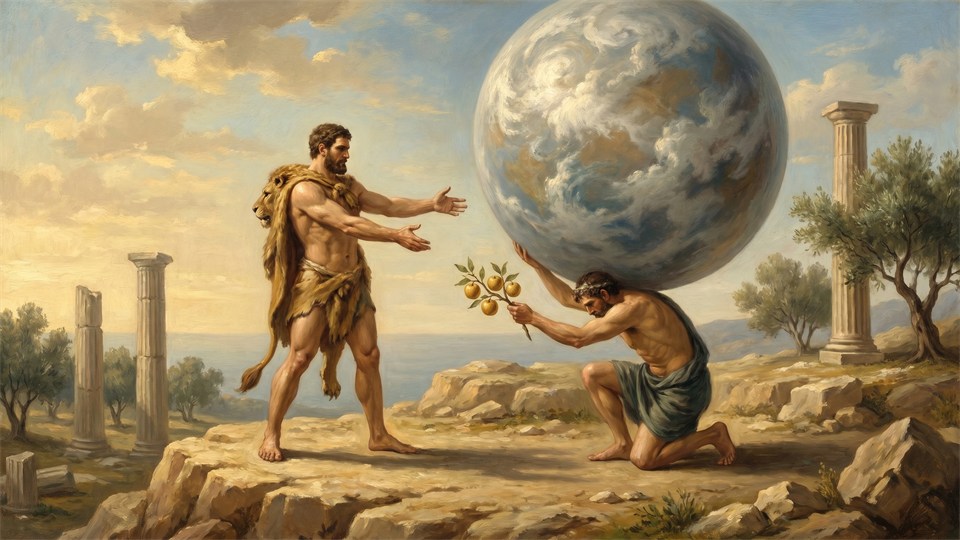
The encounter between Heracles and Atlas has been interpreted in many ways. Some see it as a story of strength versus cunning, because Heracles does not win through brute force alone, but by thinking carefully. Others read it as a story about responsibility that cannot be escaped so easily. Atlas tries to break free, but ends up back in his old role. Themes like these make the myth rich and useful for later writers and artists, who have often used Atlas to explore the relationship between freedom, duty, and fate.
For a modern audience, this part of the myth is also interesting because it makes Atlas more human. He is not only a symbol, but a figure with hope and frustration. It is precisely this mixture of monumental strength and tragic confinement that gives Atlas his special place in cultural history.
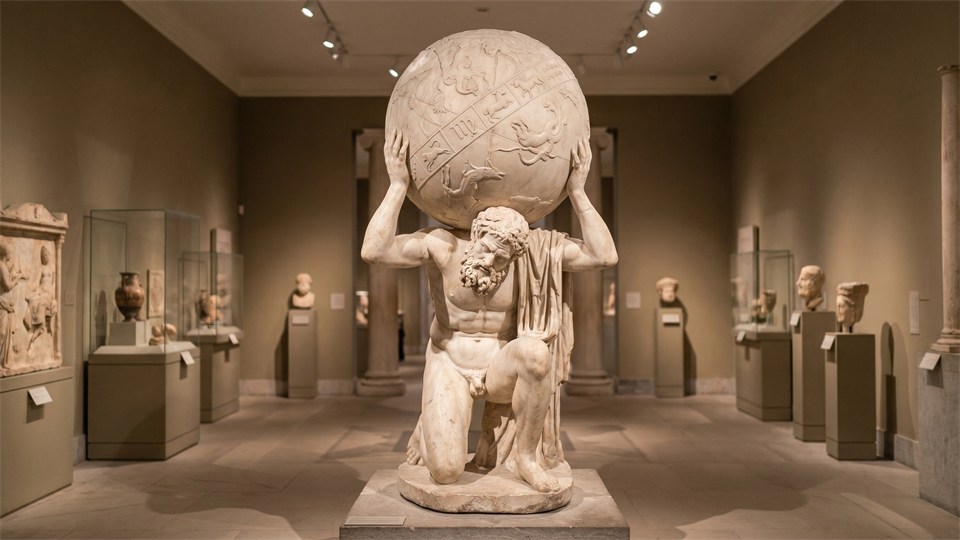
Atlas has been a popular motif since antiquity. In Greek and Roman art, he was often shown as a muscular man bending beneath a round or vaulted form over his back and shoulders. A well-known ancient type is the so-called “Farnese Atlas,” a sculpture in which he carries a celestial globe with constellations. This type of representation is especially important because it connects the myth with the cosmos and knowledge of the universe. Here, Atlas becomes not only an image of physical strength, but also of world order and the structure of the heavens.
In the Renaissance and later in Neoclassicism, artists returned to the motifs of antiquity, and Atlas gained new life as a symbol of heroic anatomy and dramatic movement. His tense muscles, bent back, and strained posture gave painters and sculptors the opportunity to show the body under extreme stress. For that reason, Atlas is often seen in architecture as a supporting figure, where male sculptures function as column-like elements. These figures are sometimes called atlantes, and they are the male parallel to caryatids. Here, the myth is directly translated into the language of the building’s form: a body that bears weight.
In modern art and visual culture, Atlas has often been simplified into an icon. He appears as a silhouette with a sphere on his shoulders, in posters, book covers, company symbols, and illustrations. This simple image immediately communicates ideas such as strength, global reach, responsibility, or hard work. That is why Atlas is often used by organizations that want to signal a global outlook or robustness.
At the same time, modern artists have also used Atlas more critically. In some works, he becomes an image of humanity under pressure from society, technology, or the economy. Instead of a heroic Titan, he becomes a figure almost crushed by his burden. This shows how flexible the myth is. Atlas can stand both for proud strength and for vulnerability under weight. It is precisely this double meaning that still makes him relevant.
Many people first encounter Atlas through the word “atlas” meaning a collection of maps. This usage comes from early modern book culture. Cartographers and publishers began using Atlas as a title or image for works that gathered maps of the world. The figure fit well here, because he was already associated with the heavens, the world, and the idea of carrying something large and comprehensive. The name gave books of maps a classical and scholarly authority.
Over time, the word became so common that many forgot its mythological background. Today, most people think of an atlas as a reference book with maps, not as a Titan. Nevertheless, the connection is important, because it shows how a mythical figure can move from religion and storytelling into everyday language and education. Atlas is thus a good example of how images from antiquity continue to live on in modern concepts.
That the word “atlas” became linked to maps is no coincidence. Maps are about creating an overview of the world, and Atlas was often shown in art with a globe or the vault of heaven. He therefore became a natural symbol of encompassing the whole. When you open an atlas, you seek structure, orientation, and coherence. In a way, the word therefore carries forward the old idea of Atlas as the one who holds something enormous together.
It is also a reminder that art and culture do not exist only in museums. They live on in words, images, and symbols that we use without always thinking about their origin. Atlas is one of the clearest examples of this form of cultural heritage.
Atlas still appears in modern stories, both directly and indirectly. In fantasy, comics, and film, his name is often used for figures or objects associated with enormous strength or world-bearing power. Even when the myth is not retold precisely, its core lives on. A character who “carries the world on his shoulders” is easy to understand, because Atlas has already given culture this image.
In literature, Atlas is also used metaphorically. A person can be described as an Atlas if they carry great responsibility for family, society, or work. In this way, the figure functions as a cultural shorthand for something heavy, but necessary. This shows how powerful an old mythical image can be when it continues to make sense in new contexts.
Atlas continues to fascinate because he unites the grand and the recognizable. He is enormous, cosmic, and mythical, yet his situation also feels human. Many people can see themselves in the feeling of being pressured by responsibility or expectations. At the same time, he contains something admirable: the ability to endure. That is why Atlas can evoke both sympathy and respect.
His long life in art and culture is also due to the fact that he is visually powerful. A figure bent beneath the sky is an image one does not easily forget. It can be understood without many words, and it can be adapted to new times. That is why Atlas keeps returning, from ancient sculptures to modern graphic design.

Titan Atlas is far more than an ancient mythical figure. He is one of the most enduring symbols from Greek mythology and has for centuries stood for strength, burden, responsibility, and endurance. From the Titans’ struggle against Zeus to the encounter with Heracles and onward to sculptures, architecture, books of maps, and modern popular culture, Atlas has preserved his power as both image and idea.
If one wants to understand why certain figures survive in cultural history, Atlas is an obvious example. He is easy to recognize, yet rich in meaning. His myth tells of punishment and fate, but also of enduring under weight. That is precisely why he still speaks to modern people. Atlas does not carry only the sky in the myth; he also carries a large part of the cultural imagination of what it means to bear something heavy and keep going anyway.