

The Roman Empire is one of the most influential empires in world history. It is often associated with great armies, powerful emperors, and impressive buildings, but it was also a society with laws, trade, religion, art, and a daily life for millions of people. When one speaks of The Roman Empire, one is not only speaking of wars and conquests, but of a culture that left deep marks on Europe, North Africa, and the Middle East. Many of the ideas, institutions, and aesthetic ideals that later societies built upon can be traced back to Rome. That is why the Roman Empire is an obvious subject within art and culture, because it was both a political superpower and a cultural machine that shaped large parts of the ancient world.
According to tradition, Rome began as a small city by the Tiber in Italy. The famous myth of Romulus and Remus tells of the city's foundation, but historically Rome gradually emerged as a local power. At first Rome was a monarchy, later a republic, where power was formally shared between magistrates, the Senate, and popular assemblies. During this republican period, Rome expanded its control over the Italian peninsula and gradually became a strong military power. The wars against Carthage, the so-called Punic Wars, were decisive. After the victories, Rome gained dominion over large areas around the Mediterranean and began to develop from a regional state into an empire. This growth created great wealth, but also social tensions, because power and land were concentrated in fewer hands.
The last century of the republic was marked by unrest. Powerful generals such as Marius, Sulla, Pompey, and Julius Caesar used their armies as political tools. At the same time, the gap between rich and poor grew, and many citizens felt that the old republic no longer worked. Julius Caesar became a central figure when he conquered Gaul and achieved enormous prestige. His growing power frightened his opponents in the Senate, and this led to his murder in 44 BC. However, the murder did not save the republic. On the contrary, it triggered new civil wars, in which Caesar's adopted son Octavian eventually triumphed over Mark Antony and Cleopatra. Thus, the way was paved for a new form of rule.
Octavian later took the name Augustus and is regarded as the first emperor of the Roman Empire. He was careful not to call himself king, because the Romans associated monarchy with tyranny. Instead, he presented himself as the savior of the republic, even though in practice he gathered power to himself. Under Augustus, the state was stabilized, the army reorganized, the tax system improved, and many building projects were set in motion. He created a system in which the emperor stood at the center, but where old republican institutions still existed as a facade. This mixture of tradition and renewal became crucial to the empire's durability. Augustus also understood the importance of culture and supported poets, artists, and architects, so that his rule came to appear as the beginning of a new golden age.
The Roman Empire was not held together by soldiers alone. An important reason for its strength was its ability to organize vast territories. The Romans built roads on an enormous scale, and these roads made it possible to move troops, goods, officials, and messages quickly. Cities also played a central role. Throughout the empire, cities arose with forums, temples, bath complexes, theaters, and markets. In many places, inhabitants in Spain, North Africa, or Asia Minor could live in urban environments that in many ways resembled Rome. In addition, the Romans developed an extensive legal system. Roman law became a tool for governing a diverse empire, and the idea of law as something systematic and written down later gained enormous importance in Europe. Even when the provinces had local traditions, they were gradually tied to the empire through administration, language, and infrastructure.
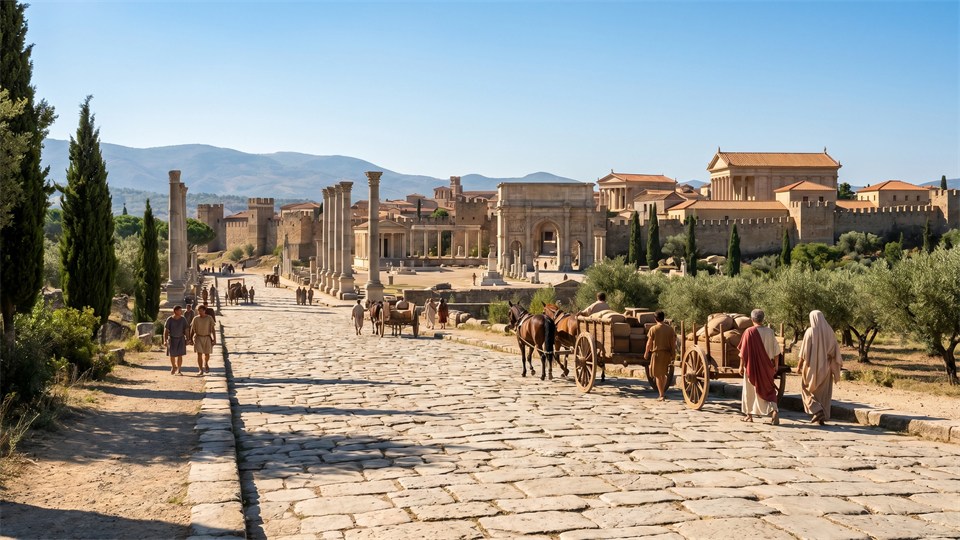
Roman art and architecture were closely connected to politics. Great buildings displayed the empire's strength, order, and ambitions. Amphitheaters, triumphal arches, aqueducts, basilicas, and temples were not only practical or religious spaces; they were also symbols. The Colosseum is a well-known example. It was an arena for entertainment, but also a monument to imperial power and technical skill. The Romans were skilled engineers and used, among other things, concrete, vaults, and domes in ways that made it possible to build larger and more complex structures than before. Their architecture was inspired by the Greeks, but the Romans made the style more monumental and functional. When an emperor built a new structure, he was not merely showing generosity, but also control over resources, labor, and the public gaze.
Roman art consisted of far more than great monuments. Sculptures of emperors, generals, and gods stood in public spaces and private homes. Portrait art was especially important, because it often emphasized facial features and individuality. Where Greek art often idealized the body, Roman portraits could highlight age, seriousness, and experience. This suited Roman values such as duty and authority well. Mosaics and wall paintings decorated villas and bath complexes with motifs from mythology, nature, and daily life. Finds from Pompeii show how colorful Roman domestic culture could be. Even everyday objects such as lamps, glass, and pottery could be beautifully decorated. Art was therefore not only something for temples and palaces, but part of the visual environment across many layers of society.
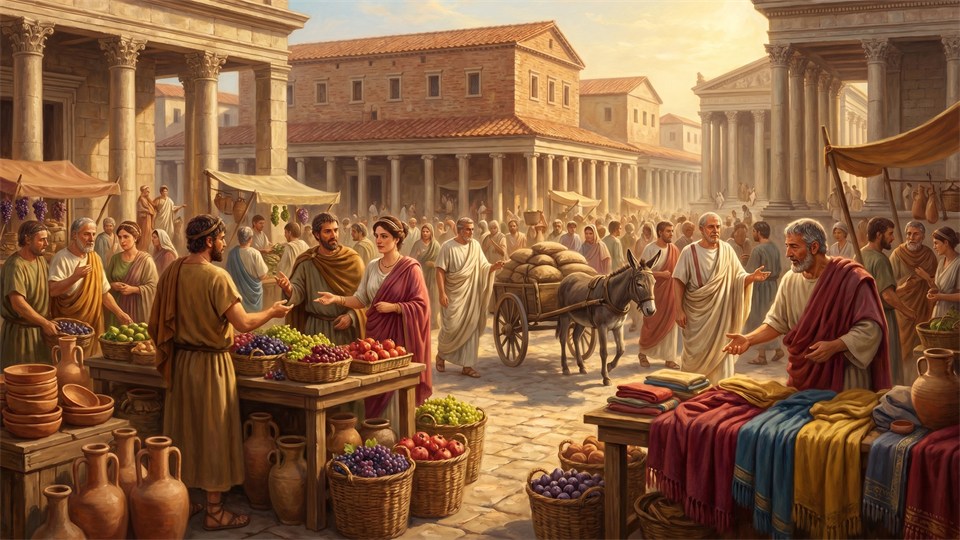
It is easy to focus on emperors and battles, but the Roman Empire consisted first and foremost of people with ordinary lives. A Roman citizen in a large city might spend the day on trade, work, bathing, religious rituals, and social interaction. In the cities there were bakeries, workshops, taverns, and apartment buildings, often packed closely together. The rich lived in large houses or villas, while many poor people lived in cramped conditions. Diet varied according to means, but bread, olive oil, wine, and porridge were common elements. Slaves played a major role in the economy and were found in homes, mines, agriculture, and administration. At the same time, some slaves could gain freedom and become freedmen with professions of their own. Women's opportunities were limited compared with men's, but their role in family, religion, and the economy was important. Everyday life in the empire was therefore very different depending on gender, status, place, and wealth.
Religion in the Roman Empire was diverse and practically oriented. The Romans worshipped many gods and often adopted deities and rituals from other cultures. Jupiter, Mars, and Venus were central gods, but the empire also contained Egyptian, Persian, and local cults. Emperor worship became important in many provinces, where loyalty to the state was shown by honoring the emperor. This religious flexibility made it possible for many traditions to exist side by side. At the same time, religion could be politically sensitive if a group refused to take part in public rituals. This was one of the reasons why the early Christians were met with suspicion. Christianity began as a small movement in the eastern part of the empire, but gradually grew. During the 4th century, the situation changed dramatically when Emperor Constantine gave Christianity better conditions, and later it became the dominant religion. In this way, the Roman Empire also changed Europe's religious history.
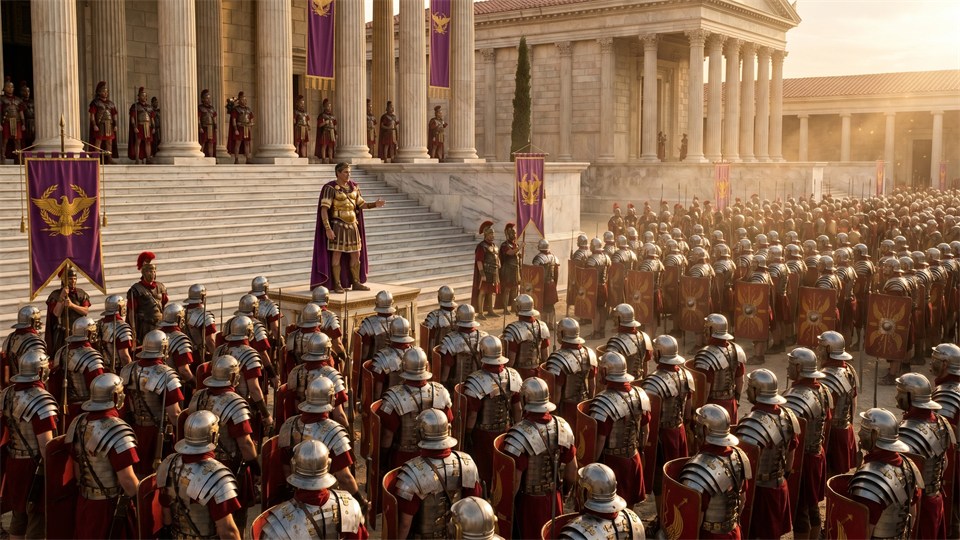
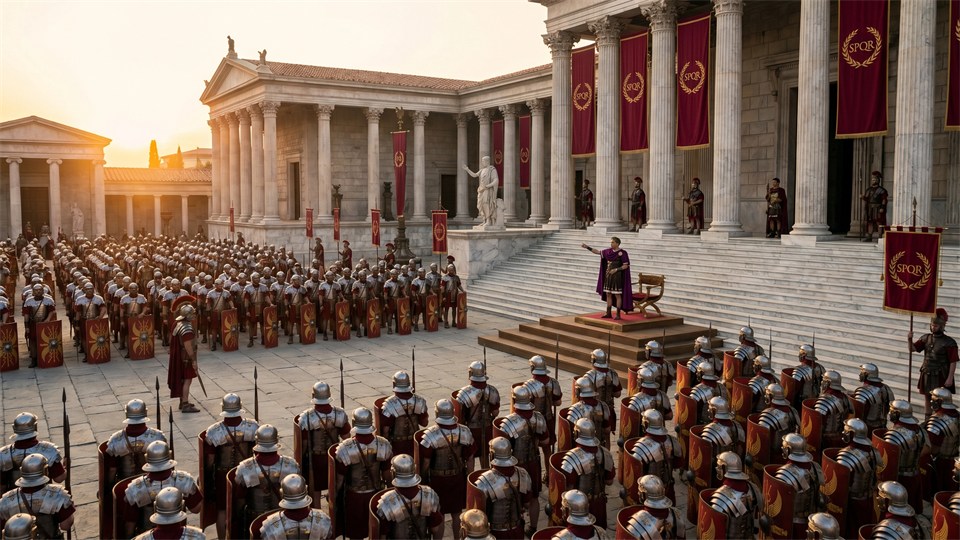
The history of the Roman Empire is closely tied to its emperors. Some created stability, while others led to chaos. Emperors such as Trajan, Hadrian, and Marcus Aurelius are often associated with the empire's golden age. Under Trajan, the empire reached its greatest geographical extent. Hadrian strengthened the borders and invested in construction, including the famous wall in Britain. Marcus Aurelius became known both as emperor and philosopher. The army was absolutely crucial in this period. The legions protected the borders, put down rebellions, and could also determine who became emperor. Precisely for that reason, the system was vulnerable. If the army lost confidence in an emperor, a rival could quickly be proclaimed. Despite this risk, it succeeded for long periods in maintaining peace and prosperity, often called Pax Romana. This relative stability made trade, construction, and cultural exchange possible on a large scale.
The fall of the Roman Empire was not a single event, but a long process. As early as the 3rd century, the empire experienced serious crises with civil wars, economic problems, inflation, and pressure at the borders. Imperial power became unstable, and the army gained even greater political influence. Later, reforming emperors such as Diocletian and Constantine tried to save the system by reorganizing the administration and dividing power more clearly. This helped for a time, but the difference between the eastern and western parts of the empire became more apparent. The western part was gradually weakened by internal conflicts, declining tax revenues, and attacks from various Germanic groups. In the year 476, the last Western Roman emperor was deposed, and this is often used as a symbol of the fall of the Western Roman Empire. However, the Eastern Roman Empire continued for many centuries as what we today call the Byzantine Empire. Therefore, Rome did not disappear suddenly; it changed form.
The importance of the Roman Empire did not end with the age of the emperors. On the contrary, the empire became a model for later generations. Roman architecture inspired the builders of the Renaissance, the public buildings of Neoclassicism, and modern parliaments, museums, and monuments. Columns, domes, and triumphal arches are still visible in many cities. The Latin language became the foundation for several modern languages, and Roman law influenced legal systems far into modern times. The very idea of empire, citizenship, and public order was also shaped by Roman experience. In art, literature, and film, Rome constantly returns as a motif, because the empire contains both grandeur and tragedy. It can symbolize discipline, civilization, brutality, or decline depending on the context. That is precisely why The Roman Empire continues to fascinate. It is not only an ancient empire, but a cultural reference that still helps us understand power, identity, and historical legacy.
The Roman Empire was far more than a series of emperors and famous battles. It was a complex world in which politics, religion, art, law, and everyday life were interwoven. The empire grew from a small city-state into an enormous power that connected many peoples and cultures under one system. At the same time, it was a society of great contrasts, where prosperity and violence, order and unrest existed side by side. When we study the Roman Empire today, we gain not only knowledge of antiquity, but also a mirror for later civilizations. Its buildings, images, ideas, and institutions continue to influence how we think about the state, culture, and the public sphere. That is why the Roman Empire is still a central subject when one wants to understand the long history of art and culture.