
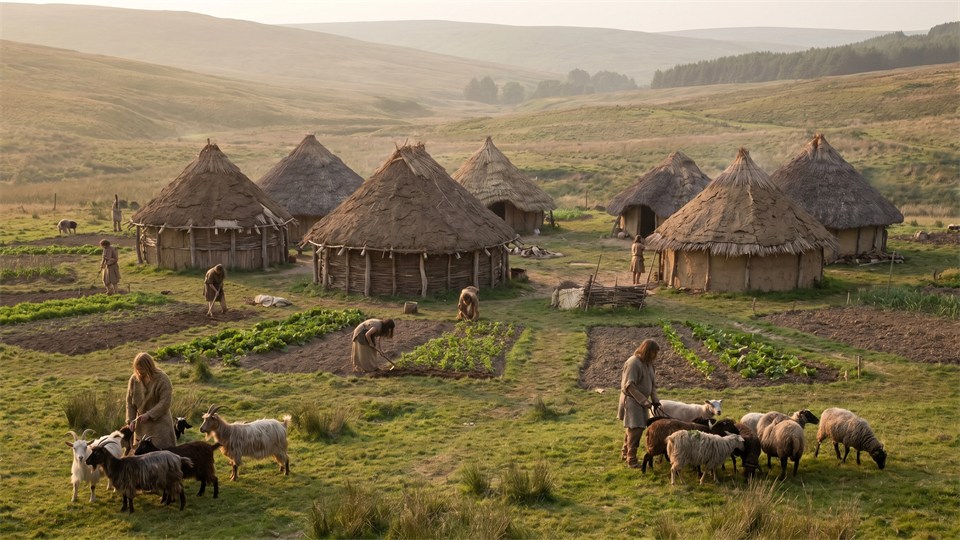


The Stone Age is the longest period in human history. It began millions of years ago, when early humans and human-like species started using simple stone tools, and it ended only when metals gradually took over many of stone’s functions. When we talk about the Stone Age, we are therefore not talking about one uniform era, but about an enormous epoch of great change. During this period, humans learned to make tools, control fire, hunt in groups, create art, bury their dead, and later cultivate the land. The Stone Age is important because many of the basic features of human life emerged here, long before written sources and organized states.
The Stone Age is an archaeological term for the time when tools were mainly made of stone, but also of wood, bone, antler, and other natural materials. The name may make the period sound simple, but the reality was far more nuanced. Stone tools could be surprisingly advanced, and they were adapted to different environments and needs. People in the Stone Age did not all live in the same way. Some were nomadic hunters and gatherers, others lived more permanently in one place, and in the later part of the period the first farming communities emerged. The Stone Age is therefore used as a practical framework for understanding the long development from early hominins to more complex human societies.
The Stone Age is usually divided into the Paleolithic, Mesolithic, and Neolithic. The Paleolithic is the longest phase and covers the time of the earliest stone tools, the first human species, and later modern humans. The Mesolithic is a transitional period after the last Ice Age, when many groups still lived by hunting, fishing, and gathering, but adapted to new landscapes and climates. The Neolithic marks the transition to agriculture, animal husbandry, and more permanent settlements in many parts of the world. These periods did not begin and end at the same time everywhere, because development happened differently from region to region.
The oldest known stone tools are very simple. They could consist of a stone that had been struck to create a sharp edge, which could be used to cut meat, scrape hides, or crush bones. Although they seem primitive today, they were a crucial technological leap. A sharp tool made it easier to make use of animals, process plants, and produce other objects. Early species such as Homo habilis and later Homo erectus are often associated with this development. Over time, the tools became more standardized and specialized. Hand axes, scrapers, and spear points show that humans did not merely react to the world, but planned and developed solutions that could be passed on between generations.
Making a good stone tool required experience. One had to know the material, understand how the stone fractured, and be able to strike with the right force and angle. Flint was especially valued in many places because it could be shaped into very sharp edges. This knowledge did not arise by chance. It was learned through observation, practice, and social transmission. Stone tools therefore tell us not only about technique, but also about culture. When archaeologists find similar tools at the same settlements or across larger areas, it suggests that skills were shared within groups. Even in the earliest societies, there was therefore learning, tradition, and probably some form of teaching between older and younger members.
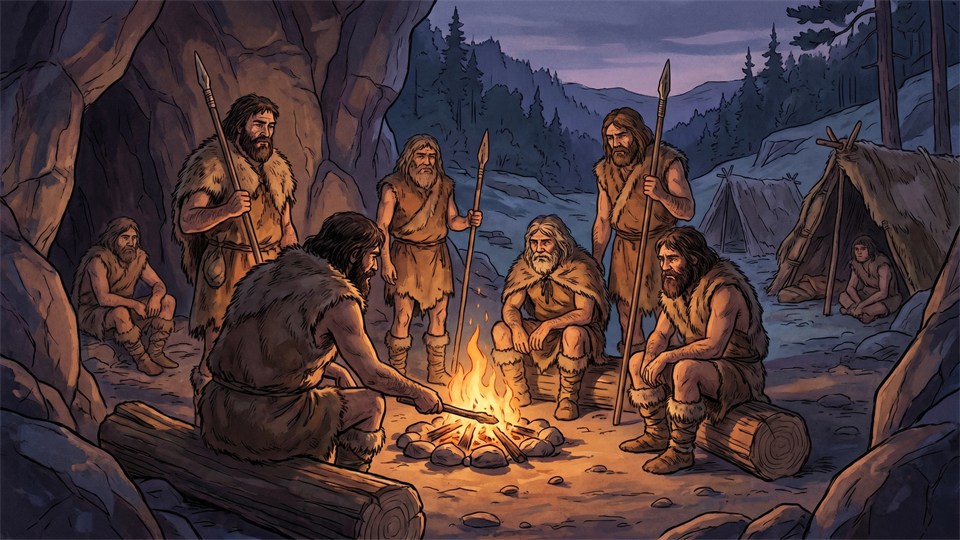
Control of fire was one of the most important milestones of the Stone Age. Fire provided warmth in cold regions, light in the darkness, and protection against predators. It also made it possible to cook food, which changed the diet significantly. Cooked food is easier to chew and digest, and this may have had great importance for human development. At the same time, fire created a social center. Around the campfire, people could share food, tell stories, plan hunts, and strengthen the community. Fire was therefore both a practical tool and a cultural gathering point. Being able to light, maintain, and transport fire required knowledge and discipline, and it shows how organized Stone Age groups already were.
Hunting in the Stone Age was rarely a matter of brute strength alone. It required cooperation, timing, and knowledge of animal movements. People hunted different animals depending on the area and climate, from smaller animals and fish to large mammals such as bison, deer, and mammoths. Spears, throwing techniques, traps, and later more refined weapons made hunting more effective. But hunting was risky, and therefore gathering plants, nuts, roots, shellfish, and insects was also an important part of the diet. Many Stone Age societies survived precisely by combining several strategies. This gives a more realistic picture than the idea that everyone lived only as big-game hunters. Flexibility was often the key to survival.
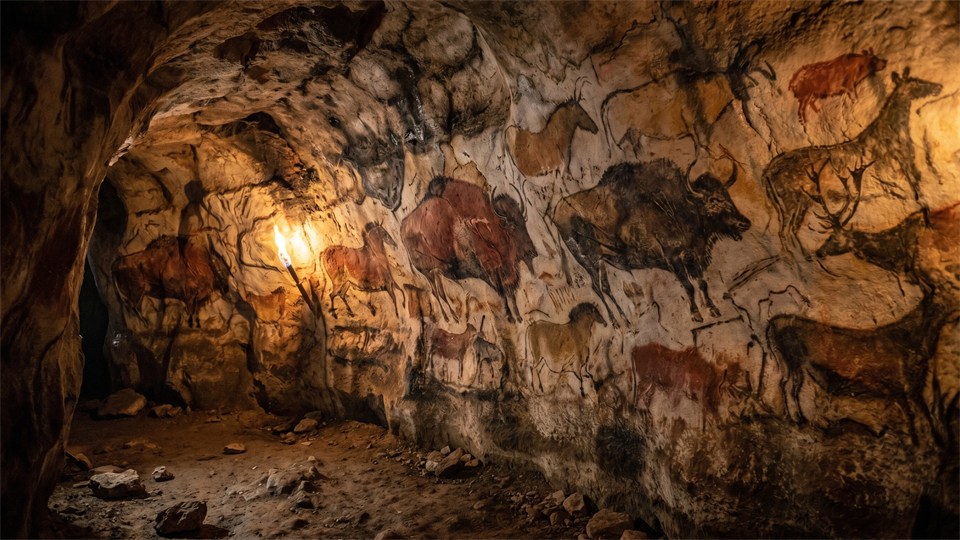
The Stone Age was not only a time of survival. It was also a time when humans created images, symbols, and objects with possible ritual or social significance. Cave paintings, engraved patterns, small figurines, and decorated tools show that people thought symbolically. Famous cave paintings featuring animals such as horses, bison, and deer show both powers of observation and artistic sense. Pigments such as ochre were used for colors, and in some places walls were used so that the shape of the rock gave the motif life. This art was hardly just decoration. It may have been connected to hunting, myths, identity, or rituals. Although we do not know all the meanings, the finds clearly show that Stone Age people had a rich inner life.
When archaeologists find graves from the Stone Age, it opens an important window into human thoughts about death. Some of the dead were buried with tools, jewelry, pigments, or animal bones, which suggests that the burial had symbolic significance. This may point to beliefs about an afterlife, status, or the community’s relationship to the deceased. Deliberate burials also show care and social cohesion. Spending time and resources on the dead tells us that people were not thinking only about immediate survival. They also thought in terms of meaning, memory, and relationships. This is an important part of the Stone Age because it reminds us that humanity is not only about tools, but also about emotions, rituals, and shared beliefs.
Large parts of the Stone Age were marked by changing climates, especially during the ice ages. These changes had enormous importance for where people could live, which animals they encountered, and which resources they had access to. When the ice retreated after the last Ice Age, the landscapes changed dramatically. Forests spread in many areas, coastlines shifted, and new lakes and rivers appeared. This meant that people had to adapt their way of life. In some regions, fishing became more important; in others, hunting forest animals and gathering nuts and plants became more central. The Stone Age was therefore not static, but a long history of adaptation to nature’s changes.
The Mesolithic is sometimes overlooked because it lies between the better-known periods of big-game hunting and agriculture. But it was crucial. Here, people often developed smaller, more precise tools that could be used for arrows, harpoons, and composite tools. Many groups lived near coasts, lakes, and rivers, where fish, birds, and shellfish were important resources. At the same time, settlements in some places became more long-lasting, even though many people still moved with the seasons. The Mesolithic shows that human development rarely happens in sudden leaps. It often consists of many small adaptations, where old and new ways of life exist side by side for a long time.
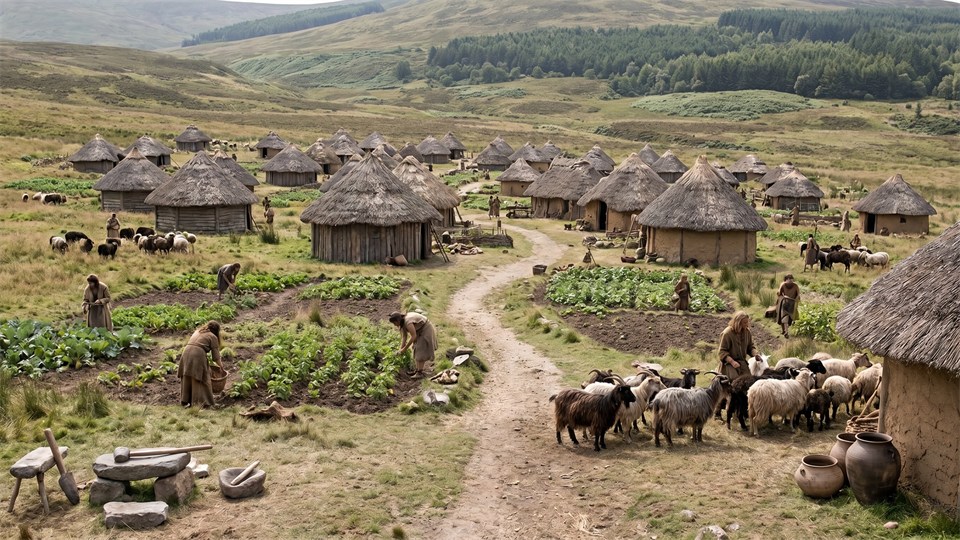
In the Neolithic, people in several places began to cultivate plants and keep domestic animals. This process is often called the Neolithic Revolution, but it happened gradually and differently around the world. Wheat, barley, lentils, and other crops were grown in some areas, while goats, sheep, pigs, and cattle were domesticated and bred. Agriculture fundamentally changed everyday life. When people could produce food more systematically, it became easier to live permanently in villages. Houses, storage facilities, and fences became more important, and work followed the rhythm of the seasons with sowing, tending, and harvest. At the same time, agriculture brought new challenges, such as disease, harder physical labor, and greater dependence on a few crops.
With more permanent settlement came new social patterns. Ownership, division of labor, and exchange became more important. Some people became skilled in pottery, weaving, or specialized tools, while others focused more on cultivation and livestock. Villages could grow, and relationships between groups became more complex. Trade in flint, obsidian, shells, and other materials shows that contacts could extend far. In the Neolithic, monumental structures such as burial chambers and stone circles also appeared in some places, pointing to shared rituals and organized labor. The transition to agriculture therefore did not just make the diet different. It also changed social structure, time, work, and people’s relationship to the landscape.
The Stone Age is important because it contains the beginnings of much of what we associate with human life. Here we see the first technologies, the earliest signs of art and symbols, the development of cooperation on a larger scale, and the transition to settled societies. Many modern questions can actually be traced back to the Stone Age: How do humans adapt to climate change? How does technology affect our lives? What happens when societies move from a mobile way of life to permanent settlement? Archaeological finds do not provide all the answers, but they show that humans have always been inventive, social, and dependent on nature. The Stone Age is therefore not just a distant past, but an important mirror for understanding ourselves.
The Stone Age stretches across such a long span of time that it is almost hard to grasp, but that is precisely why it is so fascinating. In this epoch, the foundation was laid for humanity’s technical, social, and cultural development. From the first chipped stones to villages with agriculture and domestic animals, the Stone Age shows a story of ingenuity and adaptation. It also reminds us that human history did not begin with kings, cities, or writing, but with small groups that learned to work together, understand nature, and create meaning in the world. When we study the Stone Age, we do not just see primitive tools. We see the beginning of the long journey that led to civilizations, art, culture, and modern societies.