


In this article, we provide an introduction to coffee brewing, where we briefly go through the process from when the berries are picked to when the finished coffee is brewed.
This includes topics such as coffee bean processing, roasting, grinding, and brewing.
Coffee beans are made by processing the seeds from the coffee fruit. The two most commonly used methods are the wet and dry methods, respectively.

This is the original method for removing the skin. Here, the fruit is laid out to dry with the skin on, which is then removed afterwards.

After the berries are dried, they are ready to be sent out into the world, where the next step is roasting.
There are a wide range of coffee varieties, but Arabica and Robusta are the two varieties used in the majority of the world's coffee production.

The Arabica variety is the more expensive of the two, but it is also the one that provides the best taste, which is partly due to a lower caffeine content. The Arabica variety is grown at altitudes from 500-2000 meters, while Robusta is grown below 500 meters, and in addition, Arabica is much more fragile than Robusta, which is the main reason for the large price difference.
Besides the taste, the Robusta plant also has the disadvantage that the planting method is harsher on the environment. On the other hand, its resistance means that there may be less need to use chemicals to combat diseases or insect attacks, but cultivation of Robusta is still worse for the environment than Arabica.
We will always recommend buying Arabica coffee both for the sake of taste and the environment. If you want to save money, we recommend doing so in other areas, such as when buying equipment.
For those of us who live far from the equator, this is the first step we can do ourselves. However, it requires very expensive equipment to do quality roasting of coffee beans, but if you want to experiment with it, it can be done with equipment for under 5,000 DKK.

The degree of roasting is best defined by the color, but there are also other terms such as city roast, but these are often defined differently among roasteries. So here we stick to the color shade, which we describe below.
Grinding is the first process where we ordinary consumers can do it ourselves and actually improve the coffee compared to buying pre-ground coffee. How you grind the beans is very dependent on the brewing method, which is described in the next chapter. As extremes, beans for espresso should be ground very finely, while beans for French press should be ground very coarsely.
The most important parameter for a grinder is the uniformity of the grind size. Coffee brewing is primarily about extraction (how long the water is in contact with the coffee), and the optimal time depends on the grind size. So the more the grind size varies, the more the extraction will fluctuate.
Manual grinders are grinders that are operated by hand.

You can get good manual grinders from around 400 DKK. The cheapest grinders should generally be avoided, as they produce a very uneven grind size. If you move up over 1000 DKK, almost all grinders are of high quality, and they all provide a very uniform grind.
Motorized grinders significantly reduce grinding time, as they can run at much higher speeds than you can by hand.
The motor has a very large impact on the uniformity of the grind size, and you should preferably go for a price around 2000 DKK where you get both blades and motor of proper quality.
Since this is an intro to coffee, we will not delve too much into data, but we will give a quick overview of the most important ones here.
A coffee machine works by heating the water to near boiling point and then steam pushes the water up over the coffee filter and then it runs through the coffee. A coffee machine is the easiest form of coffee brewing, as it automatically controls the amount of water and the only maintenance is regular descaling.

Coffee beans for coffee machines should be ground medium fine. This is typically the size delivered in bags of ground coffee, unless otherwise specified.
The pour-over method is similar to the coffee machine, with the significant difference that here you heat the water and pour it through the funnel yourself.
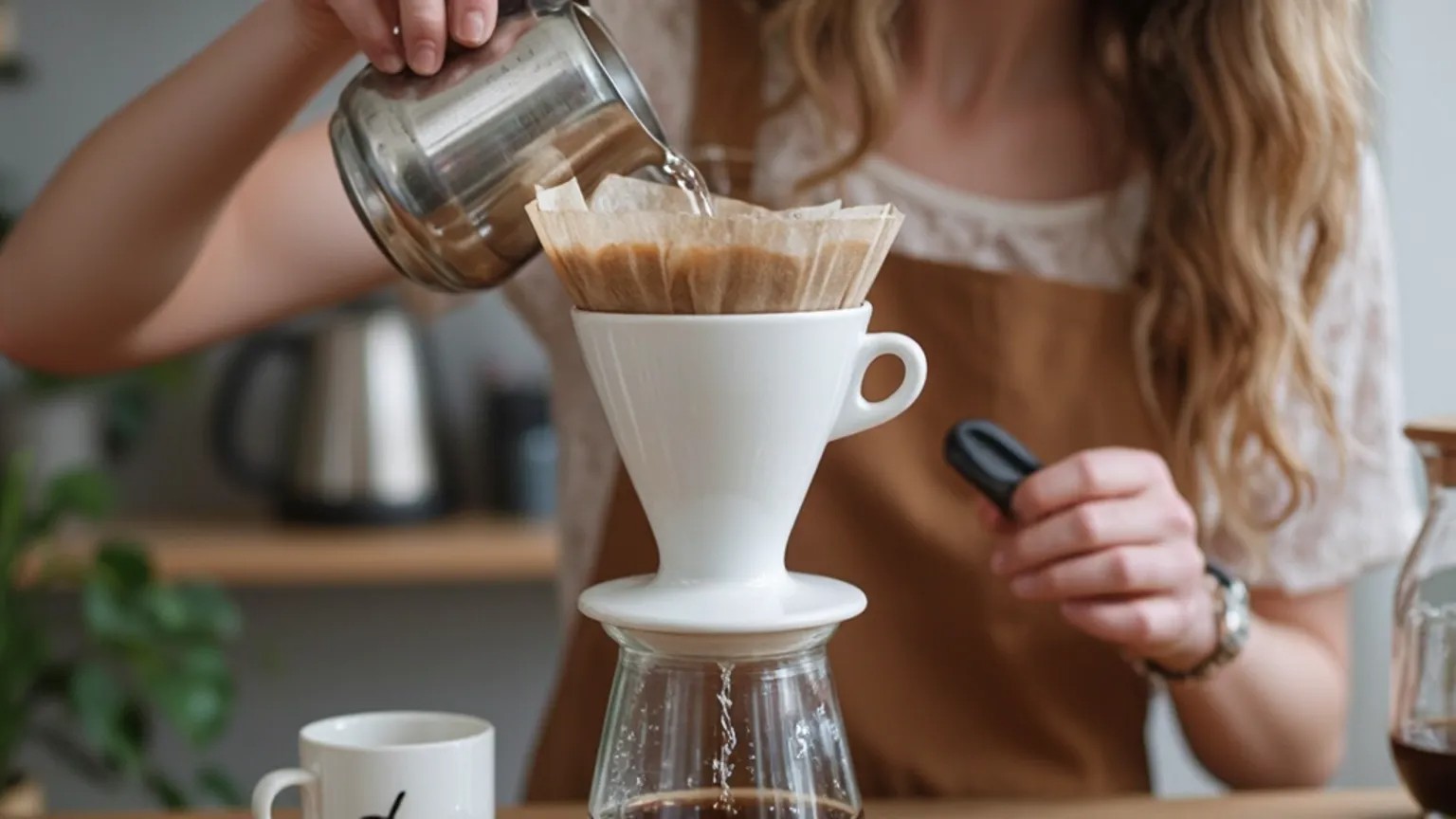
The advantage of this method is that you now have full control over how long the water is in contact with the coffee. The only disadvantage is the extra work it requires. Because you have full control over the water flow, this is a very popular method among coffee enthusiasts.
Espresso is made by sending water through very finely ground coffee at a pressure of 9 bar.

For an espresso shot, 7 or 14 grams of coffee is used depending on whether you want to make a single shot or a double shot. The coffee is placed in a so-called portafilter (pictured), which is inserted into the espresso machine, which then sends water through the filter at a pressure of 9 bar.
Making a good espresso requires several attempts to fine-tune the grind size, as the pressure of 9 bar usually cannot be changed. As a starting point, the water should run through the portafilter in 25-27 seconds, so if you start by adjusting the coffee to come through at the right speed, you can then taste your way to the settings that give the best espresso.
When the water is sent through the coffee at high pressure, foam is formed on the surface, unlike brewing with a coffee machine, where the water just runs through the coffee.