
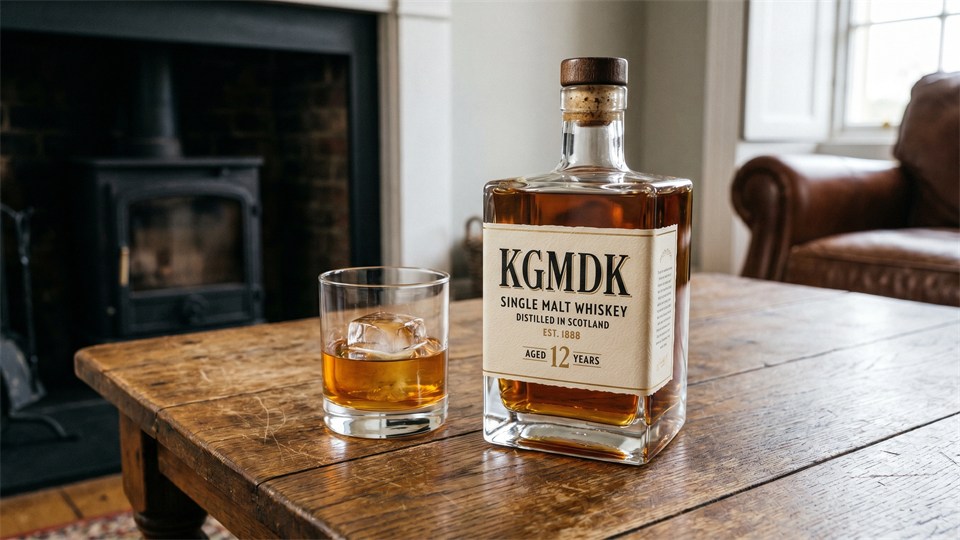


Whiskey is a spirit made from grain, water, and yeast, which is aged in wooden casks after distillation. It sounds simple, but the result can be surprisingly varied. Some whiskeys are smooth and sweet with notes of vanilla and caramel, while others are dry, spicy, smoky, or fruity. For beginners, whiskey can seem like a somewhat closed world with many rules, strange terms, and strong opinions. But in practice, it is a drink you can absolutely learn to understand step by step. Once you know the most important concepts, it becomes much easier to choose a bottle, taste with intention, and find your own style. In this article, you will get a simple introduction to what whiskey is, how it is made, which main types you should know, and how to best enjoy it as someone new to the category.
The production of whiskey begins with grain. It can be barley, corn, rye, or wheat, and the choice of grain has a major impact on the flavor. The grain is crushed and mixed with water so the starch can be converted into sugar. Yeast is then added, which turns the sugar into alcohol during fermentation. The liquid produced at this stage is more like a strong beer than finished whiskey. Next, the liquid is distilled to concentrate the alcohol and refine the flavor. Finally, the spirit is aged in casks, often made of oak, where it develops color, aroma, and complexity over time. It is especially the aging that makes whiskey whiskey. The cask adds notes such as vanilla, spice, toast, caramel, and wood. Climate, cask type, and aging time all play a role, which is why two whiskeys made in almost the same way can still taste very different.
If you want to understand whiskey in a simple way, you can think of three major sources of flavor: the raw material, the distillation, and the cask. The grain variety provides the basic character. Barley can bring elegance and malt character, corn often gives a rounder and sweeter style, while rye typically contributes pepper, spice, and dryness. Distillation affects how light or robust the spirit becomes. Some producers aim for a clean and smooth style, while others want more weight and character. The cask is the final major factor. New charred casks often give strong sweetness, vanilla, and toasted wood, while used casks can provide more restrained and complex nuances. When you taste whiskey, it is therefore useful to ask yourself: am I tasting the grain, the distillation, or the cask most clearly? That makes it easier to put the experience into words, even if you are completely new.
Whiskey comes in many styles, but for beginners it is enough to know a few main groups. Scotch whisky is often the first thing many people think of. It can be light and fruity, rich and sherry-driven, or peaty, smoky, and intense. Irish whiskey is often known for a softer and more easy-drinking style, although more powerful versions also exist. American whiskey includes, among other things, bourbon and rye. Bourbon is typically sweet with notes of vanilla, caramel, and oak, while rye is often spicier and drier. Canadian whisky is often described as mild and light, and Japanese whisky is known for balance, precision, and elegance. The most important thing is not to remember every detail, but to understand that the word whiskey covers several traditions. When you try different types side by side, the differences quickly become clear and much easier to remember.
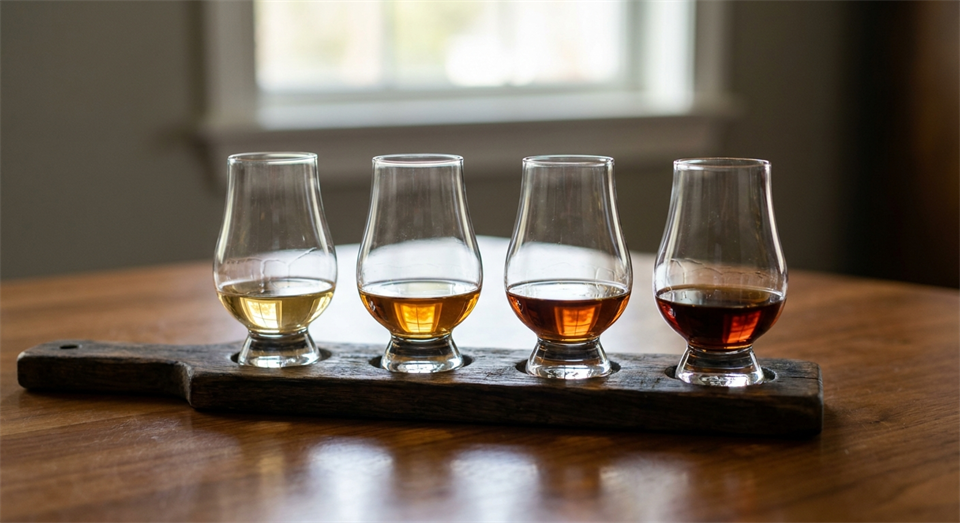
The spelling confuses many people. In general, “whisky” is often used for Scotch, Canadian, and Japanese whisky, while “whiskey” is typically used for Irish and American whiskey. However, this is mainly a linguistic and historical difference, not a difference in quality. So you cannot tell whether a bottle is better or worse based on the spelling alone. For a beginner, it is more important to look at the style than at the letters. If it says bourbon, rye, single malt, or blended, that tells you much more about what is inside. Still, it is useful to know the difference, because you will often encounter both forms in shops, on menus, and in articles. In this article, the word whiskey is used as a general term, but when you read labels, it is good to know that both spellings are normal and correct within their respective traditions.
When you stand in front of the shelf in a store, you quickly come across words like single malt, blended, small batch, and single barrel. They may seem technical, but they are understandable. Single malt basically means that the whiskey comes from one distillery and is made from malted barley. Many people associate single malt with depth and clear distillery character. Blended means that whiskey from several sources has been mixed to create a specific style. That can be an advantage, because the result is often balanced and consistent from bottle to bottle. Small batch is used especially for smaller blends, while single barrel means that the contents come from one single cask. That can give more personality and variation. As a beginner, you do not need to chase the rarest designations. Often, a good blended whiskey or a friendly single malt is a better place to start than a very powerful special release.
Age is another term many people notice. A number on the label normally shows the youngest whiskey in the bottle. So a 12-year-old whiskey has been aged for at least 12 years. However, that does not automatically mean that older is always better. Some younger whiskeys are lively, fresh, and very charming, while very old versions can become more wood-driven and dry. Price and age often go together, but flavor and quality do not always. That is why it is wise to think of age as information, not as a final answer. For beginners, it is often better to focus on style and balance than to chase high age statements. A good whiskey is first and foremost one you want to drink again.
Tasting whiskey is not about impressing anyone with advanced descriptions. It is about noticing what you yourself experience. Start by looking at the color, which can give a hint about cask aging, but not the whole truth. Then gently smell the glass. Do not put your nose too far into the glass right away, because the alcohol can overpower the finer aromas. Instead, try with your mouth slightly open and take small sniffs. You may notice vanilla, apple, honey, dried fruit, nuts, smoke, or spices. Then take a small sip and let the whiskey roll around in your mouth for a moment. Notice whether it feels light, creamy, oily, dry, or warm. Finally, you can think about the finish: does it disappear quickly, or does it linger with new nuances?
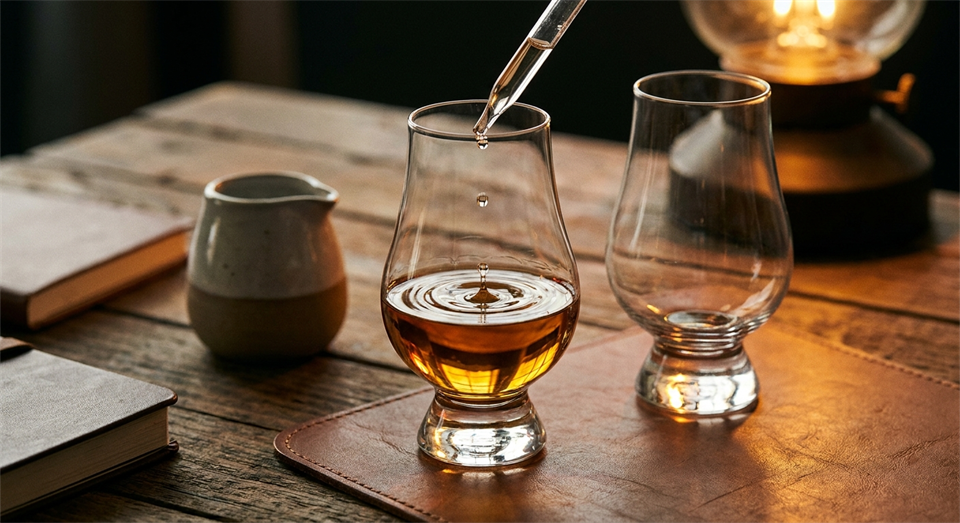
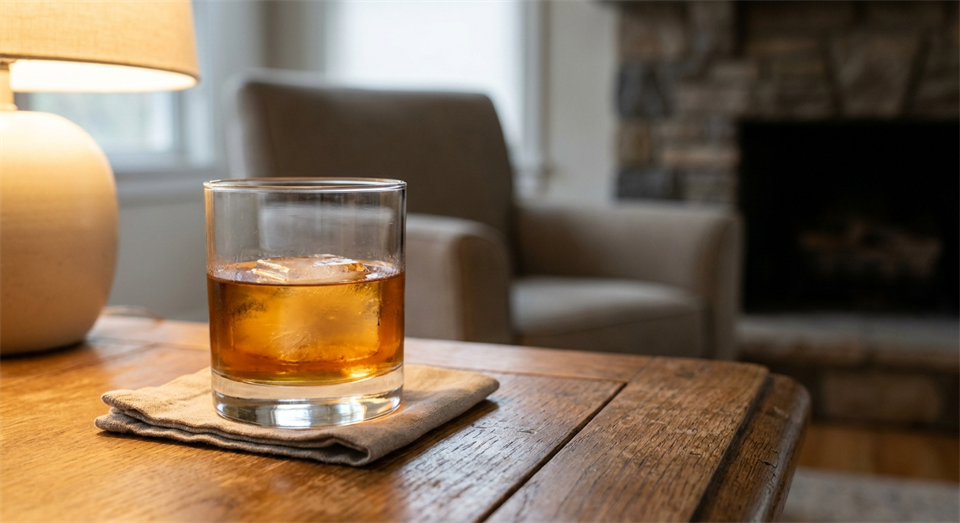
Many people think that proper whiskey must be drunk neat, but that is a myth. A few drops of water can open up the aromas and make the whiskey easier to understand, especially if it has a high alcohol content. The water softens some of the alcohol and can highlight sweetness, fruit, or spice. Ice can also be used, but a lot of cold also mutes aroma and flavor, so beginners do not always get the best impression of the whiskey that way. If you want to get to know a new whiskey, it is therefore smart to first taste it neat, then with a few drops of water. That way you notice the difference and learn how it develops in the glass. There is no single correct method. The goal is not to follow a rule, but to find the serve that gives you the best experience.
Whiskey is often described with words that can seem surprisingly specific: vanilla, caramel, apple, pear, leather, tobacco, chocolate, pepper, or smoke. That does not mean these things have been added. The flavor notes arise naturally through raw materials, fermentation, distillation, and aging. Bourbon often has clear notes of vanilla, caramel, coconut, and sweet oak from new casks. A fruity Scotch whisky can suggest pear, honey, and malt biscuits. A sherry-aged whiskey can have tones of raisins, nuts, orange peel, and spice. Smoky versions can bring associations of campfire, peat, sea air, or medicinal notes. As a beginner, you should not be afraid to use your own words. If you think something smells like baked apples or breakfast cereal, that is a valid observation. Tasting becomes easier the more you practice putting words to what you experience.
The best first bottle is usually one that is balanced, not too expensive, and not too extreme in style. Many beginners enjoy a smooth Irish whiskey, a rounded bourbon, or a mild Scotch single malt without too much smoke. If you already know that you like sweet flavors such as caramel and vanilla, bourbon can be a good place to start. If you prefer something lighter and more fruity, a mild Scotch or Irish style may suit you better. Avoid choosing based only on attractive packaging or a high price. Instead, look for words like smooth, fruity, mellow, vanilla, or honey if you want a gentle introduction. It can also be a good idea to start with a tasting set or order a small glass at a bar before buying a whole bottle. That way, you will learn more quickly which direction you want to explore further.
You do not need expensive equipment to enjoy whiskey, but serving does matter. A small glass with room for the aroma gives a better experience than a large glass filled with ice. Many people use a tulip-shaped glass for tasting because it concentrates the aromas, but a regular low glass can also work well for relaxed serving. Whiskey is often drunk at room temperature. If the bottle is very warm, the alcohol can seem sharper, and if it is very cold, some of the nuances are hidden. Store the bottle upright, in the dark, and at a reasonably stable temperature. Unlike wine, whiskey does not continue to develop in the bottle in the same way, but air in a nearly empty bottle can affect the flavor over time. If you drink only occasionally, it can therefore be an advantage to keep an eye on how much air is left in the bottle.
Whiskey can seem complex at first encounter, but it becomes much more approachable when you break it down into simple parts. The grain provides the basic flavor, distillation shapes the style, and the cask adds depth and character. On top of that come the different traditions from Scotland, Ireland, the United States, Canada, and Japan, each of which gives its own expression. For beginners, the most important thing is not to know every detail, but to taste with curiosity and without making it too difficult. Try different types, notice sweetness, spice, fruit, and smoke, and find out what you like best. Whiskey is not only for collectors and connoisseurs. It is also a drink that you can gradually learn to appreciate, one glass at a time.