


DA | EN | DE | FR | ES

The Eye The Human Visual Organ

sundhed og medicin Kroppen
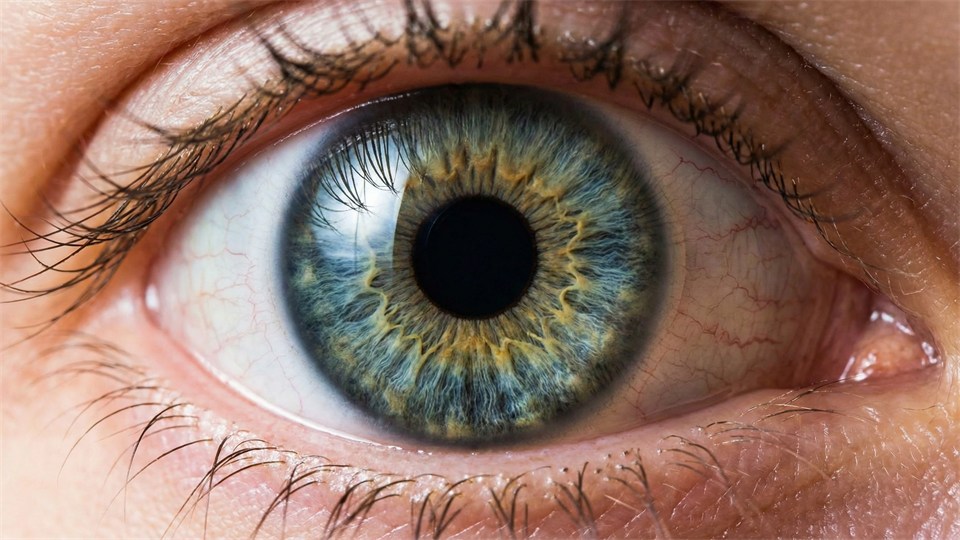
The Eye Title Image

The eye is one of the body's most advanced and fascinating organs. It enables us to perceive light, colors, and shapes, and thus to understand and navigate the world around us. Without vision, our everyday life would look completely different. In this article, you will get a thorough yet easy-to-understand overview of how the eye is structured, how it works, what problems can arise, and how you can best take care of your vision.
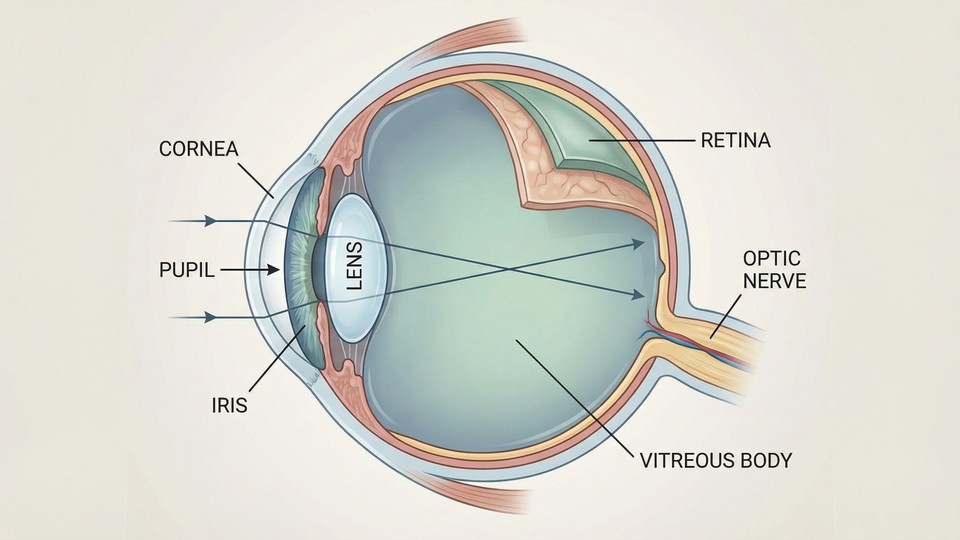
Cross-section of the human eye with the main parts

The structure of the eye

The eye is a small, almost spherical structure with a diameter of about 2.5 cm. Although it is small, it consists of several layers and parts, each playing a crucial role in vision. To understand how vision works, it is important to know the main parts of the eye:

  • Cornea: The transparent outer part that protects the eye and refracts light.
  • Iris: The colored part that controls how much light enters through the pupil.
  • Pupil: The black "hole" in the middle of the iris where light enters.
  • Lens: A transparent structure behind the pupil that focuses light onto the retina.
  • Retina: The innermost layer at the back of the eye where light is converted into nerve impulses.
  • Optic nerve: Transmits signals from the retina to the brain, where they are interpreted as visual images.
  • Vitreous body: A jelly-like substance that fills most of the eye and maintains the eye's shape.

Example: The journey of light through the eye

When you look at an object, light first passes through the cornea, then through the pupil, further through the lens, and finally to the retina. Here, the light is converted into electrical signals that are sent to the brain via the optic nerve. The brain collects and interprets these signals so we can understand and react to what we see.

How does vision work?

Vision works through a fine interaction between the parts of the eye and the brain. The process starts when light hits the eye. The cornea and lens refract the light and ensure that it hits the retina in sharp focus. The retina contains millions of light-sensitive cells:

  • Rods: Respond to low light and are important for night vision.
  • Cones: Provide color vision and sharp vision in daylight.

The rods and cones convert the light into nerve impulses, which are sent through the optic nerve to the brain. It is only in the brain that we "see," because this is where the images are processed and interpreted.

Example: Visual impressions in darkness and light

If you go from a dark room out into sunlight, the pupil quickly contracts to protect the eye from the strong light. Conversely, the pupil dilates in the dark to let in more light. It is the rods that help you orient yourself in low light, while the cones help you see colors and details in daylight.
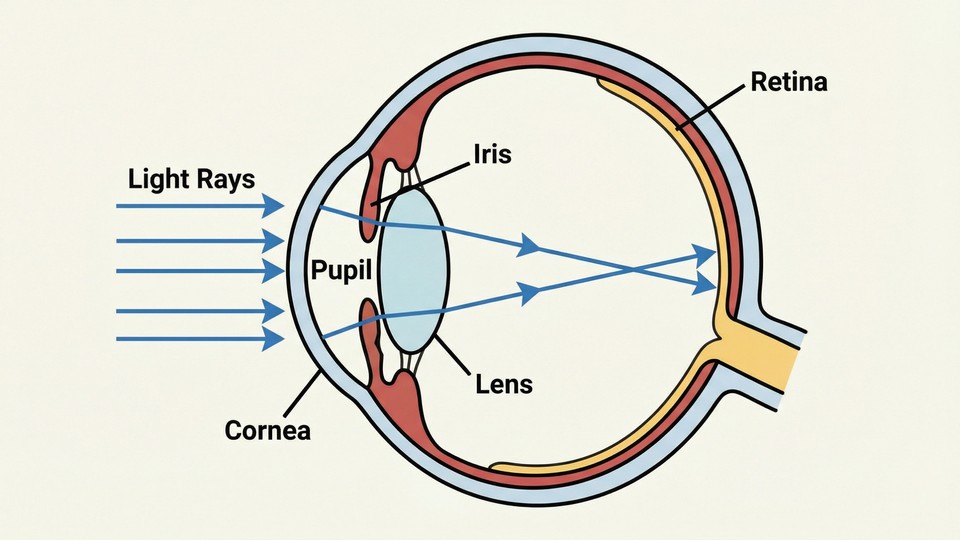
Illustration of the eye's lens focusing light on the retina

Common vision problems

Although the eye is robust, many different vision problems can occur. The most common are:

  • Nearsightedness (myopia): You can see things up close, but distant objects become blurry. This is often due to the eyeball being too long, so the image is formed in front of the retina.
  • Farsightedness (hypermetropia): You can see things at a distance, but up close it becomes blurry. Here, the eyeball is typically too short, so the image is formed behind the retina.
  • Astigmatism: The cornea or lens of the eye is unevenly shaped, which causes blurred vision both near and far.
  • Age-related farsightedness (presbyopia): The lens loses its elasticity with age, making it difficult to focus on things up close.
  • Cataract: The lens becomes cloudy, which gradually impairs vision. This is common with age.
  • Glaucoma: Increased pressure in the eye that can damage the optic nerve and lead to vision loss if not treated.

Example: Glasses and lenses

Most vision problems can be corrected with glasses or contact lenses, which adjust the refraction of light so it again hits the retina correctly. Modern eye surgery, such as laser treatment, can also permanently correct many vision errors.

Eye health and how to take care of your eyes

Although many vision problems are hereditary or occur with age, you can do a lot to take care of your eyes:

  • Regular eye exams: Have your vision and eye health checked by an optician or ophthalmologist—especially if you are over 40 or have vision problems.
  • Protect your eyes from UV rays: Wear sunglasses with UV protection to avoid damage to the cornea and lens.
  • Healthy lifestyle: Eat a varied diet with plenty of vegetables, fish, and whole grains. Vitamins such as A, C, and E as well as zinc are important for eye health.
  • Avoid smoking: Smoking increases the risk of cataracts and age-related retinal disease.
  • Good habits in front of screens: Take breaks, blink often, and ensure good lighting if you spend a lot of time in front of a computer or mobile device.
Person puts on sunglasses in bright sunlight to protect the eyes

Example: The 20-20-20 rule

If you work a lot in front of a screen, you can use the 20-20-20 rule: Every 20 minutes, look at something at least 20 feet (about 6 meters) away for 20 seconds. This helps prevent tired and dry eyes.

When should you seek help?

Most people experience temporary problems such as tired or dry eyes, but you should contact an ophthalmologist if you experience:

  • Sudden blurred vision or vision loss
  • Severe pain in the eye
  • Flashes of light, black spots, or a "curtain sensation" in front of the eye
  • Redness, swelling, or discharge that does not go away

Early treatment can often prevent permanent damage to vision.

The future of vision technology

Research into the eye and vision is developing rapidly. Artificial lenses, advanced laser surgeries, and "smart" contact lenses are just some of the technologies that are on the way or already in use today. There is also research into gene therapy for hereditary eye diseases and bionic eyes that can give sight to the blind. These advances bode well for the future treatment of eye diseases.

Conclusion

The eye is an incredibly complex and important organ that allows us to experience the world in images, colors, and movement. To maintain good vision throughout life, it is important to know the structure of the eye, understand common vision problems, and take responsibility for eye health through good habits and regular check-ups. By taking care of your eyes today, you can enjoy the gift of sight for many years to come.


Similar articles

The Ear
Kroppen
The Ear
An overview of the body's sound sensor
The Keto Diet
Kost og vægttab
The Keto Diet
A Fat-Focused Lifestyle
The Body's Nutrients
Næringsstoffer
The Body's Nutrients
Fuel and Building Blocks

You might also like

Astrology
Det overnaturlige
Astrology
A Window to the Universe
World History According to KGM.DK
Historie
World History According to KGM.DK
From the Big Bang to Covid
Rosé Wine
Øl og Vin
Rosé Wine
Rosé Wine: From Summer Drink to Serious Wine Experience
USB Sticks
Hardware
USB Sticks
From Type-A to USB-C and Everything In Between