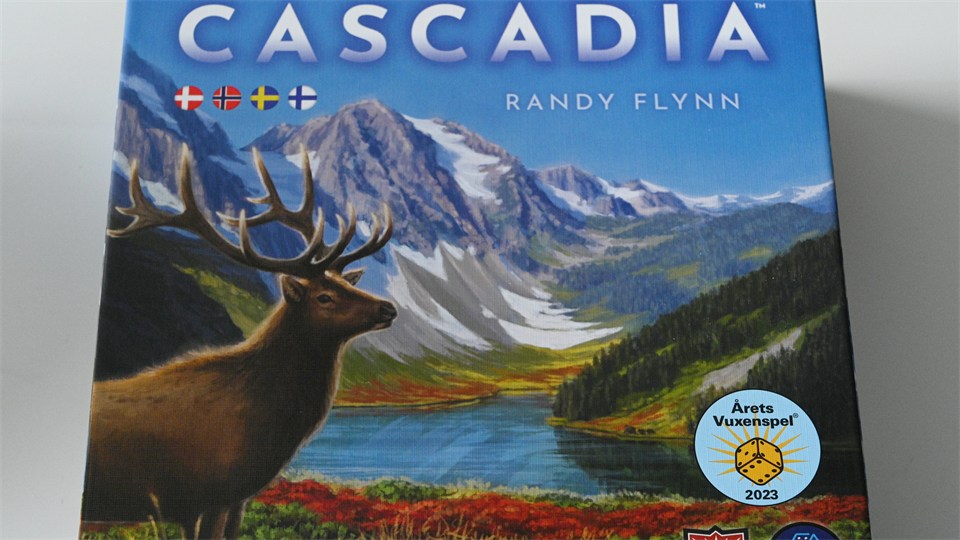


Cascadia is a modern board game that combines a simple turn structure with a surprisingly large number of choices. The game has a nature theme, where you build a landscape with forests, rivers, mountains, wetlands, and prairies while also placing wildlife in the right locations. This makes Cascadia easy to learn for new players, while still being exciting for those who enjoy planning and small tactical decisions. If you want to understand why so many people highlight Cascadia as an elegant and relaxing game, a good place to start is with the rules, the scoring system, and the most useful beginner strategies.
In Cascadia, each player builds their own nature preserve by taking a set consisting of one habitat tile and one wildlife token. The habitat tile is placed into your growing landscape so that terrain types connect in a smart way, while the wildlife token is placed on a suitable tile in your area. The goal is to score points on two fronts at the same time: for the animals based on special scoring cards, and for large connected areas of the same habitat type. It sounds simple, and in practice it is, but it is precisely the combination of these two goals that makes the game interesting. You constantly have to consider whether you want to optimize for animal scoring right now or build a landscape that pays off more in the long run.
The game is known for its calm atmosphere. There are no direct attacks, no negotiation, and only limited conflict over the tiles available on the table. Even so, the players affect each other because everyone is looking at the same shared selection. If an opponent needs a bear or a river tile, you can choose it before they do. Cascadia therefore feels peaceful without being passive. It is a good example of a game where the tension lies in timing, pattern recognition, and the ability to keep several plans open at once.
A typical game of Cascadia begins with each player receiving a starting tile, which forms the center of their personal landscape. The habitat tiles are then shuffled, and a number of wildlife tokens are prepared. Four habitat tiles are placed on the table together with four wildlife tokens so that they form four possible pairs. When you choose on your turn, you normally take one of these pairs. In addition, one scoring card is chosen for each animal type, and this is important because these cards determine how bears, elk, foxes, hawks, and salmon score points in the current game. This means the game varies from one play to the next.
Setup does not take long, but it has a major impact on the experience. Since each animal can score in several different ways depending on the cards, your priorities are different almost every time. Sometimes large groups of salmon are rewarded; other times you would rather spread out foxes to gain bonuses from different neighboring animals. This variation is one of the reasons Cascadia stays fresh. The rules do not change much, but your goals do. For beginners, it is helpful to spend a little time reading all the scoring cards carefully before the first turn begins, so you do not overlook obvious opportunities later in the game.
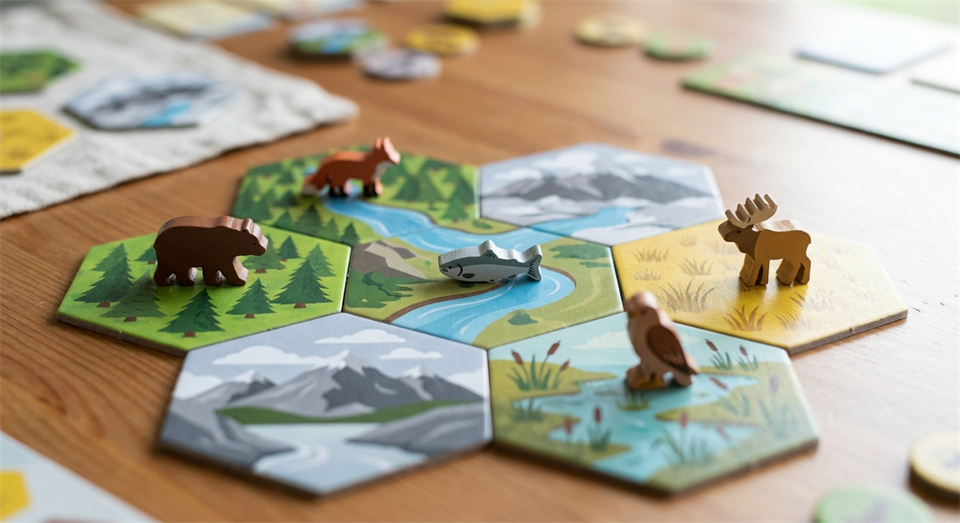
On your turn, you generally choose one of the four available sets on the table. You take both the habitat tile and the wildlife token from the same position. The habitat tile must be placed adjacent to at least one of your existing tiles, so your landscape gradually grows. Many tiles show two habitat types, and this constantly creates small puzzles: should you use the tile to extend a river, connect a forest, or keep two options open? Once the habitat tile has been placed, you place the wildlife token on a tile in your area, but only if the chosen habitat type allows that particular animal. Not all animals can live everywhere, and that is an important restriction.
After your placement, the market is refilled so the next player has four new options to choose from. There are also nature tokens, which provide small extra options, such as changing combinations or replacing a choice. They are an important part of the game because they can save a turn when the market otherwise does not fit your plan. For new players, the turn structure is pleasantly easy to follow: choose, place, refill. That is one of Cascadia’s great strengths. The rules are easy to remember, but the decisions gradually become more interesting as your landscape takes shape and space becomes more valuable.
Points in Cascadia mainly come from three sources: animal scoring, habitat corridors, and bonuses for nature tokens. Animal scoring depends on the five chosen scoring cards. Each animal type has its own logic. Bears may, for example, reward pairs but not large clusters, while hawks often want to stand alone with distance from other hawks. Salmon usually want to form runs, and foxes often score based on the variety among neighboring animals. This means you cannot just place animals randomly. You need to understand each animal’s pattern and build accordingly. Once you understand this, the game’s decisions become much more meaningful.
The second major source of points is habitat corridors. Here, you look at how large connected areas you have created of each habitat type. A long river or a large connected forest scores more than small scattered areas. This creates an interesting balance, because a habitat tile can be good for the landscape and bad for the animals, or vice versa. The third source is nature tokens, which in some game variants can also be worth points if they are not used. This creates a classic dilemma: should you use a token now to save an important turn, or keep it until the end? Cascadia is at its best when these small choices feel close and meaningful.
Imagine that you are playing with a bear card where bears only score in pairs. If you place three bears together, you may only get points for two of them, while the third is effectively wasted. At the same time, a large forest corridor may be taking shape in that same area, so you may still want to use the space there. That leaves you with a classic Cascadia choice: do you maximize the animal or the terrain? In the same way, a fox can be strong if it stands next to several different animals, but weak if all its neighbors are the same. The game therefore rewards not just lucky moves, but the ability to read the tiles and think a couple of turns ahead.
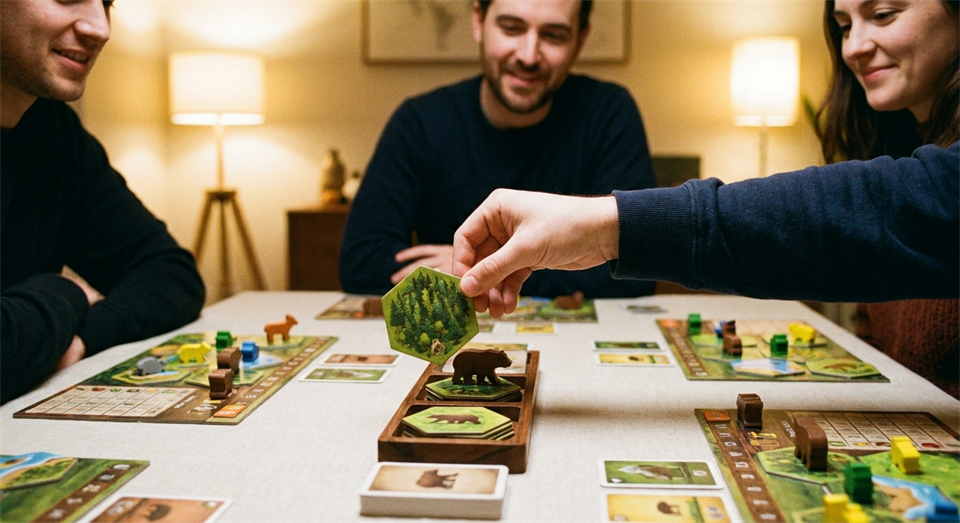
The most common beginner mistake in Cascadia is trying to do everything at once. You see a good river tile, a useful elk, and a possible fox combination, and you end up with a landscape that points in too many directions. A better approach is to choose two or three clear focus areas early on. It may be that you want to build large habitat areas in forest and river while also focusing on salmon and foxes. Once you have a direction, it becomes easier to evaluate the market. You do not need to take the objectively best tile; you need to take the tile that best fits your particular plan.
It is also wise to keep an eye on flexibility. Tiles with two useful habitat types are often strong because they give you more options later. In the same way, you should avoid closing off good spaces too early. If an animal can only be placed in certain habitats, it can be costly to fill those spaces with other animals without a clear reason. Many new players also underestimate the value of nature tokens. They seem small, but they can be the difference between a mediocre turn and a perfect combination. Do not save them for the whole game without reason, but do not use them too quickly either. The best timing is often when a single adjustment can improve both animal scoring and habitat at the same time.
Even though Cascadia is not aggressive, it is still important to pay attention to what others are collecting. If an opponent is clearly building long salmon runs, a single important salmon from the market may be more valuable for you to take than it first appears. Not necessarily to block deliberately every time, but because the shared supply is a central part of the game. At the same time, you can often predict which tiles will be left behind and plan accordingly. This kind of light table reading is a good habit for beginners because it makes your choices more precise without making the game heavy or confrontational.
Cascadia is often praised because it combines accessibility and depth in a rare way. New players can join in almost immediately, since a turn is easy to explain. At the same time, there is enough variation in scoring cards, tile distribution, and player decisions that experienced players still have plenty to think about. The theme also helps a lot. When you place rivers, forests, and animals, the actions feel intuitive. You do not need to remember abstract symbol systems to the same extent as in more technical games. This makes Cascadia an obvious choice for families, couples, and groups of friends who want a strategic game without too much friction.
Another strength is the pace. There are rarely long pauses, and the game develops visibly from turn to turn. Your area grows, patterns emerge, and the final scoring usually feels fair because you can see how your choices created the result. Even when you lose, it is often easy to point to what you could have done better. This makes Cascadia well suited as a learning game. It makes you want to try again with a new idea, perhaps focusing more on habitat next time or being more disciplined with animal placements. That kind of friendly replayability is a big part of the game’s appeal.
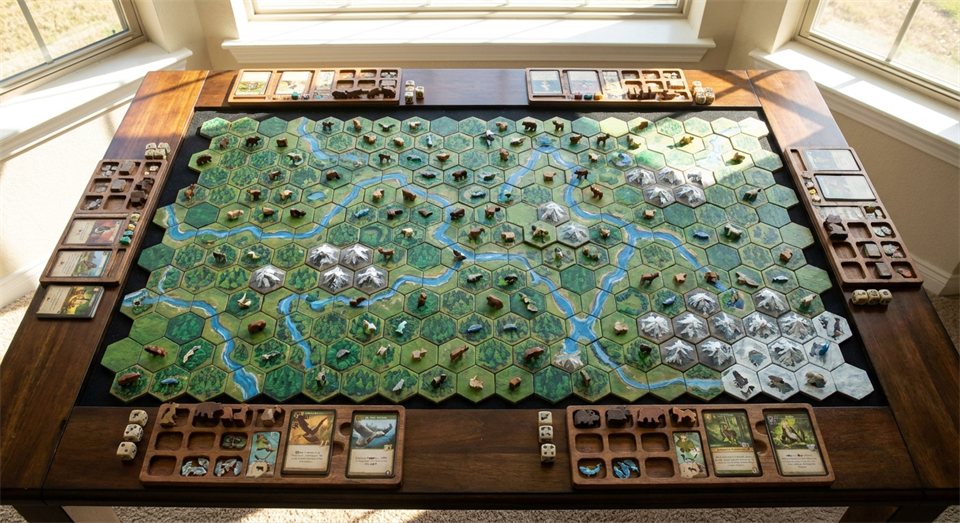
Cascadia is especially well suited to players who enjoy calm, tactical games with low conflict and clear rules. It is not a game for those seeking bluffing, negotiation, or dramatic attacks, but it is very strong as a relaxed strategy game. Many people use it as an introduction to modern board games because the theme is inviting and because you quickly understand what you are trying to achieve. At the same time, there is enough challenge that the game does not feel childish or too simple. That balance makes it unusually versatile.
The game also works well if you want an experience that is cozy without being mindless. You still have to make meaningful choices, but you are rarely punished harshly for a single misstep. That makes Cascadia a good choice on days when you want to use your brain a little, but do not feel like playing a long or heavy strategy game. For beginners, it is especially an advantage that you learn core board game skills such as pattern building, prioritization, and timing in a format that feels friendly and manageable.
Cascadia is an excellent example of how much a board game can get out of simple rules and good choices. You choose a tile, place an animal, and slowly build a landscape, but beneath the calm surface there are many small strategic decisions. For beginners, it is easy to get started, and for more experienced players there is enough variation to keep things interesting. If you are looking for a nature-inspired game with beautiful presentation, low conflict, and satisfying scoring puzzles, Cascadia is a safe place to start. It is a game that invites one more round, because you can always see a new and slightly better way to build your landscape.