


The board game Pandemic is one of the best-known cooperative games in the modern board gaming hobby. Instead of competing against each other, the players work together as a team that must save the world from four deadly diseases. That makes the game exciting in a different way than classic point-based games, because everyone wins or loses together. For beginners, Pandemic is a great place to start if you want to try a game with clear rules, high tension, and lots of shared decisions. Here you get a thorough introduction to how the game works, what makes it special, and how to get started without feeling overwhelmed.
In Pandemic, each participant plays a specialist on a global crisis team. Together, you travel between cities on the world map, treat diseases, build research stations, and try to discover cures before the situation spirals out of control. The game is not about removing every disease cube from the board, but about finding a cure for each of the four diseases. It sounds simple, but the pressure rises quickly because the diseases keep spreading to new cities.
The core of Pandemic is that the game itself acts as the opponent. After each player's turn, new cities become infected, and sometimes epidemics occur, making everything worse. If there are too many outbreaks, if the player cards run out, or if there are no disease cubes left in one color, the whole team loses. That is why every turn feels important. You constantly have to balance short-term firefighting with long-term planning, and that balance is a big part of the game's strength.
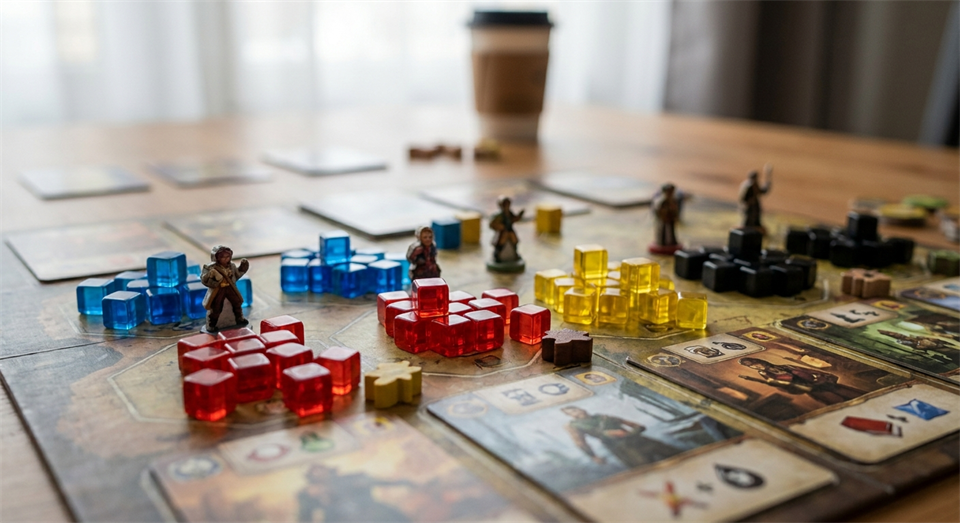
The game board shows a number of cities around the world connected by lines. These lines determine where the players can move. Each city has a color that matches one of the four diseases: blue, yellow, black, and red. When a city becomes infected, cubes in the corresponding color are placed on that city. If a city already has three cubes and gets another one, it triggers an outbreak, which spreads infection to neighboring cities. This is where the chaos can really begin.
There are two main types of cards in the game. Player cards are used, among other things, to travel quickly and to discover cures. Infection cards determine which cities are hit by disease. In addition, there are epidemic cards, which are shuffled into the player deck and create the biggest crises. The components are easy to understand, but the interaction between them makes the game intense. Even new players quickly learn that a single move can have major consequences a few turns later.
Each player gets a role with a special ability. This helps make cooperation interesting, because not everyone can do the same things. A Medic can, for example, remove disease more effectively than others, while a Researcher can more easily help discover cures. A Dispatcher can move other players around the board, and an Operations Expert is good at setting up research stations. Roles do not just provide variety, but also direction. They help beginners understand what they can especially contribute.
The clever thing about the roles is that they create natural conversations at the table. Instead of everyone doing a little of the same thing, it becomes obvious to coordinate: Who should collect cards? Who should clean up an area with many disease cubes? Who should travel far to prevent a critical outbreak? Pandemic is at its best when the roles are used actively, and when the players think in terms of shared solutions instead of individual turns.
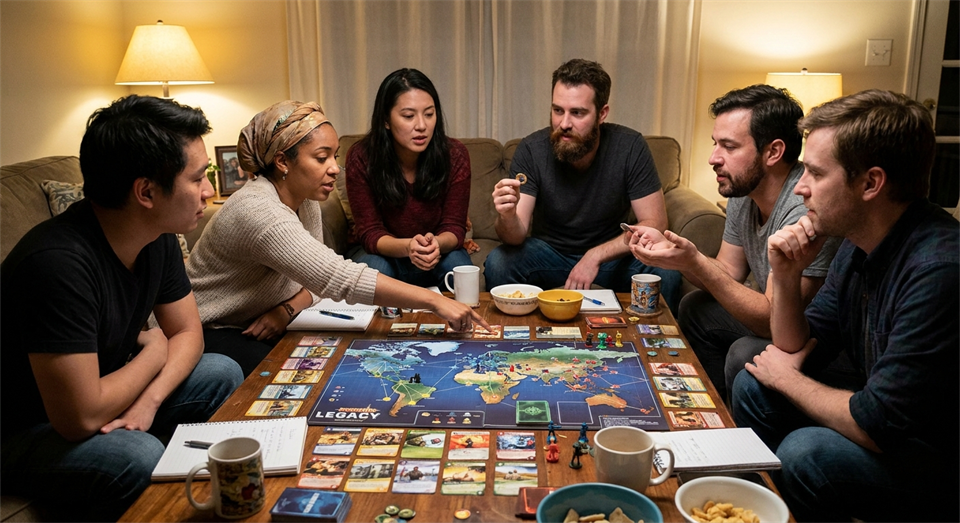
A turn in Pandemic is divided into a fixed structure, which makes the game easy to follow. First, the player performs up to four actions. This can be moving to a neighboring city, taking a direct flight by using a card, treating disease in the city you are in, building a research station, or sharing knowledge with another player. When the four actions have been used, the player draws two cards from the player deck. Finally, infection cards are drawn, which spread disease on the board.
The fixed rhythm makes it easy for beginners to learn the game, but the choices within a turn are rarely simple. Should you use your actions to clean up a dangerous region, or should you travel toward a research station to work on a cure? Should the team use valuable cards for transportation now, or save them for later? The better you become at reading the board, the clearer it becomes that Pandemic is about timing. The right move is often the one that both solves a current problem and prepares the next step.
Many board games are built on competition, but Pandemic stands out by making shared problem-solving the core of the experience. That creates a different atmosphere around the table. You celebrate together when a cure is discovered at the last moment, and you feel the pressure together when three cities are on the brink of outbreak. The game often creates dramatic stories, because defeat and success arise through a chain of decisions that feel meaningful.
Another strength is that the game is easy to learn, but difficult to master. The rules can be explained relatively quickly, and most people understand the basic idea after a few turns. Even so, there is a lot of depth in assessing risk, planning movement, and making the best possible use of the roles. Pandemic is therefore well suited both to new players and to groups that want a game they can return to many times. Each setup feels a little different, because cards and epidemics create new challenges.
A classic beginner mistake is spending too many turns removing disease cubes everywhere. It can feel satisfying to clean up the board, but if you only react to problems, you fall behind. Remember that you win by discovering four cures. Treating disease is important, but mostly as a way to buy time. If a region looks reasonably stable, it may be better to collect cards and move the right players into position instead of removing every single cube.
It helps to think in terms of priorities. Cities with three cubes are dangerous, because they can cause outbreaks. Areas with many close connections can also be critical, because an outbreak there can spread more easily. Clean up where the risk is greatest, but do not let the whole game turn into firefighting. Always keep an eye on which card colors the players have in hand, and who can realistically collect five cards first.
Pandemic rewards discussion and open planning. It is almost always an advantage to talk out loud about the options: Who is close to a research station? Who can share an important card? Who can stop a threatening outbreak with the fewest actions? When everyone contributes to the plan, the game becomes both better and more fun. For new groups, it can be useful to take plenty of time between turns so everyone understands why certain choices are being made.
At the same time, it is a good idea to avoid letting one person control the whole game. Pandemic can tempt the most experienced player to decide everything, because the information is open. But the experience becomes stronger when everyone gets room to think along. Ask each other for suggestions, and use the roles as the starting point for the discussion. That way, the game becomes more cooperative in practice and not just in the rules.
Pandemic can be adjusted in difficulty by changing the number of epidemic cards in the player deck. Fewer epidemics make for a more accessible game, while more make the experience significantly harder. This is a major advantage for beginners, because you can start gently and increase the challenge later. Many groups find that their first victories feel very satisfying, precisely because the game constantly puts pressure on the team without becoming overwhelming.
The pace in Pandemic is usually fast and intense. A game often lasts around 45 minutes to an hour, depending on how many players you are and how much you discuss. That makes it a good choice for a regular game night, when you want a focused game with a clear tension curve. The replay value is high, because roles, card distribution, and disease development rarely unfold in the same way. Even when you know the rules well, new situations still arise that require fresh solutions.
Pandemic is especially well suited to players who like cooperation, planning, and the feeling of solving a shared puzzle. It works well for beginners, because the theme is easy to understand and because the actions on a turn are concrete and manageable. At the same time, there is enough depth that more experienced players can also find a challenge in it. The game is well suited to friends, couples, and families with slightly older children who can handle thinking a few moves ahead.
If you prefer direct competition, hidden information, or very light party games, Pandemic may be less obvious. But for many people, the cooperation is exactly what makes the game memorable. It creates a shared story in which everyone has a part in both mistakes and triumphs. You rarely walk away feeling like you just moved pieces around; instead, you remember the decisive outbreak, the last-minute rescue, and the cure that was discovered just before everything looked hopeless.
Pandemic is a strong example of how engaging a cooperative board game can be. It combines a simple basic structure with difficult choices, clear roles, and constant tension. For beginners, it is a good introduction to modern board games, because it is easy to learn while still providing a sense of depth and drama. If you would like to try a game where the table comes together around a shared goal, and where every decision feels important, Pandemic is an excellent choice. It is a game that both challenges and brings people together, and one that often makes you want to start a new round right away.