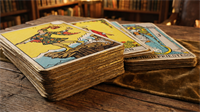
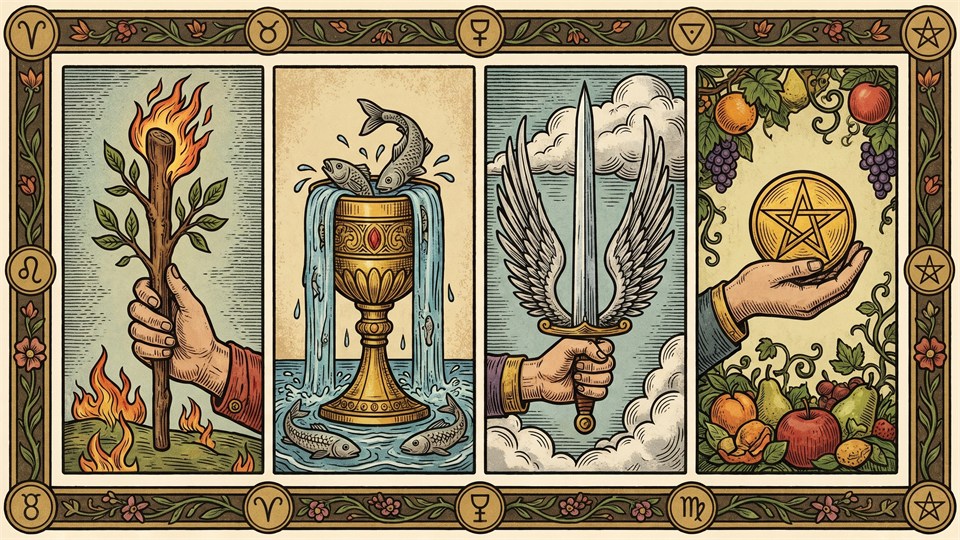


The Minor Arcana is the part of tarot that often feels the most grounded and recognizable in everyday life. While the major cards typically deal with big life themes and turning points, the Minor Arcana shows the patterns, choices, feelings, and actions that fill daily life. The cards are divided into four suits: swords, cups, wands, and pentacles. Each suit points to a particular area of life, and together they create a nuanced picture of thoughts, relationships, energy, and practical matters. For beginners, it can seem like a lot of cards to keep track of, but once you understand the basic tone of the suits, tarot becomes much easier to read. The Minor Arcana is therefore a good place to build your understanding, because the symbolism often reflects experiences that most people already know from everyday life.
The Minor Arcana consists of 56 cards and in many ways functions as tarot’s everyday layer. The cards are divided into four suits with 14 cards each: ace through ten as well as four court cards. This makes the system more manageable, because you can read by number, suit, and figure type. If, for example, you see several cards from the same suit in a spread, it often points to a particular area of life taking up extra space. Many people feel that the Minor Arcana resembles playing cards a little, and that is no coincidence. The structure has clear similarities to ordinary card games, but tarot cards have a broader symbolic language. In practice, the Minor Arcana is often used to describe situations, relationships, challenges, and opportunities that are current right now, rather than grand stories of fate.
For beginners, it is useful to think of the suits as four different lenses. Swords often deal with thoughts, conflicts, and decisions. Cups point to feelings, relationships, and intuition. Wands are associated with energy, will, creativity, and action. Pentacles deal with the concrete, such as work, resources, the body, and stability. When you get to know these four basic tracks, it becomes easier to understand both individual cards and entire spreads. You do not need to memorize all 56 cards from the start. A more realistic and useful approach is to learn the mood of the suits first and then notice how the numbers color the meaning. In that way, tarot becomes less mysterious and more like a language you gradually learn to read.
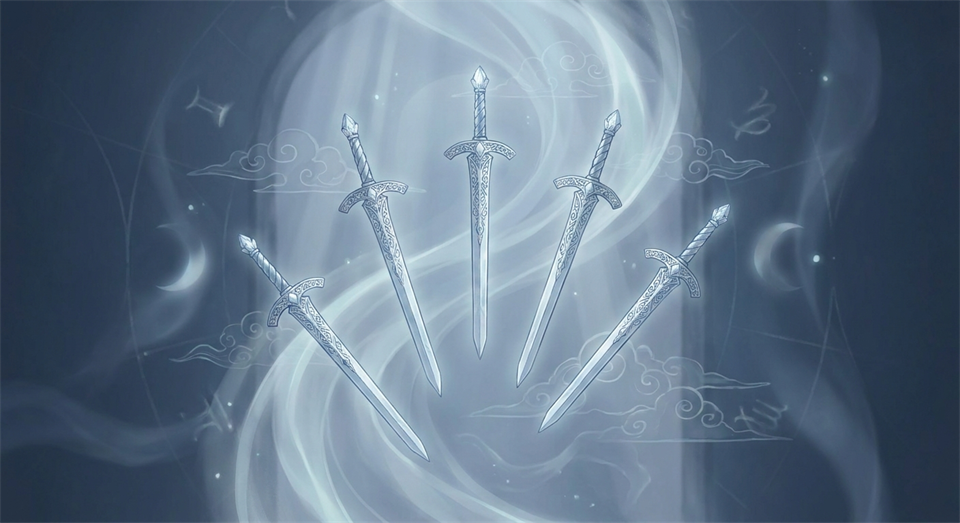
Swords are normally associated with the element of air and deal with the mind. This is the suit of thoughts, analysis, communication, decisions, and mental tension. When swords appear in a spread, they often point to something happening in the head: considerations, doubt, clear insights, or inner conflicts. Many people experience swords as a somewhat harsh suit, because it also contains disagreement, sorrow, and sharp realizations. But swords are not only heavy. They can also show clarity, honesty, and the ability to cut through confusion. If cups are felt in the heart, swords are often felt in the thoughts. That is why they are especially useful when you want to understand decisions, boundaries, and communication in a situation.
A typical example is when a person stands between two choices and draws a sword card. Here the card may point to the need to think clearly, speak honestly, or accept a truth one would rather avoid. A card like the ace of swords is often associated with breakthroughs, insight, and a new understanding. A card further along in the sequence may show more complex mental patterns, such as worry or exhaustion. Swords remind us that thoughts can be both a tool and a burden. If there are many swords in a spread, it may be a sign that you are analyzing a lot, perhaps too much, or that a situation requires sharp communication rather than feelings alone. The suit therefore invites honesty, precision, and awareness of how words and thoughts shape the experience.
Cups are associated with the element of water and deal with emotional life. Here you find love, longing, joy, vulnerability, empathy, and intuition. When cups appear in a spread, they often tell you something about how a situation feels, not only what is happening. They point to relationships between people, but also to the relationship with oneself. For beginners, cups are often the easiest to sense, because they deal with something universal: the reactions of the heart. If a spread is dominated by cups, it is often a sign that feelings play a greater role than logic, or that a matter should be understood through mood and relationship rather than through arguments alone.
Cups can be warm and gentle, but they are not always easy. Water can flow calmly, but it can also flood. That is why the suit contains both joy and emotional unrest. A card in this suit may point to falling in love, reconciliation, or deep connection, but also to disappointment, illusion, or emotional overload. If, for example, you ask about a friendship or a romantic relationship, cups will often be central. They can show whether the relationship is open, mutual, and nourishing, or whether there are feelings that are not being met. Cups teach us that feelings are not just something that happens to us, but also something we can listen to. In tarot, they function as a reminder that intuition and empathy often say something important that cannot be measured or calculated.
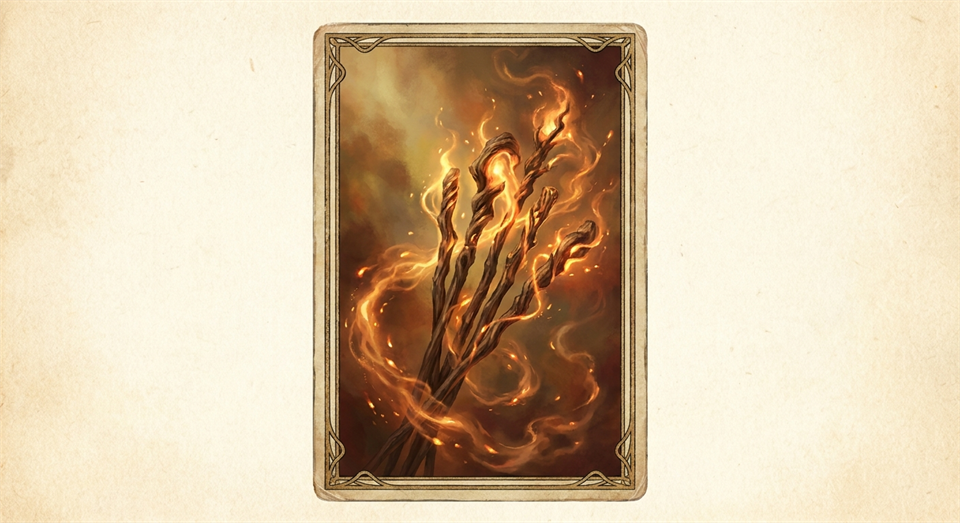
Wands are associated with the element of fire and are the suit of action, drive, courage, and creativity. Where swords think and cups feel, wands do something. They often show movement, ambition, initiative, and the desire to create or explore. When wands appear, there is often energy at play, whether it is inspiring, impatient, or a little unruly. This suit is often seen in questions about work, projects, personal development, passion, and direction. For beginners, wands are useful to know because they clearly show the difference between dreaming about something and actually setting it in motion. They point to the spark that makes things happen.
In practice, wands can show everything from a new idea to a period of high activity. An ace of wands is often associated with a new beginning, enthusiasm, and creative power, while other cards in the suit may point to competition, progress, or the need to stay focused. However, wands can also warn against spreading your energy too thin. If you have many plans but find it difficult to complete them, a spread with many wands may reflect exactly that restless force. The suit is therefore not only about having energy, but also about using it wisely. It reminds us that passion is valuable, but that it becomes strongest when it has direction. Wands are the cards of the courage to begin, the desire to grow, and the will to take the next step.
Pentacles are associated with the element of earth and deal with the concrete world. Here you find themes such as work, finances, home, health, routines, material resources, and long-term building. Pentacles are the suit that often feels the most tangible, because it points to what you can build, save, care for, or maintain. When pentacles appear in a spread, it often concerns stability, responsibility, and what requires patience. For beginners, this suit is a good reminder that tarot is not only about feelings and symbolism, but also about very ordinary matters such as time, money, habits, and physical well-being.
Pentacles often show how something develops over time. They may point to work that grows slowly, a financial decision, the need for more structure, or the importance of taking care of the body. An ace of pentacles is often associated with a concrete opportunity, while other cards in the suit may deal with learning, investment, security, or concern about resources. If a spread is dominated by pentacles, it may be a sign that the solution is not found in big feelings or quick decisions, but in small, steady steps. Pentacles teach us the value of persistence. They show that many results arise through practice, not only inspiration. In tarot, they provide grounding and help translate insights into something that can actually be lived in everyday life.
When you read the Minor Arcana, it is rarely enough to look at one card in isolation. What is most interesting often arises when the suits meet each other. A spread with both swords and cups can, for example, show the tension between thought and feeling. Many wands together with few pentacles may point to lots of energy, but a lack of structure. Many pentacles and almost no cups may suggest that something works practically, but feels flat or emotionally empty. By comparing the suits, you get a more vivid picture of the situation. This makes tarot more nuanced and less mechanical.
A simple exercise for beginners is to ask yourself: What takes up the most space here? Is it thoughts, feelings, action, or the practical? After that, you can look at what is missing. If, for example, a person asks about stress and draws many swords and wands, but no cups or pentacles, it may point to high mental and physical activity without enough rest, care, or grounding. In that way, the suits become a tool for seeing balance and imbalance. You do not need to predict anything dramatic to get value from tarot. Often it is enough to discover which area of life is calling for attention. The Minor Arcana is powerful precisely there, because it makes abstract experiences easier to understand and work with.
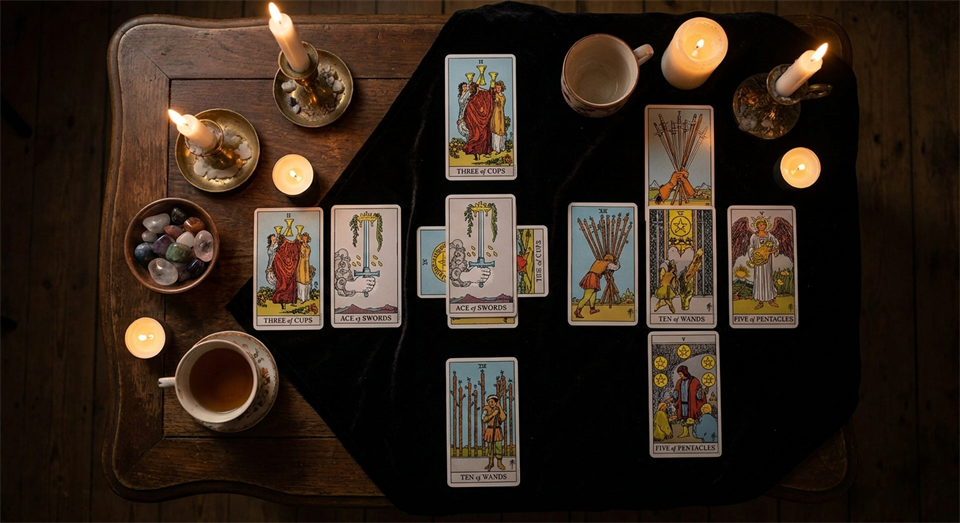
If you want to get to know the Minor Arcana, it is a good idea to start simply. Choose one suit at a time and notice how it appears in small spreads. You can also keep notes on which suits often appear and how they match your experiences. In that way, you do not only learn the book meanings, but also develop your own understanding. Tarot often becomes most useful when it is experienced as a tool for reflection rather than a test you have to pass. The most important thing is not to remember everything perfectly, but to see patterns and ask good questions.
The Minor Arcana – swords, cups, wands, and pentacles – provides a practical and vivid language for everyday experiences. The four suits help put words to what you think, feel, do, and build. For beginners, it is a reassuring entry into tarot, because the system is clear, repetitive, and full of recognizable themes. The more you work with the suits, the more natural it becomes to see the connections between them. Instead of seeming overwhelming, the cards begin to look like a map of human experience. And that is exactly why the Minor Arcana is so valuable: it shows that even small moments, daily choices, and ordinary feelings contain meaning when you look at them with attention.