


Music theory is the study of how music is constructed, and how the individual elements interact to create harmonic, rhythmic, and melodic wholes. It is a language that enables musicians to communicate precisely, regardless of which instrument they play or which musical style they work with.
In this article, you will get an overview of basic concepts such as notes, octaves, scales, tempo, intervals, and much more. For a deeper review of specific topics such as chords and the circle of fifths, we refer to our separate articles.
Notes are the written language of music and are used to show both pitch and duration. With the help of notes, musicians can read, write, and share music independently of instrument or genre. Just like letters in an alphabet, the notes are symbols that together form a musical sentence.
Notes are written on a staff, which consists of five horizontal lines and four spaces. Each line and each space represents a specific pitch, and which pitch it is depends on which clef is used.
The most common clef is the G-clef -
The musical notes are named A, B (or H), C, D, E, F, and G. In Danish tradition, H is often used instead of B, and what is called B♭ in English is called B in Denmark. After G, the sequence starts again with A – the notes repeat in octaves.
A note's placement on the lines indicates its pitch. The higher the note head is placed, the higher the pitch. If the notes go beyond the five lines, ledger lines are used above or below the staff.
The note head's appearance and accessories show how long the note should last. Here are the most common note values:
Whole and half notes have hollow note heads, while quarter and shorter notes have filled (black) heads. Shorter notes also have beams or flags on the note stem.
In music, silence is just as important as sound. Rests are notated with their own symbols and have the same duration as their corresponding note values. A whole note rest, for example, lasts four beats and is placed hanging under a line, while a quarter note rest has its own hooked symbol.
Below are the most common rest symbols in musical notation. Each rest corresponds to a note value and indicates silence of the same duration.
There are many other elements in musical notation – including:
Below are selected symbols that are often used in musical notation in addition to the notes and rests:
Learning to read music opens up a deeper understanding of the structure of music and makes it easier to learn new pieces, play together with others, and analyze music.
An octave is the interval between two notes where one has twice the frequency or half the frequency of the other. On the piano, the pattern of notes repeats for each octave.
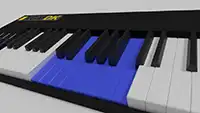
Here is an example of two octaves of C major on the piano:
A scale is a series of notes arranged in ascending or descending order according to a specific pattern. The most well-known is the major scale: Whole – Whole – Half – Whole – Whole – Whole – Half.
Example: C major scale
See the link below to our article about the major and minor scale.
An interval is the distance between two notes, measured either in named steps (e.g. third, fourth, fifth) or in number of semitones.
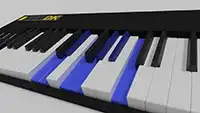
Here is an example of a perfect fifth (C to G):
Intervals are fundamental for both melodic movement (how a melody “goes up and down”) and harmonic structure (e.g. which notes are played simultaneously in a chord).
Intervals are named according to how many steps there are between the two notes in the scale, including the starting point. For example, the distance from C to E is a third (C–D–E = 3 steps), and from C to G is a fifth (C–D–E–F–G = 5 steps).
In addition, there are augmented and diminished intervals, which are just above or below the normal intervals. For example, the distance from C to F# is an augmented fourth.
Intervals are used to describe:
Training the ear to recognize intervals is an important part of ear training. Many intervals have characteristic sound impressions. For example, a minor third often sounds sad, while a perfect fifth sounds stable and open.
Tempo indicates how fast the music should be played, measured in BPM. Classical terms:
A key indicates which notes and chords are used as the basis for a piece of music. The key is typically defined by the tonic (tonika), which the music is based on, as well as whether the scale is major or minor. The key thus determines both melody and harmony.
When you say that a piece is in, for example, G major, it means that the music uses the notes from the G major scale (G – A – B – C – D – E – F#), and that G functions as the harmonic and melodic center. Chords and melodies will generally revolve around this note.
The key is indicated in sheet music by accidentals (sharps ♯ or flats ♭), which are placed at the beginning of the staff. The number and type of accidentals determine which key is in use. For example, D major has two sharps (F# and C#), while B♭ major has two flats (B♭ and E♭).
Each major key has a relative minor key, which uses the same notes and accidentals, but has a different tonic. For example, A minor is relative to C major, and E minor is relative to G major. The two keys thus share scale and chords, but have different character and sound.
Keys are used for analysis, composition, and improvisation. When you know the key, you can:
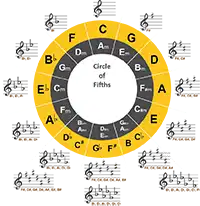
To understand the relationship between keys (especially their accidentals and relations), the circle of fifths can be used. It shows how keys are connected in a logical structure based on fifth intervals. See the link to our article about the circle of fifths below.
Chords are a central part of music theory and form the basis for harmony in most Western music. A chord occurs when three or more notes are played simultaneously. The most basic chord type is the triad, which consists of a root, a third, and a fifth.
There are two primary types of triads: major chords and minor chords. A major chord has a major third (four semitones above the root), which gives it a bright and positive sound. A minor chord instead has a minor third (three semitones above the root), which gives a darker and more melancholic character. The fifth is five notes above the root (seven semitones) and is the same in both major and minor.
Example:
In addition to triads, there are also seventh chords, where you add an extra note, e.g. a seventh. These are often used in jazz, pop, and classical music to create more complex harmonies. Examples of seventh chords are Cmaj7 (C – E – G – B) and C7 (C – E – G – B♭).
Chords can be played in different inversions, where a note other than the root is at the bottom. This changes the chord’s tone color and is used to create variation in harmonic progressions.
Dynamics describe volume, e.g. p (soft) and f (loud). Crescendo means gradually louder, decrescendo gradually softer.
With this introduction, you have the most important building blocks to understand music theory. Practice reading sheet music, playing scales, and recognizing intervals – it is the foundation for all musical development.