

Speakers are the link in the audio chain that turns electrical signals into something we can actually hear. Whether you listen to music from a phone, a computer, a stereo system, or a TV, the speaker is crucial to how the sound is experienced. Many people start by looking at size, price, and design, but it is at least as important to understand how speakers work and why different models sound different. When you know the basic concepts, it becomes much easier to choose the right one and get more enjoyment from your music.
In this guide, we go through speakers in simple language. You will get an explanation of the most important parts, the most common types, and the key things to consider before buying. The goal is not to make the subject technically heavy, but to provide a practical understanding that anyone can use in everyday life.
A speaker is a device that converts an electrical audio signal into movements in the air. The small pressure changes in the air are picked up by our ears as sound. In practice, this happens when a diaphragm moves quickly back and forth. When the diaphragm pushes the air, sound waves are created. The more precisely this movement follows the music signal, the more natural and detailed the sound will often seem.
Even a simple speaker consists of several parts that work together. There is typically an enclosure, one or more drivers, and often a crossover that distributes the frequencies. Small speakers can be fine for speech, podcasts, and background music, while larger models often provide more fullness, better bass, and more headroom at high volume. That does not mean that bigger is always better, but size almost always affects how much air the speaker can move, and that matters for the experience.
The most common type of speaker uses a magnet, a voice coil, and a diaphragm. When current is sent through the voice coil, a magnetic field is created that reacts with the fixed magnet in the speaker. This causes the voice coil to move back and forth. Because the voice coil is attached to the diaphragm, the diaphragm moves with it. This movement creates sound waves that correspond to the music signal.
Fast movements produce high tones, while slower and larger movements produce deep tones. That is why it is difficult for a single driver to reproduce the entire audible range perfectly. Many speakers are therefore built with multiple drivers, where each driver works best in its own range. That is also why you often see words like tweeter, midrange, and woofer in descriptions of speakers. They indicate which frequencies the individual parts are designed to handle.
The tweeter reproduces the high frequencies such as cymbals, details in vocals, and small nuances in instruments. The midrange driver handles many of the frequencies where voices, guitar, and piano sit. The bass driver, or woofer, handles the deeper tones and gives weight to drums, bass guitar, and electronic sounds. In some systems there is also a subwoofer, which is specially developed for the very deepest frequencies.
The enclosure is more important than many people think. It does not just hold the parts together, but also affects resonance, control, and tone. A solid enclosure can reduce unwanted vibrations and make the sound cleaner. In addition, the crossover plays a central role. It sends the high frequencies to the tweeter and the low ones to the woofer, so each part works within its optimal range. When this is well tuned, the speaker sounds more balanced and coherent.
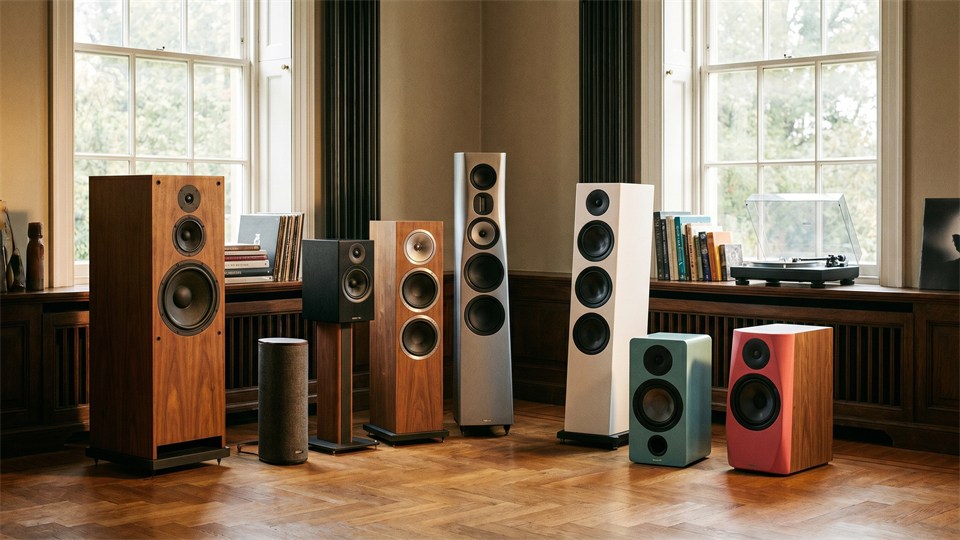
There are many kinds of speakers, but for beginners it makes sense to start with the most common categories. Bookshelf speakers are compact and fit well in smaller rooms, on desks, or on shelves. They can deliver surprisingly good sound, especially if they are placed correctly. Floor-standing speakers are larger and often have more bass and greater output. They are often used in the living room, where you want a fuller music experience without necessarily adding a subwoofer.
Active speakers have a built-in amplifier, so they can be connected directly to, for example, a phone, computer, or streamer. Passive speakers require a separate amplifier, but in return offer greater flexibility if you want to build a system step by step. Bluetooth speakers are made for simple and wireless use, while soundbars are popular for TV audio because they take up little space and are easy to install. Studio monitors are developed for more neutral reproduction and are often used for production and critical listening.
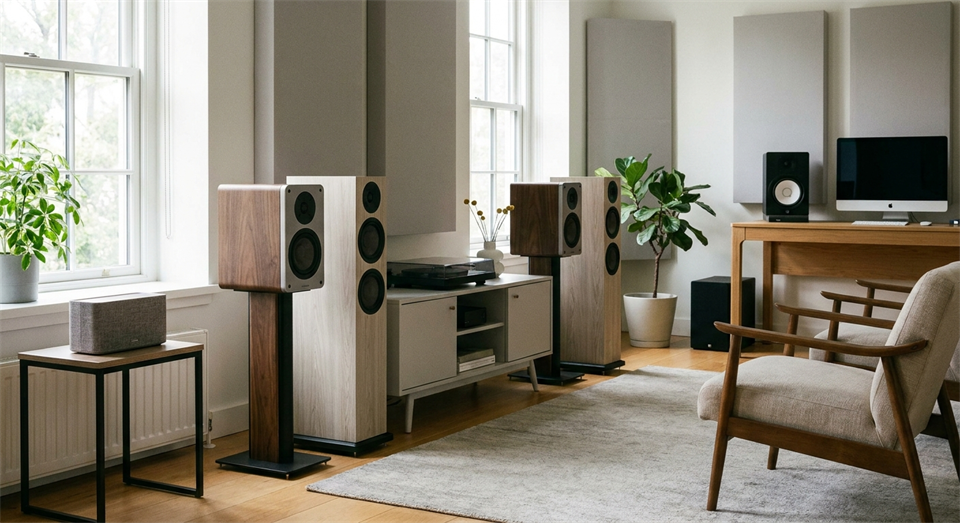
The choice between active and passive speakers often comes down to simplicity versus flexibility. An active model is easy to get started with because the amplifier is already matched to the speaker. This makes the setup straightforward and reduces the number of boxes and cables. For many beginners, that is a major advantage, especially if the speakers are to be used with a computer or in a smaller home audio system.
Passive speakers require more equipment, but make it possible to choose the amplifier, cables, and source separately. If you later want to upgrade, you can replace one part at a time. That is one of the reasons why many music enthusiasts choose this solution. There is no single solution that is best for everyone. If you want the simplest possible system, active is often the smartest choice. If you want to learn more and build a system over time, passive may be the right choice.
When reading about speakers, you often come across words like frequency range, sensitivity, impedance, and watts. It can seem technical, but the concepts can be explained simply. The frequency range shows which tones the speaker can reproduce. A model with deeper bass extension can often provide more fullness, but the numbers alone do not tell the whole story. Two speakers with the same specification can still sound very different in practice.
Sensitivity says something about how loudly the speaker plays with a given amount of power. A speaker with high sensitivity typically requires less power from the amplifier to play loudly. Impedance is about the electrical load that the speaker presents to the amplifier. Watts are often highlighted in marketing, but high wattage does not automatically mean better sound. The most important thing is that the speaker and amplifier are a good match, and that the sound works in the room where the system will be used.
Specifications are useful as guidelines, but they cannot replace listening. A speaker can have impressive numbers on paper and still sound harsh, thin, or unbalanced in an ordinary room. Conversely, a model with modest specifications can sound very musical and pleasant. That is why it is important to think about how you personally prefer sound. Some people like a warm and full tone, while others prefer a more neutral and analytical presentation.
Music taste also plays a role. Electronic music and hip-hop often place greater demands on bass and energy, while acoustic music, jazz, and vocals can reveal how well the speaker reproduces detail, space, and naturalness. If possible, it is a good idea to listen to different types of music on the same speaker. That gives you a better sense of whether it suits your needs instead of relying only on brochures and technical data.
Even good speakers can sound disappointing if they are placed poorly. Speakers close to walls can get more bass, but the bass can also become heavy or imprecise. If they are placed too close to corners, the sound can become bloated. Bookshelf speakers often work best on stands or stable furniture, where the tweeter points roughly toward the listening position. This typically gives a clearer stereo image and better balance between the frequencies.
The distance between the speakers and the distance to the listener also matter a great deal. Many people use a simple rule of thumb where the speakers and the listening position form a triangle. This usually provides a good starting point. Small adjustments can make a big difference. Moving the speakers just a few centimeters can make voices clearer, the bass tighter, and the soundstage more precise. In practice, the room is part of the speaker, because walls, floors, and furniture affect what you hear.
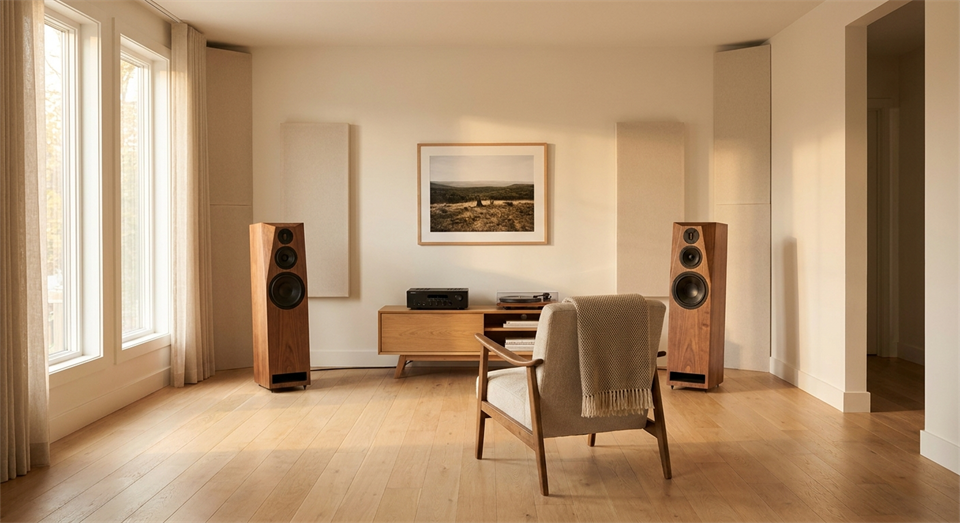
The best choice depends on the usage situation. If the speakers are to be used for background music in a small room, compact active models are often enough. If they are to be the center of a living room for serious music listening, larger bookshelf speakers or floor-standing speakers may be better. If you watch a lot of movies, a soundbar or a system with a subwoofer can be practical. If you work with music production, neutral studio monitors are often more relevant than models tuned to sound extra impressive.
The budget is important, but it is rarely wise to buy based only on the lowest price. Cheap speakers can be fine for simple use, but if you listen to a lot of music, a slightly better model can provide greater enjoyment for many years. Also think about connections. Do you need Bluetooth, cable, an optical input, or the option for a turntable via extra equipment? When you match features, room size, and sound preferences, the choice becomes easier to manage, and the risk of a bad purchase becomes smaller.
A common mistake is choosing based on appearance alone. Design obviously matters in the home, but sound quality and placement are at least as important. Another mistake is believing that more bass is always better. Powerful bass can seem impressive at first, but if it overwhelms voices and details, the sound quickly becomes tiring. Many people also overlook that the room can be the cause of poor sound, even when the speaker itself is good.
It is also common to underestimate the importance of listening distance and volume. A small Bluetooth speaker can be excellent on a table close to the listener, but insufficient in a large living room. Conversely, very large speakers can be difficult to get working optimally in a small room. The best solution is rarely the most extreme one, but the one that best suits the specific use. Balance is often more important than sheer size or advertised power figures.
Speakers are far more than just boxes that play sound. They are the final and very crucial link between the music signal and your ears. When you understand the difference between types, parts, and placement, it becomes easier to choose a model that suits both your room and your way of listening. You do not need to be an expert to get good sound, but a little basic knowledge makes a big difference.
For beginners, the most important thing is to think practically: What will the speakers be used for, where will they be placed, and what kind of sound do you like best? If you start from those questions, you will get far. A well-chosen speaker can make music more vivid, more engaging, and much more enjoyable in everyday life.