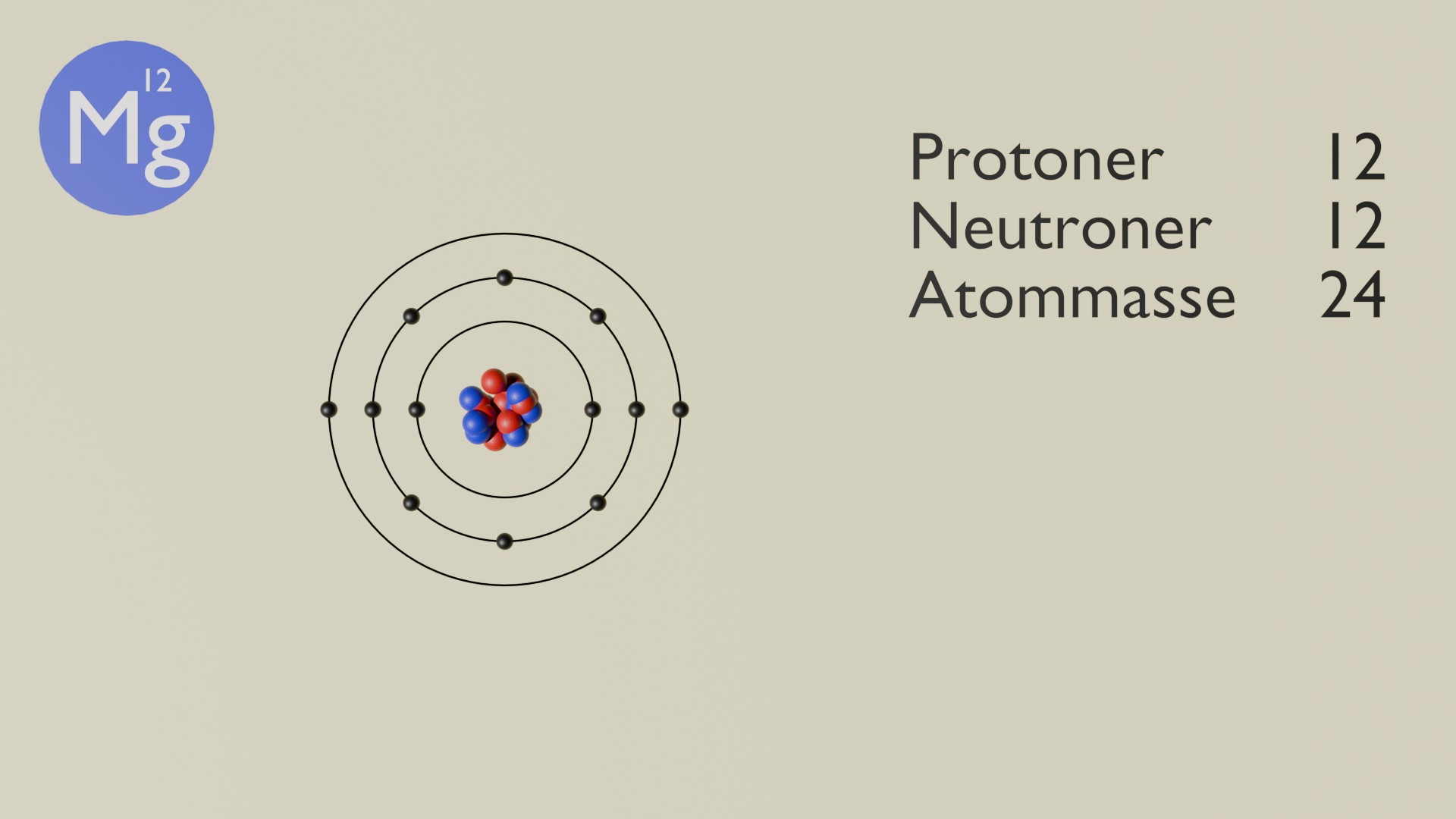
Magnesium (Mg) is a chemical element with atomic number 12. It belongs to group 2 in the periodic table, known as the alkaline earth metals. Magnesium is a light, silvery-white metal, which is important both industrially and biologically.
1. Introduction to magnesium
Magnesium has 12 protons, typically 12 neutrons, and 12 electrons. It is not found free in nature, but occurs in many minerals such as dolomite and magnesite. Magnesium is the eighth most common element in the Earth's crust and the third most abundant in seawater.
2. Physical and chemical properties
Magnesium is a soft and light metal with high strength relative to its weight. It reacts slowly with air and water at room temperature, but burns with an intense white flame when ignited.
- Melting point: 650 °C
- Boiling point: 1,090 °C
- Low density and good electrical conductivity
When burned, magnesium oxide (MgO) is formed, a white powder with a high melting point.
3. Isotopes of magnesium
Magnesium has three stable isotopes:
- Magnesium-24 (²⁴Mg): approx. 79 %
- Magnesium-25 (²⁵Mg): approx. 10 %
- Magnesium-26 (²⁶Mg): approx. 11 %
All isotopes are stable and have applications in research and geological dating.
4. Industrial applications
Magnesium is used in many industries thanks to its low weight and chemical properties:
| Application | Description |
| Light metal alloys | Magnesium is included in alloys for airplanes, cars, and bicycles, where low weight is important. |
| Electronics and casting | Used in laptops and cameras as a light and strong housing material. |
| Fireworks and emergency flares | Magnesium's strong, white light makes it ideal for visual effects and signaling. |
| Medical and biological purposes | Magnesium compounds are used as laxatives, antacids, and for muscle function. |
5. Biological significance and occurrence
Magnesium ions (Mg²⁺) are essential for living organisms. They play an important role in muscle and nerve cell function, energy production (ATP), and maintenance of bone health.
Magnesium is found in foods such as nuts, grains, leafy greens, and fish. Deficiency can lead to muscle cramps, fatigue, and in severe cases, cardiac arrest.
Magnesium is extracted industrially from seawater and mineral deposits through electrolysis and thermal reduction.