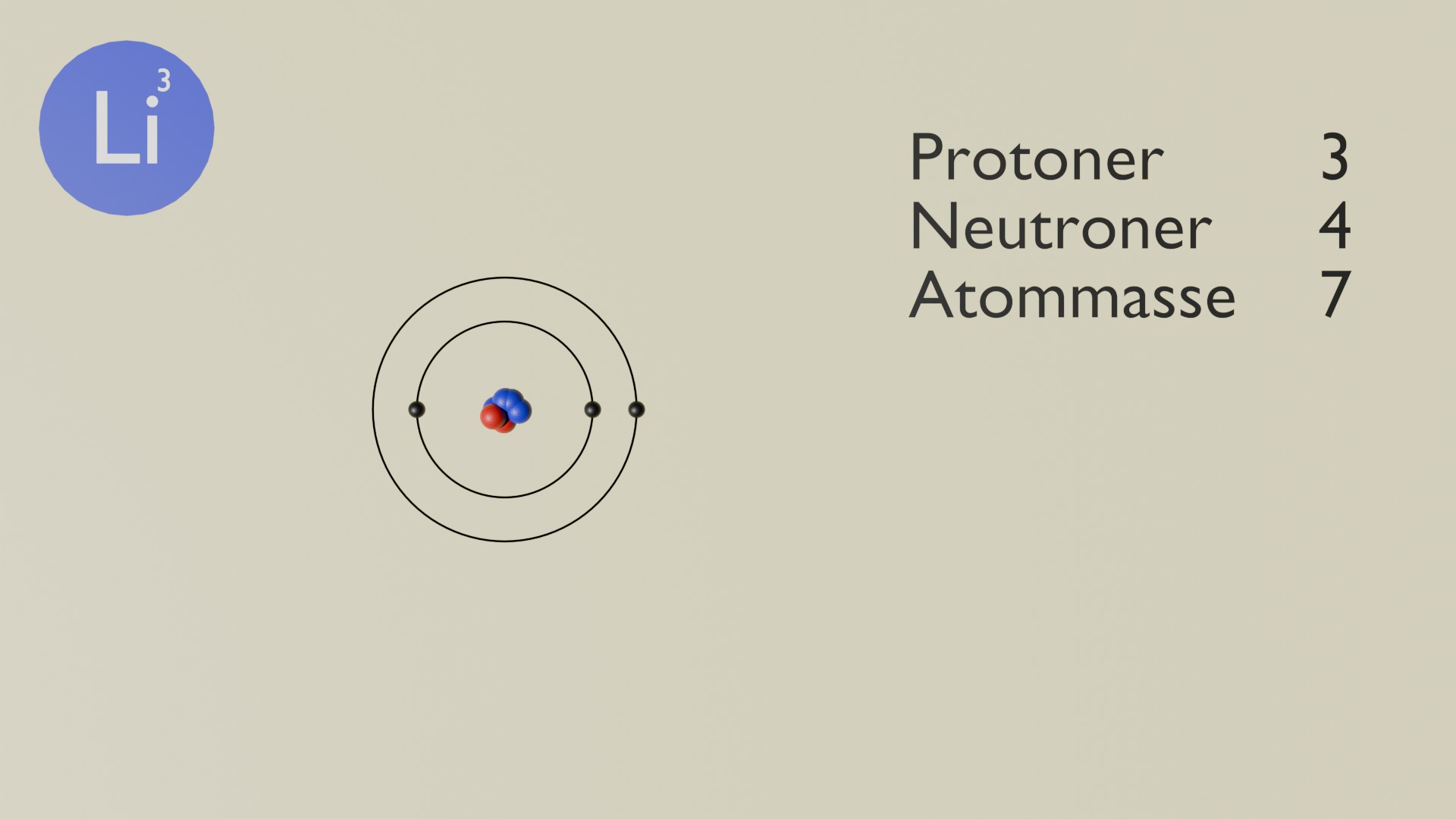
Lithium (Li) is a chemical element with atomic number 3. It belongs to the alkali metals in group 1 of the periodic table and is the lightest metal. Lithium is silvery-white, soft, and highly reactive.
1. Introduction to lithium
Lithium has 3 protons, usually 4 neutrons, and 3 electrons. It is the first metal in the periodic table and does not occur freely in nature, as it reacts quickly with air and water. Instead, it is found in salts and minerals such as spodumene and lepidolite.
2. Physical and chemical properties
Lithium is a soft, silvery-shiny metal with low density (about half that of water) and a melting point of 180.5 °C. It oxidizes quickly in air and forms a gray layer of lithium oxide. It reacts violently with water, producing hydrogen gas and a basic solution of lithium hydroxide.
Lithium forms ions with the charge Li⁺ and easily enters into chemical compounds.
3. Isotopes of lithium
Natural lithium consists of two stable isotopes:
- Lithium-6 (⁶Li): 3 protons and 3 neutrons
- Lithium-7 (⁷Li): 3 protons and 4 neutrons (most common)
Lithium-6 is important in certain nuclear physics processes, while Lithium-7 is widely used industrially.
4. Industrial applications
Lithium plays a central role in modern technology:
| Application | Description |
| Lithium-ion batteries | Used in mobile phones, laptops, and electric cars due to low weight and high energy density. |
| Glass and ceramics | Added to make the materials more resistant to temperature changes. |
| Medicine | Lithium salts are used in the treatment of bipolar disorders. |
5. Occurrence and safety
Lithium is found in mineral deposits and in brines from, for example, Chile and Australia. It is extracted through mining and evaporation.
Pure lithium and its compounds should be handled with caution. It reacts with water and moisture, and lithium salts used in medicine require careful dosing due to potential side effects.