

Imagine a computer that can solve tasks in seconds that would take ordinary supercomputers millions of years to complete. That is the vision behind the quantum computer – a revolutionary technology that is no longer just the stuff of science fiction. But what exactly is a quantum computer, and how does it differ from the computers we use today?
A classical computer uses bits to process information. Each bit can be either 0 or 1 – like a tiny switch that is on or off. All programs and data in a classical computer are built up from long sequences of these bits.
A quantum computer, on the other hand, uses qubits – quantum bits – which can be both 0 and 1 at the same time thanks to a quantum mechanical phenomenon called superposition. This means that one qubit can perform multiple calculations in parallel. When several qubits are connected, the computing power grows exponentially.
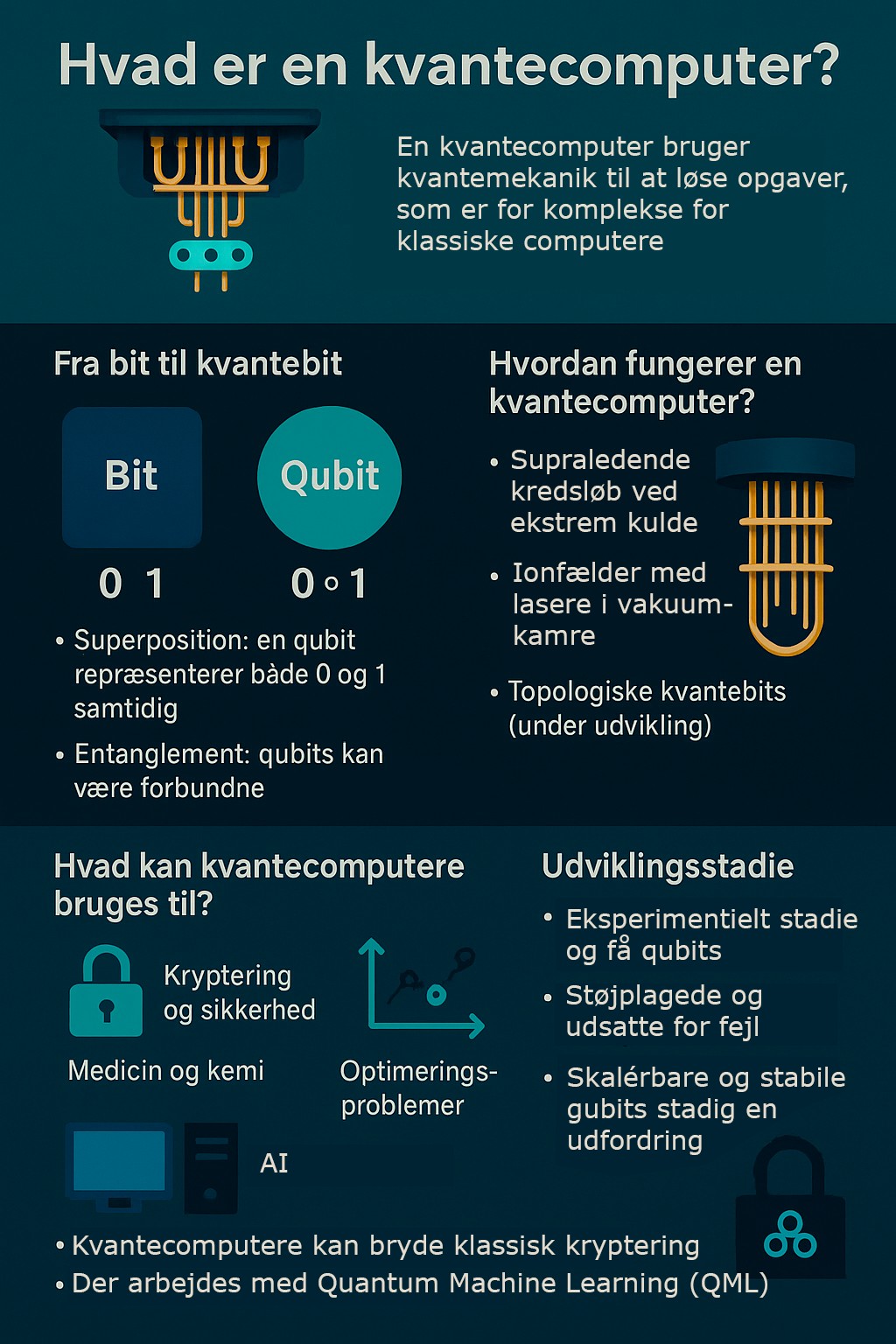
Another central phenomenon in quantum computers is entanglement, where two or more qubits become connected in such a way that the state of one depends on the other – no matter how far apart they are. This enables extremely complex and coordinated calculations.
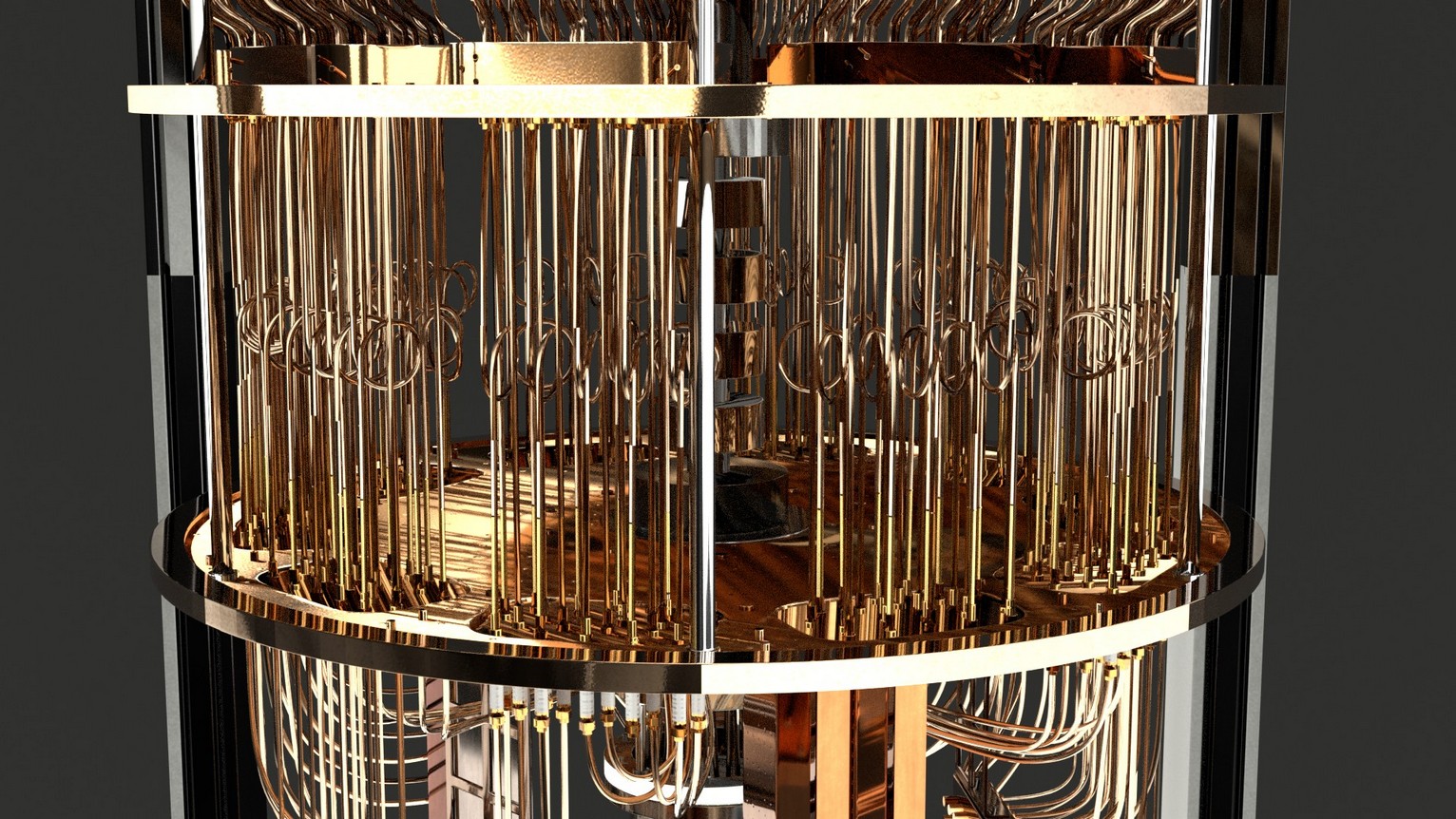
Quantum computers use quantum mechanics to perform calculations in ways that are not possible with classical computers. This requires extremely precise and controlled environments. The most widespread technologies today are based on:
Common to these technologies is that they require a vacuum, low temperature (almost absolute zero), and extreme noise reduction so that the quantum states do not collapse – a major technical challenge.
Quantum computers are not designed to replace ordinary computers, but to solve specific tasks where classical computers fall short. Some of the most promising application areas are:
Quantum computers with up to several hundred qubits have been created today, but most are still very sensitive to noise and unstable. A central problem is decoherence – that is, how long a qubit can maintain its state. Most qubits are only usable for milliseconds, and small disturbances can ruin the entire calculation.
Therefore, researchers are working to create error correction and scalable architectures, so that quantum computers can become both reliable and practical. Today, we talk about the “NISQ” era (Noisy Intermediate-Scale Quantum), where experiments can be done – but not fully reliable solutions.
Tech giants like Google, IBM, Microsoft, and China’s Baidu are investing massively in the field. In 2019, Google announced that they had achieved "quantum supremacy" by performing a calculation in 200 seconds that would take a supercomputer 10,000 years. However, critics pointed out that the task had no practical value.
The question of when quantum computers will become “useful” depends on three factors:
Optimistic estimates say 5–10 years for commercially relevant solutions. More cautious estimates talk about 15–20 years. Until then, quantum simulators and cloud platforms (such as IBM Quantum) are used for experiments and education.
If quantum computers become able to break most classical encryption systems, it will have major consequences for digital security. Therefore, there is intensive research in post-quantum cryptography – algorithms that are secure against quantum attacks.
At the same time, the technology raises ethical and societal questions. Who will have access to quantum power? What data can be manipulated or broken? And how do we ensure that quantum technology does not become only for the few?
Quantum computers represent a fundamental technological shift – not just a faster version of the existing computer, but an entirely new way of thinking about computation. With their ability to process information in parallel, simulate molecules, and optimize complex systems, quantum computers have the potential to revolutionize everything from healthcare and climate to cybersecurity and artificial intelligence.
Although the technology is still in its infancy and full of challenges, it – like the internet and electricity before it – could radically change the world. The future is quantum – and it has only just begun.