
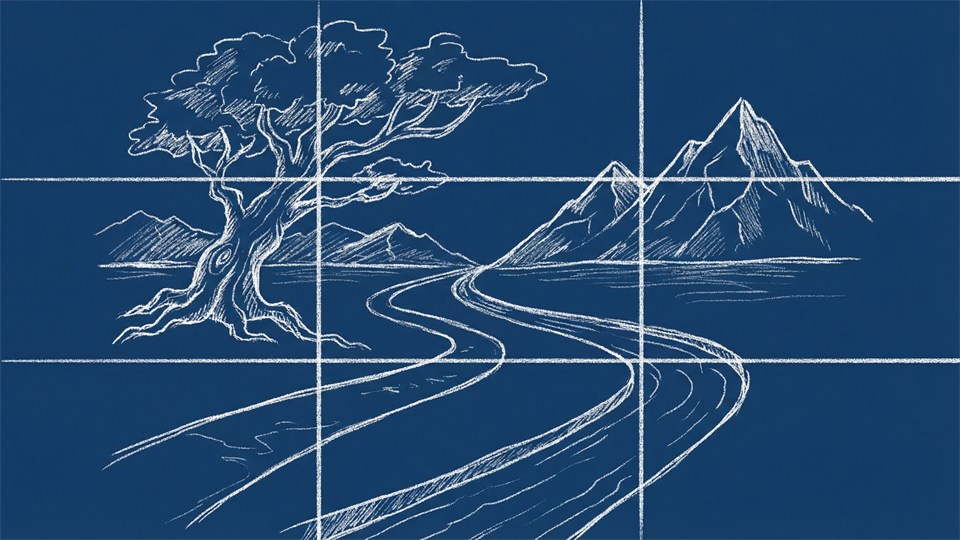


A good photograph rarely starts with coincidences. Whether you are shooting with a mobile phone, compact camera, or DSLR, the composition – that is, how the elements are placed in the image – is crucial for whether the picture is perceived as harmonious, exciting, or messy. Fortunately, there are a number of classic techniques that can help you along the way. In this article, we dive especially into the rule of thirds, but also give you several other simple tools you can use right away when taking pictures.
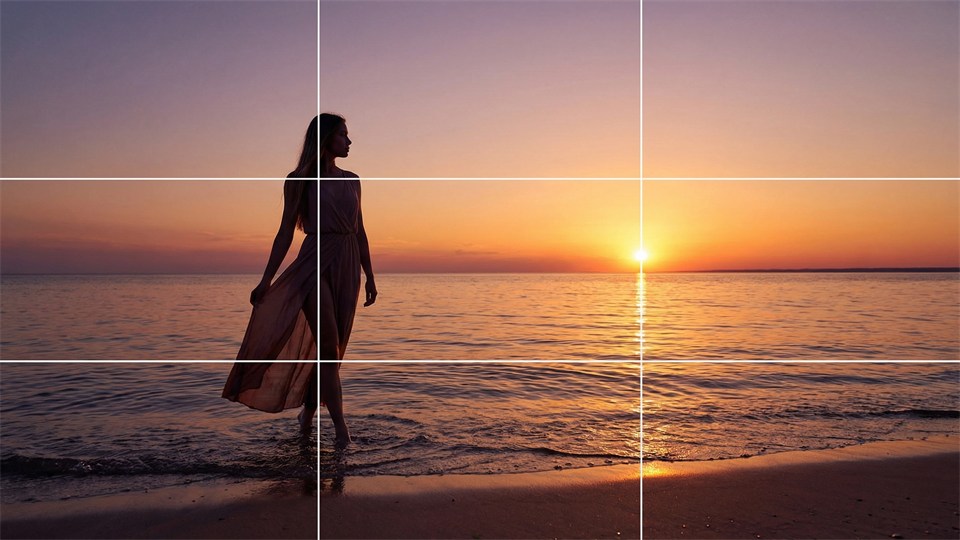
Composition is about how you arrange subjects, lines, and shapes in your image. It can be compared to arranging furniture in a room – a well-chosen placement can make all the difference. The purpose of good composition is to guide the viewer's eye, create balance, and support the expression you want. Regardless of the subject, conscious composition choices can significantly elevate the image, making it appear more professional and inviting.
The rule of thirds is the most well-known and widely used composition technique in photography. It is easy to understand and can be used by everyone – both beginners and experienced photographers. The idea is that the image is divided into nine equal parts using two vertical and two horizontal lines. It looks like a grid, where the lines divide the image into thirds both horizontally and vertically.
When you use the rule of thirds, you place the most important elements in the image – for example, a face, a flower, or the horizon – along these lines or at the points where the lines intersect. This often creates a more interesting and balanced composition than placing the subject in the center of the image.
If you are photographing a landscape, you can place the horizon along the top or bottom third line. If the sky is interesting, you can let it fill the top two thirds. If the foreground is interesting, you can let it fill more. In this way, you avoid the "boring" center image and instead create a picture that guides the eye and appears more dynamic.
For portraits, you can place the eyes at the top intersection point, so the face is not centered but has space around it. This makes the image more lively and natural.
Although the rule of thirds is effective, it is only one approach. Here are several classic techniques that can give your images extra strength:
Leading lines are lines that naturally guide the viewer's eye into the image or towards the main subject. It can be roads, paths, railings, rivers, or shadows. When you use leading lines, you can create depth and make the image more interesting. Try to position yourself so that a road, a railing, or an edge "points" towards the most important thing in the image.
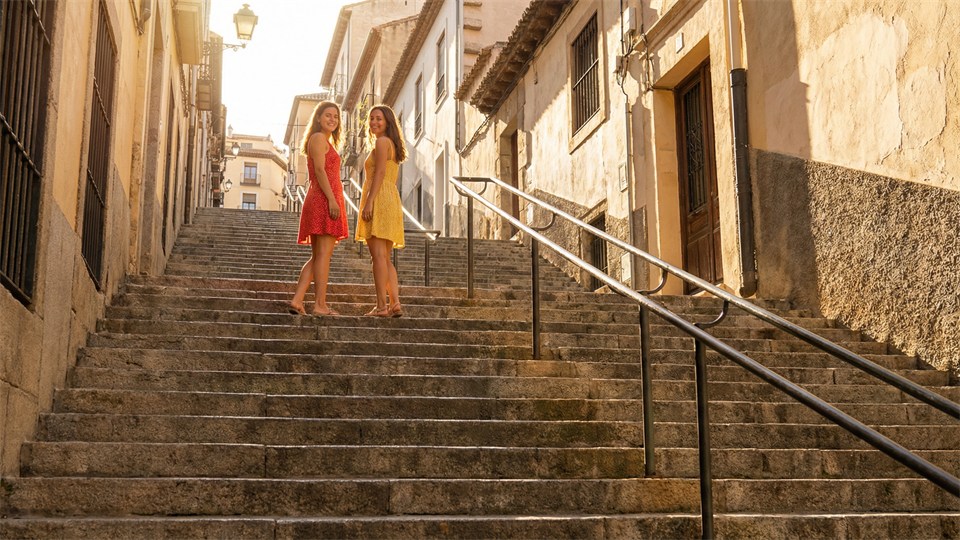
An image often appears more harmonious if the weight of the different elements balances each other. If you have a dominant object on the left, you can place a smaller or weaker element on the right to create balance. It can be a tree, a person, or a building. The balance does not have to be mathematical – it just needs to feel right.
A classic technique is to use natural frames, such as doorways, windows, branches, or arches, to frame the subject. It adds depth and guides the eye to what you want to focus on. Frames also create a sense of looking into a scene or a moment.
Sometimes you can deliberately break the rule of thirds and instead go for symmetry. Buildings, bridges, reflections in water, or repeating patterns can give a strong graphic expression. Symmetry often creates calm, while deliberate asymmetry or broken patterns can create tension.
If your subject is looking or moving in a certain direction, leave space in front of the subject in the image. This gives a sense of space and direction. If an animal or person is looking to the left, let there be more space on that side – it feels more natural and dynamic.
Most cameras and mobile phones have a function where you can activate a grid on the screen that shows the rule of thirds lines. Use it actively when composing the image. Move around, try different angles, and experiment with placing the subjects in different parts of the frame. Also try to look for natural frames or leading lines in your surroundings – it can be surprising how often they occur.
Most important: Rules are made to be broken. Once you have learned the techniques, you can consciously choose to do something different to create a particular expression. That is exactly what separates the snapshot from the well-thought-out image.
Imagine you want to take a picture of a cyclist on a road. Instead of placing the cyclist in the center of the image, you can use the rule of thirds and place the cyclist in the left third, so there is more space in front of the cyclist in the direction of movement. If the road at the same time forms a leading line that points into the image, it will create a sense of speed and direction. As seen in the image below, sometimes you have to compromise to make everything fit.

In the same way, if you take a portrait by a window, you can let the window frame act as a natural frame around the subject and place the face at one of the rule of thirds intersections.
You can also improve composition in photo editing. Most programs have cropping tools, where you can adjust the frame of the image so that the main subject lands on or near the rule of thirds lines. It is a simple way to save an image where you did not compose quite right at the moment of shooting.
Mastering composition is one of the fastest ways to take better pictures – regardless of the camera's price or quality. Start with the rule of thirds, and expand with techniques like leading lines, frames, and balancing. Remember, composition is not about rules for the sake of rules, but about supporting your message and making your images more visually appealing. Practice, experiment, and have fun – and your images will quickly rise to a new level.