



In this article, we provide an overview of the most commonly used defensive formations in handball. Formations are chosen based on the team's strengths, the opponent's attack types, and the course of the match. Some defenses are more compact, while others are offensive and focus on winning the ball.
The 6-0 defense is the most common and basic defensive formation in handball. All six defenders stand close to their own goal – in a semicircle along the line. This makes the formation easier to learn and less demanding physically and tactically.
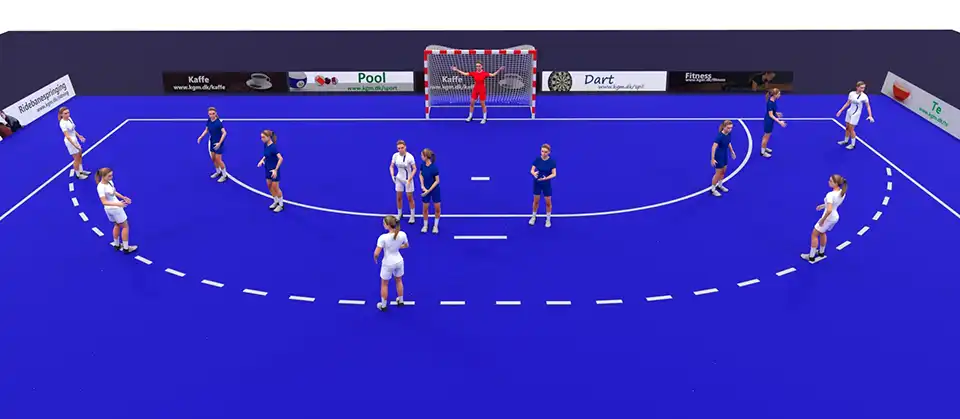
The two outermost players (1s) cover the opponent's wings. The 2s take care of the backs, and the 3s stand centrally and are responsible for the line player and the playmaker.
The 6-0 defense forces the opponent to take long shots. Therefore, it is important that especially the 2s can step forward against strong shooters. This is called "attacking 2s." As soon as the danger is over, they must quickly fall back to close the gaps again. They must also be aware of runs and screens, which are often used to break up this defense.
The advantage of 6-0 is also that the players are better positioned to start counterattacks. The wings have fewer defensive duties and can quickly run forward.
In the 5-1 formation, one of the central defenders is pulled forward on the court – typically a 3. The advanced player is tasked with putting pressure on the playmaker and preventing the opponent's build-up play.
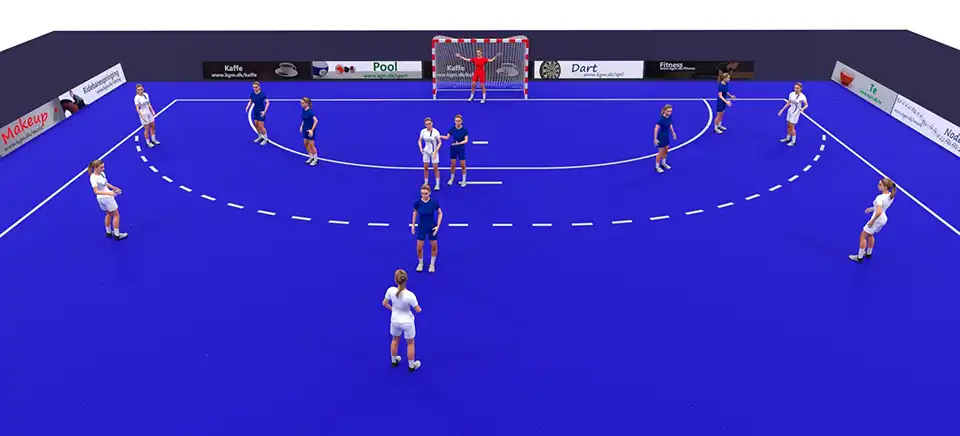
The remaining 3 now covers the line player and must be able to support both the right and left side. The 2s therefore get less support and are more often left alone against strong backs. This places greater demands on their individual defensive play.
5-1 is often used against teams with a clear playmaker that you want to isolate. However, the formation requires great communication and willingness to run – especially from the advanced player.
3-2-1 is a very offensive and complex formation, where three players cover close to the line, two are positioned further forward, and one is all the way forward as the “hunter.” It requires great game understanding and synchronized movement.
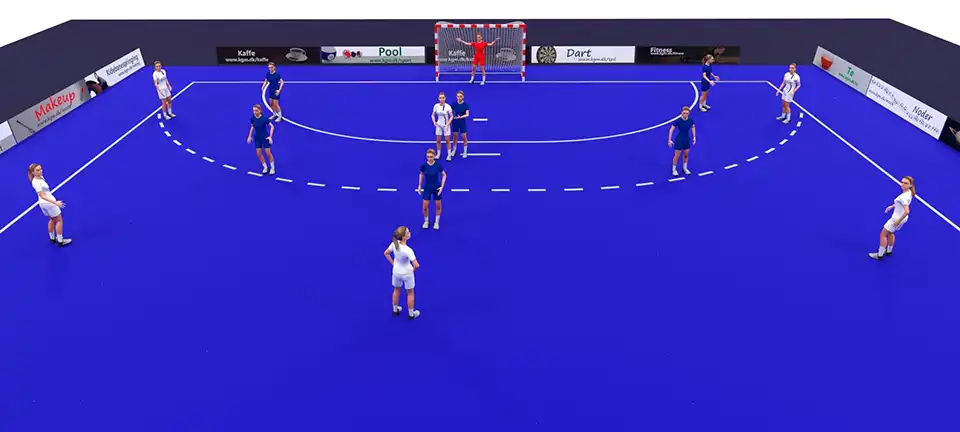
The purpose of the formation is to break the opponent's rhythm early and stress the ball carrier. It is effective against inexperienced attacks or teams without clear structure – but if the formation is broken, large spaces appear behind the defense.
3-2-1 requires excellent timing, physical surplus, and the ability to read the game. It is used especially by youth teams and in sequences – rarely throughout entire matches at the highest senior level.
In the 4-2 formation, four players stand close to the line, while two are pulled forward – typically to mark the opponent's backs man-to-man. It is often used as a special tool against teams with two very strong-shooting back players.
The disadvantage is that you open up space for the line player and require great mobility from the four remaining players, who must cover a wide area.
5+1 is similar to 5-1, but instead of pressing broadly, one specific player is closely marked – typically the playmaker or the team's biggest star. The advanced player thus follows one particular player all over the court.
The goal is to remove the opponent's most important playmaker from the game and force the other players to find alternative solutions. The disadvantage is that the rest of the team must cover a larger area, and more 2-on-2 situations may arise.
The choice of defensive formation depends on:
Many teams today master several formations and switch between them during the match – either systematically or as a reaction to the opponent.
Defensive formations are fundamental in handball and play a decisive role in both structure and match outcome. Whether you choose the compact 6-0 or the risky 3-2-1, it is about playing to your strengths and the opponent's weaknesses.
A strong defense starts with a well-functioning formation – and the ability to adapt.