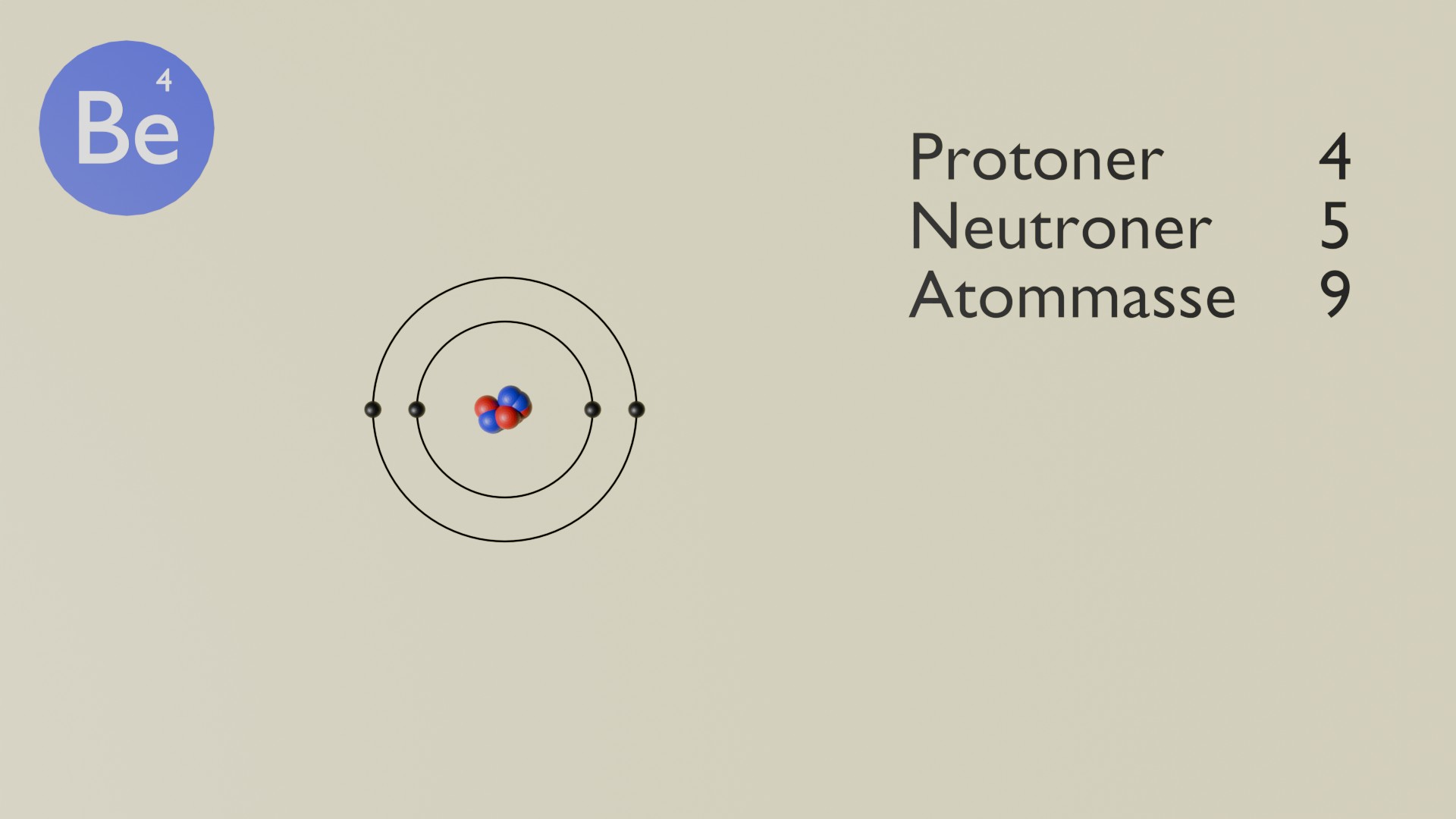
Beryllium (Be) is a chemical element with atomic number 4. It belongs to group 2 in the periodic table and is an alkaline earth metal. Beryllium is a hard, gray metal with a low density and high melting point.
1. Introduction to beryllium
Beryllium has 4 protons, usually 5 neutrons, and 4 electrons. It does not occur freely in nature, but is found in minerals such as beryl and bertrandite. Due to its low weight and great strength, it is used in high-performance industrial materials.
2. Physical and chemical properties
Beryllium is a very light and rigid metal with a silvery-gray color. It has a high melting point (1,287 °C), low density, and is not magnetic. Beryllium has excellent thermal conductivity and reflects X-rays.
It does not react with water at room temperature and quickly forms an oxide layer, which protects it from further corrosion. Beryllium ions (Be²⁺) are small and highly charged, giving the compounds special chemical properties.
3. Isotopes of beryllium
Naturally occurring beryllium consists almost exclusively of one stable isotope:
- Beryllium-9 (⁹Be): 4 protons and 5 neutrons (100 % natural abundance)
Beryllium-10 (¹⁰Be) is a radioactive isotope that is formed in the atmosphere by cosmic radiation and is used in geological dating.
4. Industrial applications
Beryllium is used in a range of high-tech applications, especially where low weight and high strength are important:
| Application | Description |
| Aerospace | Light and strong metal for structures and components in aviation and satellites. |
| Nuclear physics | Used as a moderator or reflector in certain nuclear reactors and as target material for neutron sources. |
| Electronics | Beryllium-copper alloys are used in contacts and springs due to high electrical conductivity and strength. |
5. Safety and occurrence
Beryllium is found in small amounts in the Earth's crust, but its extraction and processing require great care.
Inhalation of beryllium dust can lead to a serious lung disease called berylliosis. For this reason, there are strict safety measures in industry. Beryllium is not known to be important for biological functions in humans.