

In football, a formation is not just a lineup on paper – it is a tactical structure that influences the entire course of the game. Throughout history, different formations such as 4-4-2, 4-3-3, and 3-5-2 have been dominant, and in modern football, systems are constantly adapted depending on the squad, opponents, and match situation.
This article reviews the most commonly used football formations, their advantages and disadvantages, and how they are used in practice.
A football formation is a numerical description of how the players are organized on the pitch – typically indicated by three numbers (e.g. 4-4-2). The first number refers to the number of defenders, the next to midfielders, and the last to attackers. The goalkeeper is not included in the notation.
Formations affect both the offensive and defensive approach and determine how the team structures pressing, possession, and transitions.
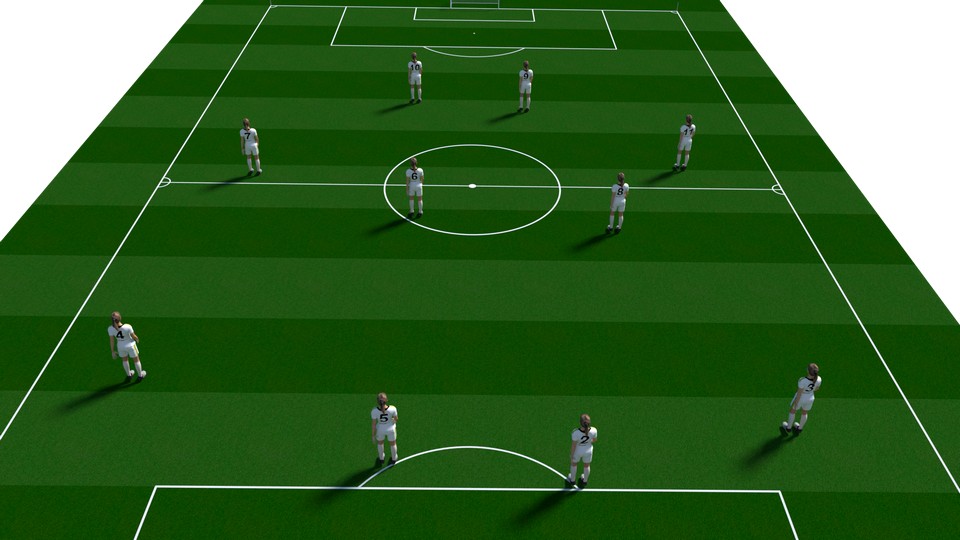
Illustration: Overview of typical formations and their positions on the pitch.
4-4-2 is one of the most used formations in football history and became especially popular in the 1980s and 1990s. It consists of four defenders, four midfielders, and two attackers.
The strength of the formation lies in its discipline and organization. Teams like England in the 90s and Atletico Madrid under Diego Simeone have had success with variants of 4-4-2.
4-3-3 has been the standard in modern possession-based football. It is often used by teams that want to dominate with the ball and control the midfield. The system consists of four defenders, three midfielders, and three attackers (typically two wingers and a central striker).
FC Barcelona and the Spanish national team have used 4-3-3 with great success, especially under Pep Guardiola and Vicente del Bosque.
4-2-3-1 has been the most popular formation in both club and international football over the past two decades. It combines two defensive midfielders with three attacking midfielders and a lone striker.
Teams like Germany in 2014 and Real Madrid under José Mourinho used the formation effectively. It works for both counter-attacking and possession-based play.
3-5-2 is a formation with three central defenders, two wingbacks, three midfielders, and two attackers. It is often used by teams that want to defend solidly and exploit the flanks aggressively.
Antonio Conte and Thomas Tuchel have used 3-5-2 and 3-4-3 with great success, including at Chelsea, Juventus, and Inter.
4-1-4-1 is a formation where one defensive midfielder sits in front of the defensive line, and two central midfielders are positioned ahead of him, with two wingers and one striker up front.
The system is often used by teams that want good balance and structured pressing play – typically with a dedicated “number 6” as a stopper and distributor.
A modern 3-4-3 consists of three central defenders, two wide wingbacks, two central midfielders, and three attackers – typically two wingers and a false 9 or classic striker.
The system was used with great success by, among others, Chelsea under Tuchel and Barcelona under Cruyff. It requires high intensity and tactical discipline.
The choice of formation depends on several factors:
Formations are the tactical language of football. They are not static, but change during a match. 4-4-2, 4-3-3, and 4-2-3-1 are just starting points – it is movement, interplay, and understanding of roles that determine whether a system succeeds.
In modern football, we see more flexibility than ever. Coaches choose formations with precision, and players must be able to adapt to changing roles. Understanding the structure and function of formations provides insight into the depth of the game – for fans, players, and analysts alike.
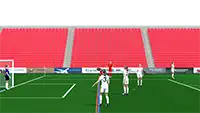
Photo: Different phases in a match – formations continuously shift between offensive and defensive structure.