Golf
Quickguide artikler omkring golf og de mange regler
Playing from the Bunker
Bunker shots: technique, rules, penalties, and drops
sportGolf
Bunkers are not just sand traps – they are an integral part of course design, testing both technique and decision-making.
Below you’ll find a practical guide to greenside‑ and fairway bunkers: basic technique, what you can/can’t do according to the rules, how to take relief (drop), and typical penalty situations. At the end, you’ll get a checklist and small diagrams to make it easy to remember.
Types of bunkers
Greenside bunkers are located close to the green and often require a soft “splash” with a sand wedge. Fairway bunkers are further away and are played more like a regular shot – but with a focus on striking the ball first.
Basic technique in greenside bunker
In greenside bunkers, you as the player will strike the ball with an open clubface and hit the sand behind the ball.
Tips
Open clubface: Choose sand wedge/lob wedge and open the face slightly (more bounce).
Stance and weight: Stand a bit wide, weight 60–70% on the front foot, knees slightly bent.
Ball position: One ball diameter forward of center (helps you hit the sand first).
Movement: Raise hands slightly, swing relatively steeply and aim 2–4 cm behind the ball.
Acceleration: Keep speed through the sand – it’s the sand that lifts the ball (not a “nip”).
Finish: Continue through the sand to a controlled finish; practice distance control via swing length, not by “braking”.
Variant shots: wet, deep, and difficult lies
When the ball is lying deep, or the sand is wet, you as the player should avoid taking too much sand before the ball.
Tips
Wet/hard sand base: Less bounce (close the clubface a bit), aim closer behind the ball (1–2 cm), more compression.
“Fried egg” (embedded ball): Steeper descent, less opening of the face; hit more sand behind the ball to “pop” it out.
High lip: More loft (lob wedge), greater opening and more power; accept shorter distance.
Side slope: Adjust stance to the slope; maintain balance and follow the slope’s direction with your swing.
Long greenside bunker: Less opening, more swing length; alternatively choose gap/pitch wedge for more roll.
Fairway bunker: played like from the fairway – with a twist
From a fairway bunker, the goal is to strike the ball first and take minimal sand.
Tips
Choose a safer club (more loft) – avoid hitting the lip.
Stable lower body: Less weight shift; think “arms/upper body” to ensure clean contact.
Ball position: Slightly ahead of center; focus on clean contact.
Game management: Often it’s wiser to play safely out to the fairway than to go for the green.
Rules in bunker – what you can and can’t do
The rules (modernized in recent years) are more permissive than before, but there are still important restrictions:
You may
Remove loose natural objects (leaves, twigs, stones) in the bunker. If the ball moves, it’s one penalty stroke and the ball must be replaced.
Touch the sand with club or hand accidentally (e.g., lightly supporting yourself)
You may not:
Test the condition of the sand by deliberately touching it.
Touch the sand immediately in front of or behind the ball.
Touch the sand with the club during practice swing, so that sand is moved.
Touch the sand in the backswing/downswing (before the shot hits the sand).
General penalty
For most rule breaches in bunker: two strokes in stroke play or loss of hole in match play.
Unplayable in bunker – drop options and penalty
If the ball is unplayable in the bunker (e.g., close to the edge or buried), you choose to declare it unplayable yourself.
In bunker:
Two club lengths (1 penalty stroke): Drop within 2 club lengths from the ball’s position (not closer to the hole).
Back on the line (1 penalty stroke): Drop on the line backwards in the bunker with the hole and the ball’s point on a straight line.
Outside bunker:
Back on the line (2 penalty strokes): Drop outside the bunker backwards on the line (new option in the modern rules) – costs 2 strokes.
Free relief (GUR, temporary water in bunker) – how to do it
If the ball is affected by abnormal course condition in the bunker (e.g., GUR, drainage grate, water in bunker), the following applies:
in the bunker
Free relief. Find the nearest point without interference in the bunker and drop within 1 club length (not closer to the hole).
Outside the bunker (Optional)
1 penalty stroke. Back on the line with the hole – useful with a lot of water or impossible lie.
Etiquette: entry/exit, raking and safety
Etiquette is important when playing bunker shots, as poor etiquette can have a direct impact for the next players who play from the bunker.
Tips
Entry/exit: Choose the lowest edge to protect the bunker.
Rake after yourself: Smooth the sand, remove footprints/shot marks; place the rake where the club wants (often outside the bunker).
Safety: Wait until the area is clear; watch out for sand spray.
Pace: Prepare club/line while others are hitting (without disturbing).
Checklist and quick reminders
Greenside: open face, weight forward, hit sand 2–4 cm behind the ball, accelerate.
Fairway: hit the ball first, steady lower body, correct club choice for the lip.
In the bunker: remove loose items with care; don’t touch sand to test; no practice swings that move sand.
Unplayable: 1 stroke (in bunker) – 2 club lengths or back-on-line; 2 strokes for back-on-line outside the bunker.
Free relief (GUR/water): in bunker free; outside bunker for 1 stroke.




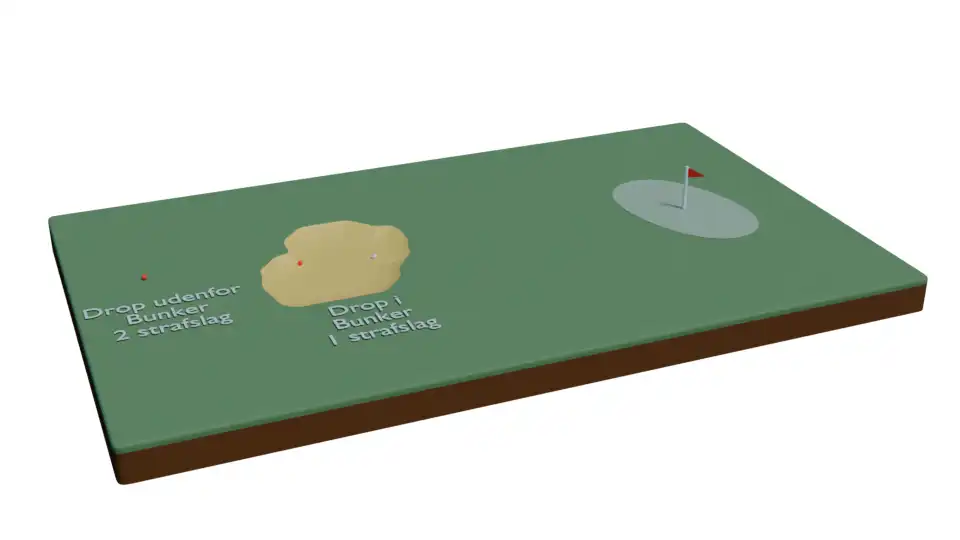 In bunker:
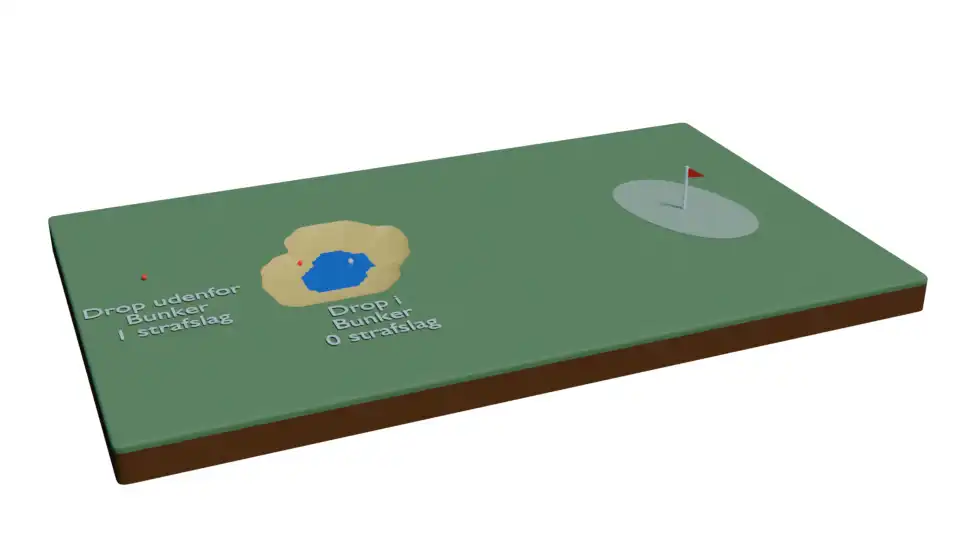 in the bunker
Free relief. Find the nearest point without interference in the bunker and drop within 1 club length (not closer to the hole).
Outside the bunker (Optional)
1 penalty stroke. Back on the line with the hole – useful with a lot of water or impossible lie.
in the bunker
Free relief. Find the nearest point without interference in the bunker and drop within 1 club length (not closer to the hole).
Outside the bunker (Optional)
1 penalty stroke. Back on the line with the hole – useful with a lot of water or impossible lie.