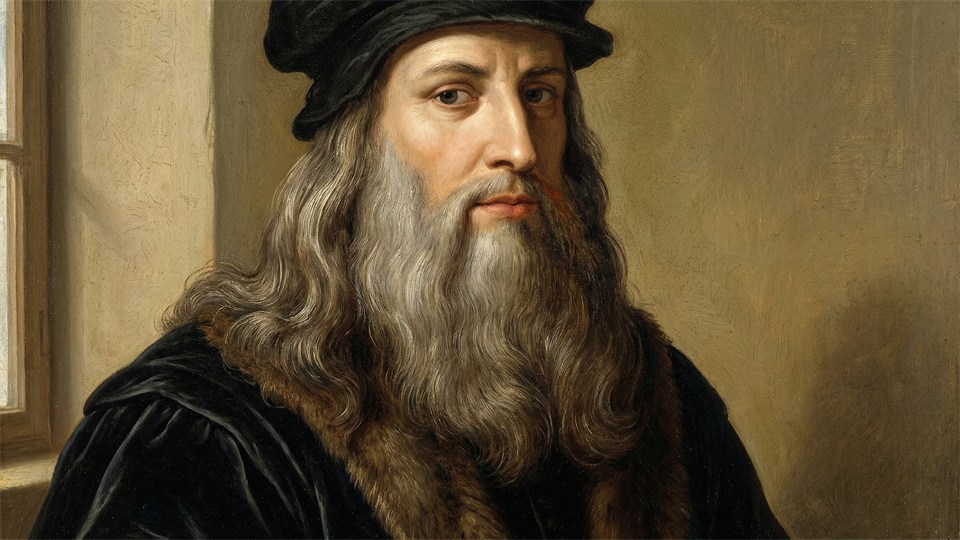


Leonardo da Vinci (1452-1519) is one of the most well-known names in world history. He was not only a brilliant artist, but also a visionary scientist, engineer, inventor, and thinker. His curiosity and ability to combine art and science have made him a role model for both creative and analytical people. In this article, we take a closer look at Leonardo's life and examine how his work has influenced both modern art and science.
Leonardo was born in Vinci, a small town in Italy, as the son of a notary and a peasant girl. From an early age, he showed great interest in nature, drawing, and mechanics. His talents were quickly discovered, and as a teenager, he became an apprentice to the famous Florentine artist Andrea del Verrocchio. Here, Leonardo learned not only painting, but also sculpture, mechanics, and mathematics – the foundations for his lifelong interdisciplinary approach to knowledge.
Leonardo is often called the classic Renaissance man because he excelled in so many different disciplines. He worked as a painter, sculptor, architect, engineer, anatomist, and inventor. His notebooks, containing thousands of sketches and thoughts, reveal his tireless curiosity and desire to understand the connections of the world.
Leonardo revolutionized painting in several ways. He developed techniques such as sfumato, where soft transitions between light and shadow create more realistic and lifelike portraits. This is clearly seen in his most famous work, Mona Lisa, where the subtle nuances of the face and the enigmatic smile still fascinate people around the world. His use of perspective and anatomy set new standards for realism in art, inspiring both contemporaries and later artists.
Leonardo's methods have formed the basis for modern portrait art and painting. Artists such as Rembrandt and Caravaggio were inspired by his studies of light and anatomy. Today, we see Leonardo's techniques used in everything from classical paintings to digital artwork, where artists use 3D renderings and advanced shading techniques to achieve depth and realism. His work with composition and emotional expression has also influenced photographers and filmmakers.
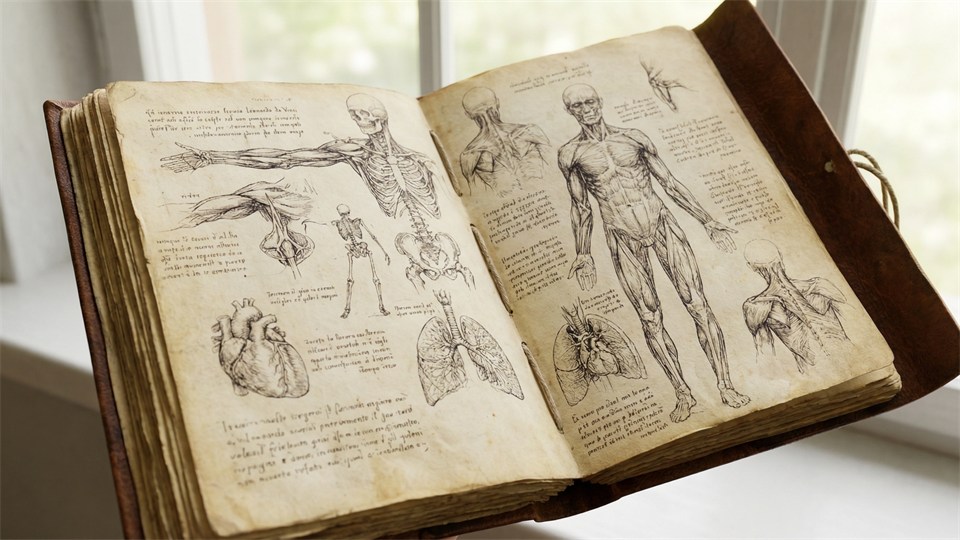
Leonardo spent countless hours studying and dissecting human and animal bodies. His detailed sketches of muscles, bones, and organs are still admired for their precision. These drawings provided a new understanding of the body's structure and function, which was far ahead of its time. For example, Leonardo described how the heart pumps blood, which was not scientifically proven until several hundred years later.
Leonardo designed machines that were only realized centuries later. He drew early versions of flying machines, parachutes, tanks, bicycles, and machines for lifting water. Many of his inventions were never built in his own time, but his ideas have inspired modern engineers and inventors. For example, the basic principles of the helicopter are based on Leonardo's famous sketch of an "aerial screw" – a spiral-shaped machine that was intended to lift itself from the ground.
Leonardo's notebooks are a treasure trove of scientific observations, mathematical calculations, and technical drawings. Here you can find everything from studies of water currents to plans for building constructions. His practice of combining text and image in his notes has set a standard for modern scientific documentation. Many researchers today still use sketches and visualizations as an important tool to explain complex ideas.
Leonardo insisted that one could not understand the world without observing it directly. He believed in empiricism – that knowledge should be based on experience and observation rather than tradition or theory alone. He connected this viewpoint with both art and science. When he painted, he used his scientific studies to make the subjects more lifelike. When he conducted scientific studies, he used his artistic sense to visualize and explain complex connections.
A classic example is Leonardo's famous drawing of The Vitruvian Man, where he combines mathematics, proportions, anatomy, and aesthetics in a single illustration. The drawing shows how the proportions of the human body can be described mathematically, and how art can be used to express scientific knowledge in an understandable way. This interdisciplinary approach is today the basis for many modern professions, where design and technology merge – for example in architecture, industrial design, and medical visualization.
Today, Leonardo da Vinci is used as a role model in the education system, where interdisciplinary thinking is encouraged. His method of combining artistic creativity and scientific curiosity is the cornerstone of STEAM education (Science, Technology, Engineering, Arts, Mathematics). Many universities encourage students to think across disciplines and use both analytical and creative skills in problem-solving.
Leonardo's name and works appear in everything from films and books to computer games and advertisements. His life has inspired novels, films, and TV series, where he is often portrayed as a genius who solves mysteries or invents fantastic machines. His iconic works such as Mona Lisa and The Last Supper are among the most recognizable images in the world and serve as cultural symbols for both artistic and intellectual creativity.
Some of the technologies we take for granted today can be traced back to Leonardo's drawings and ideas. For example, his studies of flying machines have inspired the development of helicopters and drones. His investigations of the human body have influenced modern medical imaging and anatomy teaching. Even his visions of automated machines can be found in today's robotics technology.
Leonardo da Vinci was more than just a great painter – he was a person who lived to explore, understand, and communicate the mysteries of the world. His ability to unite art and science has left lasting marks across generations. Today, his working methods and way of thinking are still used as inspiration for innovation, creativity, and learning. Leonardo reminds us of the value of curiosity, interdisciplinarity, and persistent wonder – qualities that continue to shape both art and science in the 21st century.