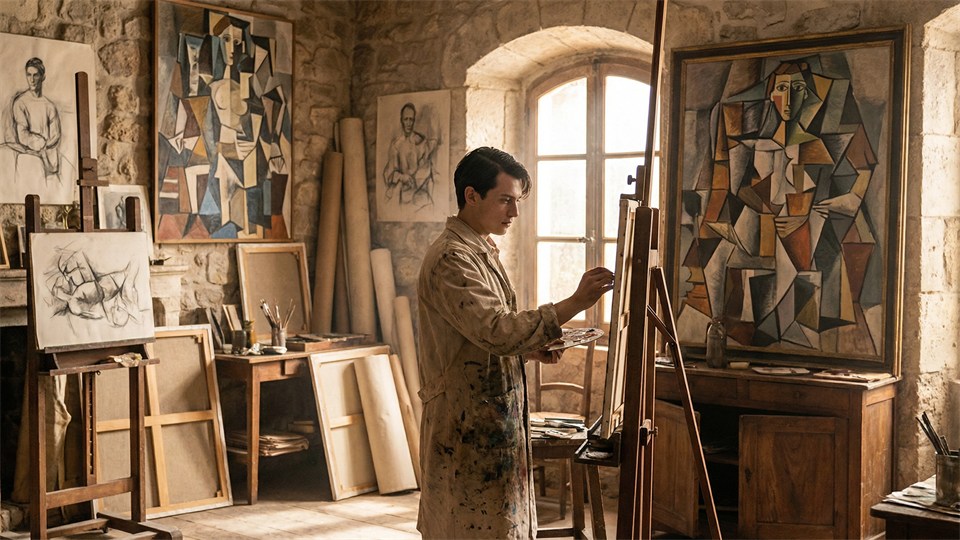


Pablo Picasso is considered one of the most influential artists of the 20th century. His work, especially within Cubism, left a significant mark on the development of modern art. Cubism was not just an art movement, but a revolution in the way we perceive and represent reality. This article explores Picasso's role as a pioneer of Cubism and takes a closer look at how this movement changed the landscape of art forever.
Pablo Picasso was born in Málaga, Spain, in 1881. From an early age, he showed extraordinary talent for drawing and painting. His father, who was himself an artist and art teacher, encouraged him to explore art. As a teenager, Picasso moved to Barcelona and later Paris, where he quickly became part of artistic circles and began experimenting with different styles.
Picasso's early works are known for his Blue and Rose periods, where he explored themes such as sorrow, poverty, and love through melancholic or warm colors. But it was only when he began to challenge the traditional ways of representing reality that he truly paved the way for modern painting. This culminated in the development of Cubism—a style that radically deviated from anything seen before.
Cubism is an art movement that emerged around 1907-1914. Instead of showing the world as it appears from one viewpoint, Cubism sought to show several angles and dimensions at once. With Cubism, artists began to break down forms into geometric shapes such as cubes, cylinders, and spheres. Perspective was dissolved, and the subject was often seen from several sides simultaneously. This gave the image a flat, almost abstract character, but also made it possible to show complex relationships on a single canvas.
Picasso developed Cubism in close collaboration with the French painter Georges Braque. Together, they challenged the classical perception of space and form and experimented with both painting and collage. Their dialogue was so intense that it is often difficult to distinguish between their works from this period. The two artists shared ideas and techniques, and their work was quickly noticed in artistic circles in Paris.
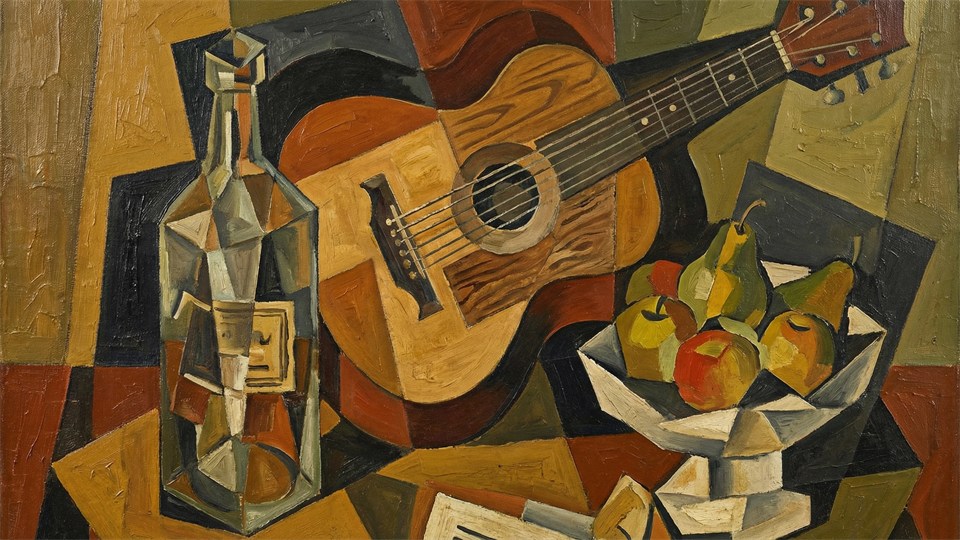
The most important characteristic of Cubism is fragmentation. The forms of the subjects are dissolved into smaller parts, which are assembled into a new whole. This can be seen, for example, in Picasso's famous work "Les Demoiselles d’Avignon" (1907), where the women are painted with angular, almost masked faces and bodies. The painting shocked at the time and became a turning point for modern art because it broke with prevailing ideals of beauty and perspectives.
Cubism is often divided into two main phases: analytical and synthetic. In the analytical phase (ca. 1908-1912), the subjects were almost dissolved into small, overlapping planes and the colors kept in subdued tones. In the synthetic phase (ca. 1912-1914), artists began to reconstruct forms and use stronger colors, collage, and new materials. Picasso was one of the first to use newspaper, wallpaper, and other everyday materials in his works, which opened up a completely new approach to art.
Before Cubism, art was largely bound to the ideal of depicting the world as realistically as possible. Cubism turned this upside down: Now it was the artist's gaze and interpretation of reality that became central. Perspective, proportions, and recognizability became secondary to composition and expression. This inspired future generations of artists to experiment with both form, material, and meaning.
Cubism influenced not only painting, but also sculpture and architecture. Sculptors such as Alexander Archipenko and Jacques Lipchitz began working with cubist forms in three dimensions. Architects were inspired by the movement's geometric principles, which can be seen in many modernist buildings from the 20th century. Even within design and fashion, Cubism had an impact, where patterns, shapes, and materials were used in new, surprising ways.
Cubism was the starting point for a long series of new art movements in the 20th century. Futurism, Constructivism, Dadaism, and abstract art are all directly or indirectly inspired by the ideas of Cubism. Artists such as Fernand Léger, Juan Gris, and later surrealists like Salvador Dalí and Joan Miró also drew on cubist elements in their work. Cubism simply opened the doors for art no longer having to represent something specific, but instead being able to challenge and engage the viewer in new ways.
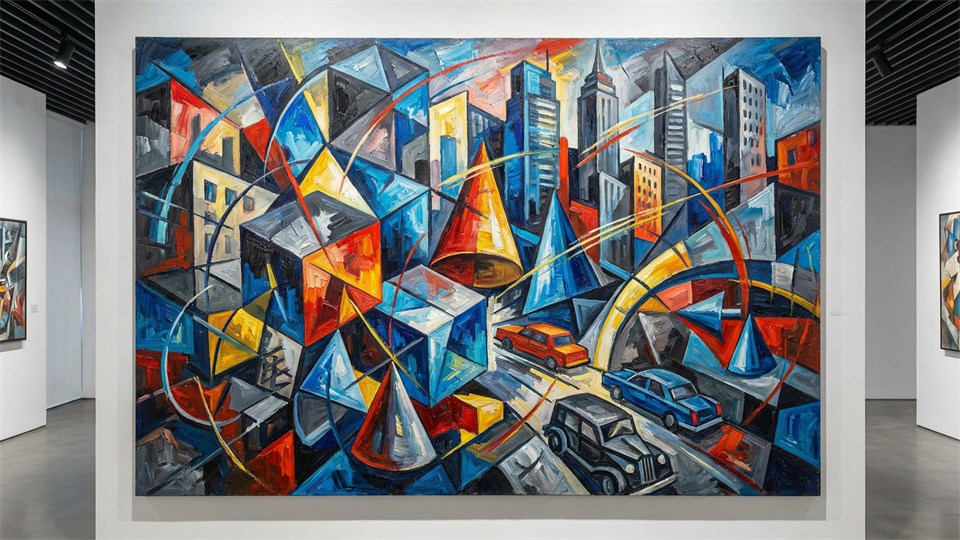
One of the most important legacies of Cubism is the idea that art does not have to imitate reality. The artist has the freedom to interpret, manipulate, and experiment. At the same time, Cubism demands more from the viewer: One must be active and piece the subject together in one's mind, understand connections, and perhaps even allow oneself to be confused. This approach has influenced the entire modern understanding of art, where the dialogue between the work and the audience has become central.
Today, the influence of Cubism can be seen everywhere, from modern art museums to advertising graphics and digital design. Many contemporary artists continue to explore geometric shapes, multiple perspectives, and experimental materials, just as Picasso and his contemporaries did over 100 years ago. Cubism also has an educational significance, as it teaches us that there is not only one way to see or understand the world.
Pablo Picasso continued to reinvent himself throughout his life. He worked with everything from ceramics and sculpture to theater and graphics. His ability to break rules and create new things inspired not only artists, but also society at large—from philosophers and architects to designers and filmmakers. Picasso became a symbol of the creative freedom that characterizes 20th-century art.
Even today, many years after his death in 1973, Picasso's works are discussed and exhibited around the world. His influence is felt both in the professional art world and by anyone who has seen a cubist painting or been inspired by new ways of seeing. The legacy of Picasso and Cubism is that art never stands still—it is always evolving, always moving towards new forms and expressions.
Pablo Picasso and Cubism marked a decisive breakthrough in 20th-century art. By challenging traditional imagery and making room for multiple perspectives, they were groundbreaking for the development of modernism. Cubism taught us that the world cannot be seen in only one way, and that the role of art is also to ask questions and open our eyes to new possibilities. That is why Picasso and Cubism still stand as milestones in art history—and as inspiration for future generations of artists and art lovers.