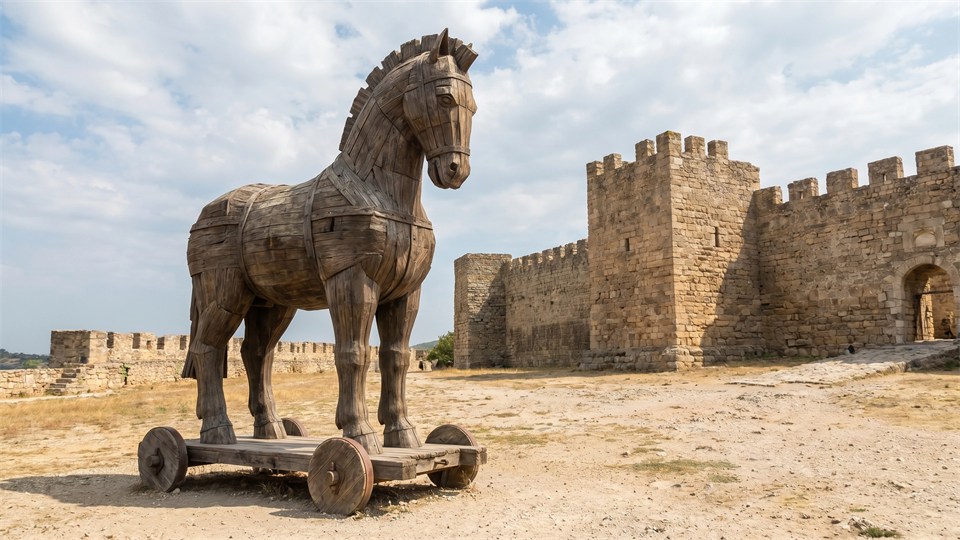


The Trojan horse is one of the most famous stories from the ancient world. Even people who have never read Greek myths often know the image: a large wooden horse brought inside the walls of Troy, after which hidden warriors emerge and open the city to the enemy. The story is dramatic, easy to remember, and full of suspense, but it is also more than just a tale of war. The Trojan horse has become a powerful symbol of cunning, deception, and the danger of accepting something that appears harmless. That is why the myth lives on far beyond ancient literature and appears in everything from paintings and sculptures to modern language and digital culture.
For beginners, the story may seem simple: the Greeks wanted to capture Troy and used a clever plan. But behind the short version lies a rich cultural history. The myth is connected to the larger story of the Trojan War, to Greek heroic poetry, and to the interpretations of later artists. At the same time, it raises questions about what is truth, what is legend, and why this particular episode has been given such a large place in our shared cultural memory. In this article, we look at the background of the myth, the story itself, its meaning in art and language, and its continued life today.
To understand the Trojan horse, it is useful first to know the setting of the story. The Trojan War is a central part of Greek mythology. According to tradition, the war began when the Trojan prince Paris abducted or seduced Helen, who was married to the Greek king Menelaus. This led a great Greek army to march against the city of Troy to bring her back and punish the Trojans. The war is said to have lasted ten years, and many of the best-known heroes of Greek mythology took part, including Achilles, Odysseus, Ajax, and Hector.
In the myths, Troy was a rich and powerful city with high walls that were almost impossible to break through. That is exactly why the story of the horse works so well as a dramatic turning point. When strength and courage are not enough, cunning must take over. In the Greek tradition, Odysseus often stands as the clever hero who triumphs not only with weapons, but with words, plans, and psychological insight. The Trojan horse fits this ideal perfectly. The story shows that war in mythology is not only about physical power, but also about the ability to see through others and exploit their weaknesses.
After many years of fighting without a decisive victory, the Greeks are said in the myth to have devised a new strategy. They built an enormous horse of wood, hollow inside, large enough to hide a chosen group of warriors. The horse was presented as an offering or a gift, and the rest of the Greek army pretended to sail away and abandon the siege. In reality, the fleet hid nearby and waited for the right moment. The plan is often attributed to Odysseus, whose reputation as a cunning and patient hero made him the natural originator in later retellings.
The choice of a horse is also interesting. In the ancient world, the horse was associated with strength, nobility, and war, but also with divine symbolism. A great wooden horse could therefore seem both impressive and sacred. That made the deception more believable. The plan relied not only on concealment, but on understanding what the Trojans wanted to believe. If the gift seemed like a sign of victory or the favor of the gods, it became easier to bring it inside. The myth thus shows that deception often works best when it plays on hope, pride, and the desire to end a long conflict.
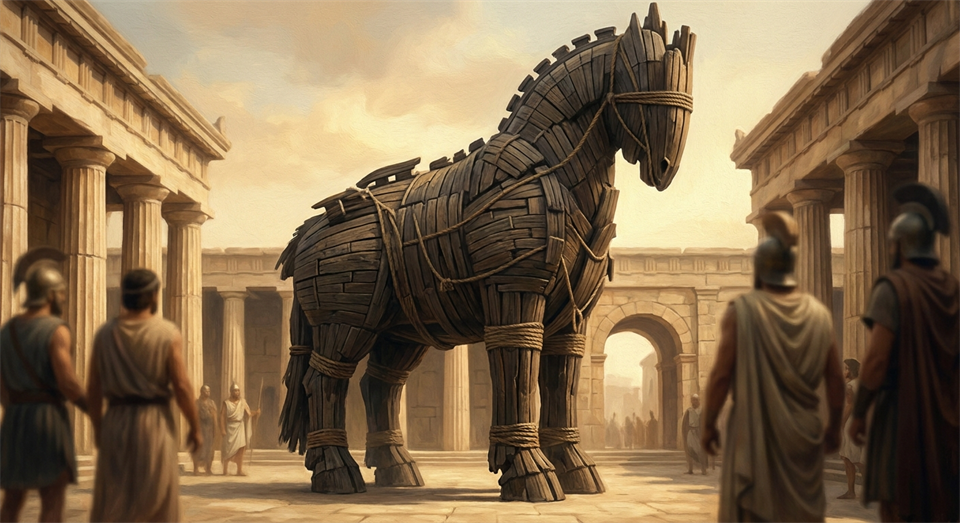
When the Trojans found the horse, disagreement arose according to the classical versions. Some warned against bringing it into the city. The most famous warning comes from the priest Laocoön, who in the Latin tradition is said to have declared that one should fear the Greeks even when they come bearing gifts. The princess Cassandra, who had the ability to see the future but was doomed never to be believed, also warned of disaster. Nevertheless, the Trojans chose to bring the horse inside the walls. These two warnings make the story even stronger, because the downfall is caused not only by the enemy’s cunning, but also by the city’s inability to listen to reasonable voices.
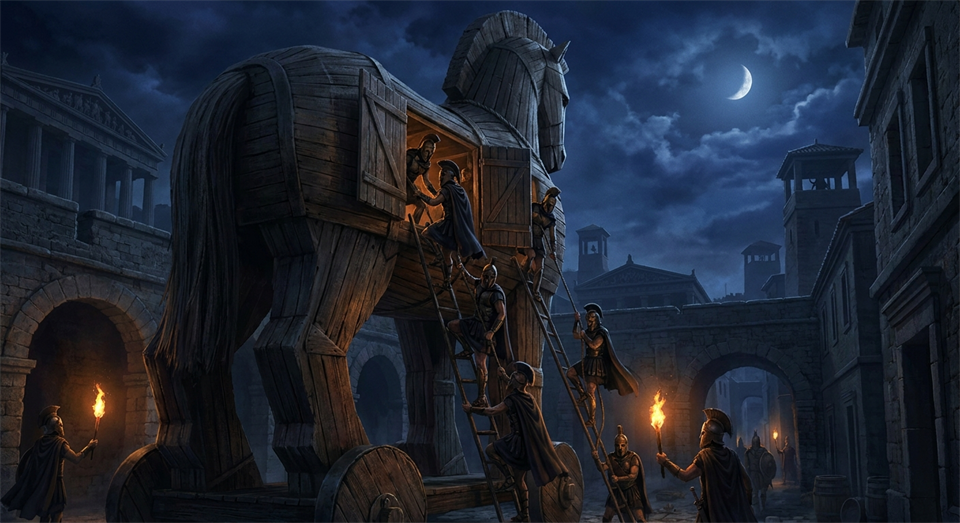
At night, while the city celebrated the apparent victory and the end of the siege, the hidden Greeks came out of the horse. They opened the gates for the Greek army, which had returned under cover of darkness. Troy was taken by surprise, set on fire, and destroyed. In this way, the great and powerful city was not defeated by a frontal assault, but by a gift it had accepted itself. It is precisely this paradox that makes the Trojan horse so memorable. The danger does not come from outside as an obvious attack, but from within, after it has been accepted and welcomed.
Many people believe that the Trojan horse is central in Homer’s Iliad, but in fact it is not described there in detail. The Iliad deals mainly with a short period in the final year of the war and focuses on the conflict between Achilles and Agamemnon. The episode of the horse itself is developed more fully in later texts, especially in Virgil’s Aeneid, where the Trojan hero Aeneas tells of the fall of Troy. Other ancient authors and later retellings have also helped shape the version most people know today. The myth is therefore a good example of how classical stories develop over time and gain new life in different works.
There has also long been discussion about whether a historical core lies behind the myth. Archaeological excavations in the area associated with ancient Troy in present-day Turkey have shown that an important city really did stand there, and that it was destroyed several times throughout history. But that does not mean that a wooden horse necessarily existed exactly as in the myth. Some scholars have suggested that the horse may be a symbol or a poetic reinterpretation, perhaps of a siege engine, an earthquake, or a religious object. Whether the episode was real or not, its cultural significance is far greater than the question of literal truth.
The Trojan horse has become a universal image of hidden danger. When we use the expression today, we usually mean something that looks useful, beautiful, or peaceful, but in reality conceals a threat. It may be in politics, in personal relationships, or in technology. The symbolism is powerful because it is built on a simple human experience: we can be deceived when we let our guard down. That is why the myth is still relevant. It tells not only of war in antiquity, but of trust, naivety, and manipulation in a broader sense.
The myth also contains another important point, namely that victory is not always achieved through brute strength. The Trojan horse shows the double nature of intelligence. Cunning can be admirable because it overcomes the impossible, but it can also seem morally ambiguous because it is based on deception. That is why the story has fascinated artists and thinkers for centuries. Is it an example of brilliant strategy or of dishonest warfare? The answer often depends on whether one sees the story from the Greek or Trojan side. It is precisely that tension that keeps the symbol alive and open to interpretation.
In visual art, the Trojan horse has been a popular motif since antiquity. Artists have often been drawn to the visual drama of the scene: the enormous wooden figure, the city walls, the celebrating Trojans, or the nighttime moment when the warriors emerge. In painting and sculpture, the motif works well because it combines monumental scale with psychological tension. The viewer knows what is about to happen, while the figures in the image often do not. This kind of dramatic irony creates a special intensity that many artists have made use of.
In literature, the Trojan horse has been retold again and again. Some versions emphasize Odysseus as the brilliant strategist, while others place weight on the tragedy of Troy and the ignored warnings of Laocoön and Cassandra. In modern novels, plays, and films, the motif is often used to explore themes such as trust, propaganda, and the fall of civilizations. The story can even be turned around so that the focus is not on heroism, but on the civilian victims and the violence that follows the deception. In this way, the myth shows its strength: it can be adapted to new times without losing its core.
Even today, we encounter the Trojan horse in many contexts. In everyday speech, the expression is used for something that enters a system or a group under false pretenses. It may be an idea, an organization, or a strategy that outwardly seems harmless, but changes something from within. In the digital world, the term has become especially well known through the label “Trojan horse” for malicious software that hides inside an apparently legitimate program. Here the ancient myth fits a modern problem almost surprisingly well, because the mechanism is the same: the danger is invited in.
The story also lives on because it is easy to transfer to new media. Films, TV series, video games, and graphic novels often use the episode as a climax or as inspiration for new stories. It works well because it combines suspense, recognizable symbolism, and a clear image. At the same time, it is morally complex enough to spark debate. Many modern interpretations ask not only whether the plan worked, but what it cost in human terms. In this way, the Trojan horse remains relevant, not only as a tale from the past, but as a mirror for contemporary thoughts about power, war, and deception.
The Trojan horse is far more than a simple myth about a wooden figure and some hidden soldiers. It brings together many of the themes that make classical stories enduringly interesting: war, cunning, pride, warnings, blindness, and downfall. The story has survived for millennia because it is both easy to remember and rich in meaning. It can be read as exciting mythology, as a symbolic narrative, and as a cultural image of hidden danger. That is exactly why it has become firmly embedded in art, literature, and everyday language.
For KGM.DK, the Trojan horse is an obvious subject in art and culture because it shows how an old story can continue to shape our imagination. Whether one encounters it in an ancient poem, a museum, a novel, or in a modern technological context, it points to the same basic insight: what looks most harmless can sometimes be the most dangerous. It is a simple but powerful lesson, and perhaps that is precisely why the Trojan horse still rides through cultural history.