

When you begin to take an interest in palm reading, almost the same question always comes up first: Should you read the right or the left hand? It is a good place to start, because the difference between the hands is one of the best-known parts of palm reading. At the same time, it is also an area where many people encounter confusing answers. Some say that the left hand shows what you were born with, while the right hand shows what you have become. Others reverse it, especially if the person is left-handed. For beginners, the most important point is that both hands are usually seen as meaningful, and that they are often read together to give a more nuanced picture.
Palm reading is used by many as a reflective leisure interest, where you look at the hand’s shapes, lines, and details to think about personality, habits, and direction in life. Whether you fully believe in the tradition or are simply curious, it makes sense to understand why the right and left hand do not necessarily tell exactly the same story. It is precisely the difference between them that makes a reading more interesting and deeper. In this article, we look at the most common interpretations, how you can compare your own hands, and how to avoid the typical beginner misunderstandings.
In many palm reading traditions, people work with the idea that the hands show two sides of the same person. One hand is often associated with inborn traits, potential, temperament, or inner life. The other hand is more often associated with development, choices, experiences, and the way a person uses their abilities in practice. This does not mean that one hand is “right” and the other is “wrong.” On the contrary, it makes the most sense to see them as a pair, where differences and similarities are equally interesting.
If both hands look very similar, it is often interpreted as a sign that the person lives relatively close to their basic temperament. If there are clear differences, it may point to development, change, or a tension between the inner and the outer. For example, a person may have a softer, more sensitive hand type on one hand and a firmer, more purposeful appearance on the other. In palm reading, such differences are not necessarily seen as opposites, but as layers in the personality. That is why it is difficult to get a good overview if you look at only one hand.
A very widespread rule of thumb is that the non-dominant hand is called the passive hand. For right-handed people, this will often be the left hand, and for left-handed people the right hand. In many interpretations, the passive hand is associated with what is inborn: natural tendencies, emotional foundation, early patterns, and the qualities you carry with you from the beginning. Some describe it as a kind of starting point or an inner map. It is not a fixed truth, but a common way of reading hands.
For beginners, it can be useful to think of the passive hand as “the raw material.” If a life line, head line, or heart line looks a certain way here, it can be interpreted as a basic pattern. However, that does not mean everything is fixed. Palm reading is often built precisely on the idea that people shape their lives through experiences and choices. That is why the passive hand becomes most interesting when it is compared with the active one.
The dominant hand is often called the active hand. For right-handed people, this is normally the right hand, and for left-handed people the left hand. Here, you typically look for signs of how the person uses their abilities, responds to life, and develops over time. Where the passive hand may point to potential, the active hand is often seen as a picture of the life actually lived. Small differences in lines, strength, depth, and patterns are therefore given significance.
If, for example, the head line seems clearer and more stable on the active hand than on the passive one, this can in traditional palm reading be interpreted as the person having become more focused or mentally clear over time. If the heart line changes character between the hands, it may point to emotional maturity or changed relationship patterns. The point is not to make dramatic conclusions from one detail, but to look for direction and connection. The active hand therefore often becomes the hand many readers spend the most time on, but without ignoring the other.
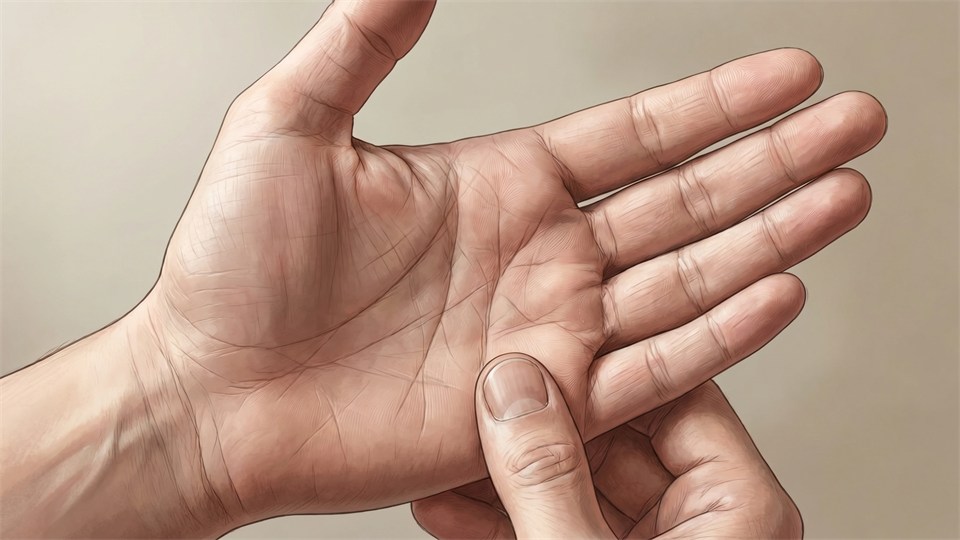
Although the rule about active and passive hand is widespread, you also encounter the simpler version where the left hand is always described as the inborn one, and the right hand as the developed one. That model is still used in many places because it is easy to remember. The problem is that it does not always take into account whether a person is actually right- or left-handed. That is why many prefer a more flexible approach, where dominance plays a role. This makes the reading more personal and less mechanical.
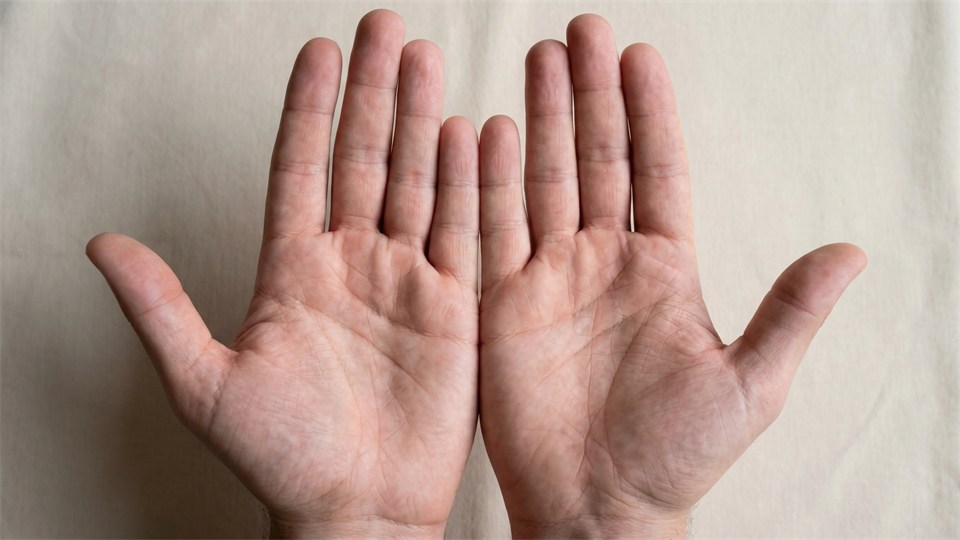
In practice, you can begin by placing both hands open in front of you and comparing them calmly. First look at the overall impression: Is one hand broader, firmer, or more tense? Then you can look at the major lines. Is the life line deeper on one hand? Is the head line straighter or more curved? Is the heart line placed higher or lower? Such differences often become clearer when the hands are side by side. Many people are surprised by how different their own hands actually are, even if they have never thought about it before.
If your most important lines look very similar on both hands, this is often interpreted as a sign of inner consistency. It may mean that your outward behavior is close to your basic temperament, or that you generally act in line with who you are. In palm reading, this is often seen as stability. That does not necessarily mean that life is easy or without changes, but that there is a certain agreement between your inner starting point and the way you express yourself.
For a beginner, it is important not to make this observation too big or dramatic. Similar hands do not have to be a sign of a “predetermined life.” They may just as easily point to a person who knows themselves well or has preserved their core values through many experiences. Palm reading often works with symbolism, so similar lines are best read as a pattern of consistency rather than as a fixed destiny.
Large differences between the hands are often read as signs of development. This may be about maturity, changed goals, new habits, or a life that has shaped the person strongly. If a line is weak on the passive hand but clear on the active one, this can in the traditional sense point to something that has been strengthened over time. Conversely, a clear line on the passive hand that seems less marked on the active one may be interpreted as a quality that is not used as much as before.
This is exactly where palm reading becomes most interesting for many people. Differences give rise to questions: Have you changed the way you think? Have you become more cautious, more open, or more purposeful? Such questions make palm reading more than just “reading signs.” It also becomes a way to reflect on personal development. That is why the right and left hand together often give a more vivid picture than each hand on its own.
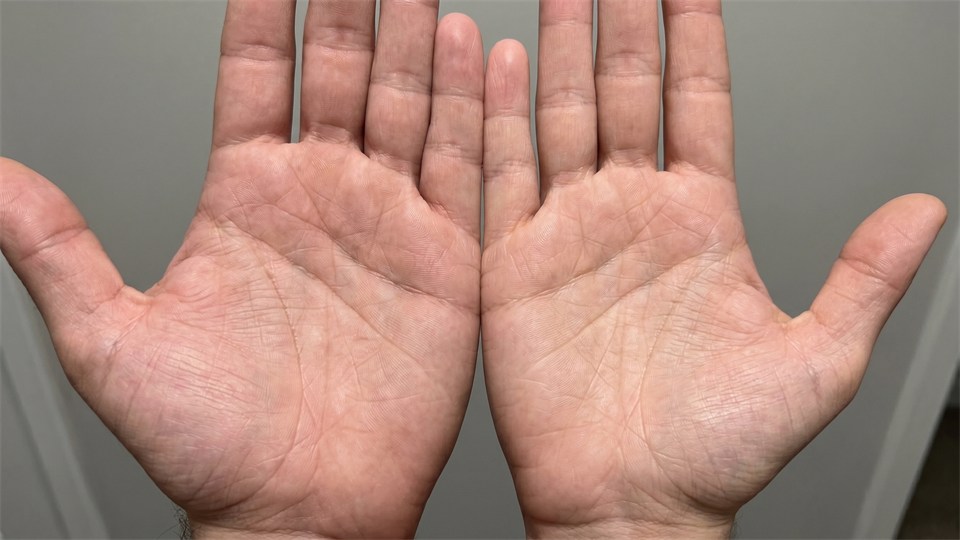
If you want to try it at home, you do not need to start with all the small details. Instead, begin with three simple steps. First, look at the shape of the hand: Is one hand more square, long, or narrow? Next, compare the three major lines, which in many traditions are called the life line, head line, and heart line. Finally, look at which hand seems most “active” in its expression: Is the skin firmer, the lines deeper, or the fingers more tense? This gives a good first impression without making the exercise too complicated.
Feel free to write your observations down in short bullet points. For example: “Left hand has softer lines, right hand has a clearer head line.” When you phrase it simply, it becomes easier to see patterns. Avoid jumping straight to big conclusions. Palm reading works best as slow observation. If you come back after a few months and look at your hands again, you may also discover that your way of reading them has become more precise. It is a good beginner method because it trains the eye while also keeping expectations realistic.
One of the biggest misunderstandings is that only one hand counts. It sounds simple, but it often makes the reading poorer. Another misunderstanding is that the right hand is always the future and the left hand is always the past. That kind of fixed rule may be easy to remember, but it overlooks that palm reading is traditionally more symbolic and flexible. The hands are not read as two separate books, but as two versions of the same story. That is why you should be cautious with overly rigid rules.
It is also common to think that small differences automatically mean major life events. In practice, experienced readers place more weight on the whole than on a single line. The structure of the hand, the shape of the fingers, the quality of the skin, and the interplay of the lines are often more important than one isolated detail. For beginners, the best advice is therefore to be curious without being overly certain. Use the right and left hand as a comparison tool, not as a quick answer sheet.
The question of the right or left hand in palm reading does not have only one single answer, but it does have a practical solution: Look at both. In many traditions, the passive hand shows your starting point, while the active hand shows how you shape it in life. For right-handed people, this will often mean the left as the foundation and the right as development, and the reverse for left-handed people. But most importantly, it is the comparison between the hands that matters, because that is where the nuances become visible.
If you are new to palm reading, you do not need to be able to do everything at once. Start by noticing differences and similarities, and practice describing them simply. In that way, the right and left hand do not become a confusing choice, but two useful perspectives on the same person. That makes palm reading more manageable, more interesting, and much easier to approach as a hobby for beginners.