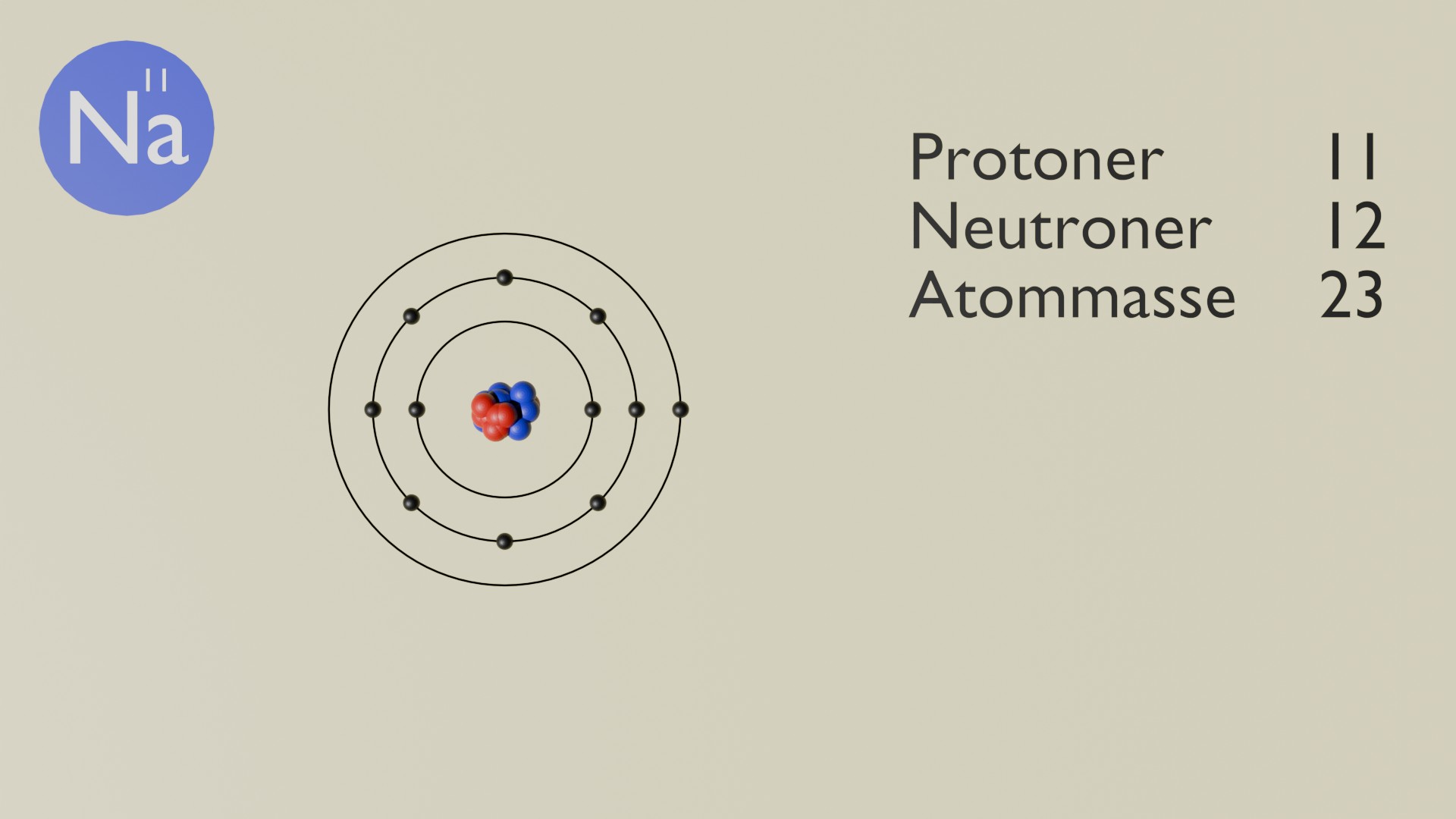
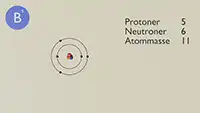
Sodium (Na) is a chemical element with atomic number 11 and belongs to group 1 in the periodic table – the alkali metals. It is a soft, silvery-white metal that reacts strongly with water and oxygen.
1. Introduction to sodium
Sodium has 11 protons, usually 12 neutrons, and 11 electrons. As an alkali metal, it has one valence electron and therefore reacts easily to achieve a stable electron structure. Sodium is not found free in nature, but occurs in salts such as sodium chloride (NaCl) – better known as common table salt.
2. Physical and chemical properties
Sodium is soft enough to be cut with a knife. It has a silvery-white color, but quickly becomes dull in air due to oxidation. It reacts violently with water, forming sodium hydroxide (NaOH) and hydrogen gas (H₂), which is often accompanied by flames or explosion.
- Melting point: 97.8 °C
- Boiling point: 883 °C
- Light metal and good conductor of electricity
3. Isotopes of sodium
Sodium has one stable natural isotope:
- Sodium-23 (²³Na): 11 protons and 12 neutrons (100 % natural abundance)
Radioactive isotopes such as sodium-22 (²²Na) are used in medical and scientific analyses.
4. Industrial applications
Sodium and its compounds have many important uses:
| Application | Description |
| Chemical industry | Used as a reactant in synthesis and for removing impurities in metals. |
| Sodium lamps | Yellow street lamps use sodium vapor, which emits strong monochromatic light. |
| Soaps and cleaning | Sodium hydroxide (NaOH) is a strong base used in soaps and drain cleaners. |
| Salt (NaCl) | Used in food, preservation, road salting, and as a source of chlorine and sodium in industry. |
5. Occurrence and safety
Sodium is typically extracted by electrolysis of molten sodium chloride. Pure sodium is stored under oil or in inert gas, as it reacts explosively with moisture and air.
Although sodium ions (Na⁺) are important for the body's fluid balance and nervous system, too much sodium in the diet can lead to high blood pressure and other health problems.