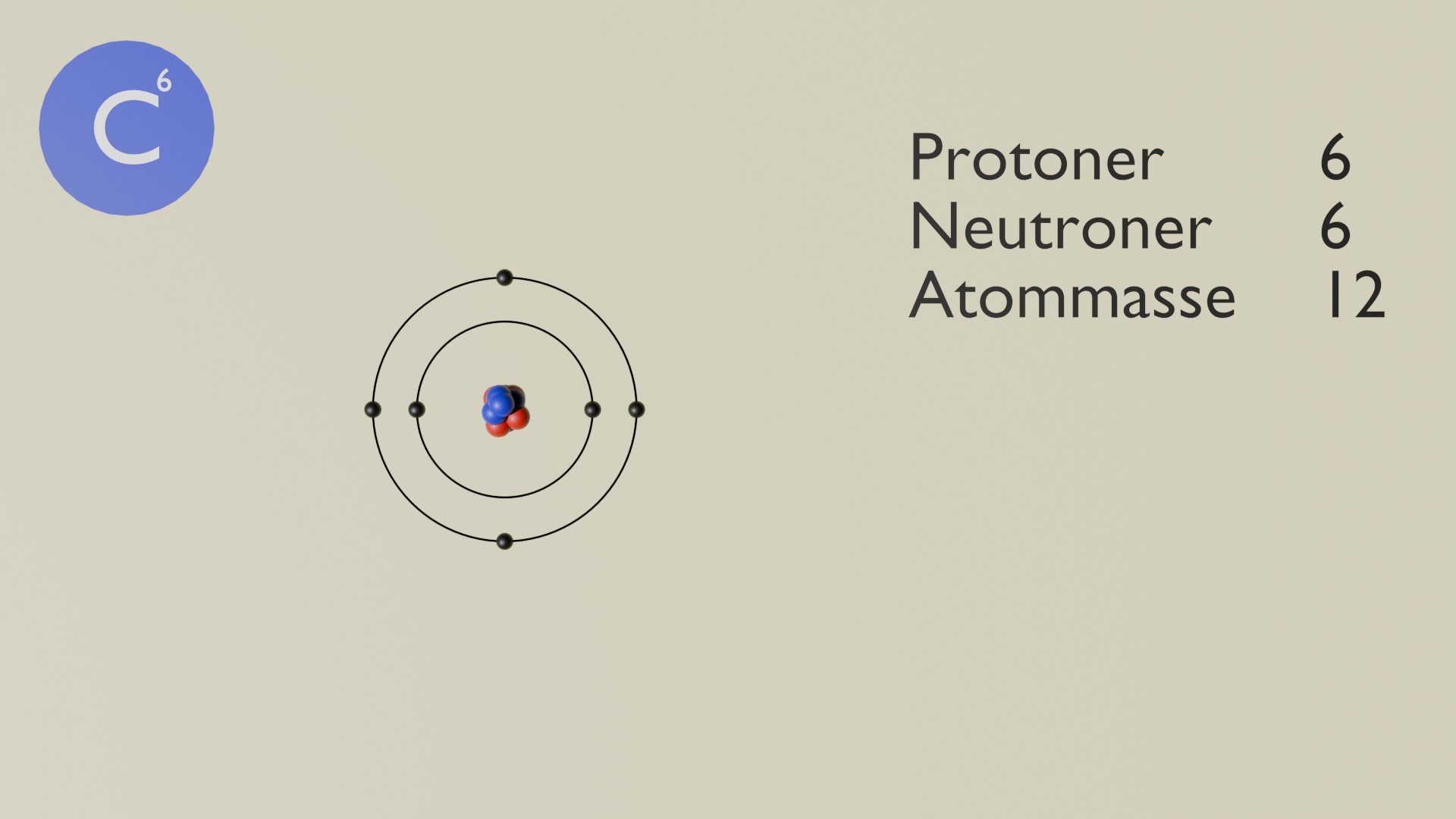
Carbon (C), also called carbon, is a non-metal with atomic number 6. It is located in group 14 of the periodic table and is fundamental to all life as we know it. Carbon is one of the most versatile elements and is found in both organic and inorganic compounds.
1. Introduction to carbon
Carbon is the building block of life. Each carbon atom has 6 protons, typically 6 neutrons, and 6 electrons. Carbon's ability to form strong chemical bonds—especially with itself—makes it possible to create thousands of complex molecules, from simple gases to DNA and proteins.
2. Physical and chemical properties
Carbon occurs in several allotropes with very different properties:
- Graphite: Soft and conductive. Used in pencils and batteries.
- Diamond: One of the hardest known materials. Transparent and insulating.
- Amorphous carbon: Black powder found in e.g. charcoal and soot.
Carbon has four valence electrons and can form four covalent bonds. This makes it extremely flexible in the formation of molecules.
3. Isotopes of carbon
Carbon has three naturally occurring isotopes:
- Carbon-12 (¹²C): 6 protons and 6 neutrons. Most common.
- Carbon-13 (¹³C): 6 protons and 7 neutrons. Used in research.
- Carbon-14 (¹⁴C): 6 protons and 8 neutrons. Radioactive and used in carbon dating.
Carbon-14 decays over time and is used to date organic materials up to about 50,000 years old.
4. Industrial applications
Carbon is widely used in both industry and technology:
| Application | Description |
| Steel and alloys | Carbon is added to iron to form steel with varying hardness. |
| Filtration and medicine | Activated carbon is used to remove toxins and odors. |
| Organic chemistry | Almost all organic compounds are carbon-based—from plastics to medicine. |
5. Natural occurrence and safety
Carbon is found in the atmosphere as carbon dioxide (CO₂), in the soil as organic material, and underground as fossil fuels (coal, oil, natural gas). In living organisms, it forms the backbone of carbohydrates, proteins, fats, and DNA.
Carbon itself is not toxic, but some carbon-based compounds such as carbon monoxide (CO) can be deadly even in small amounts.