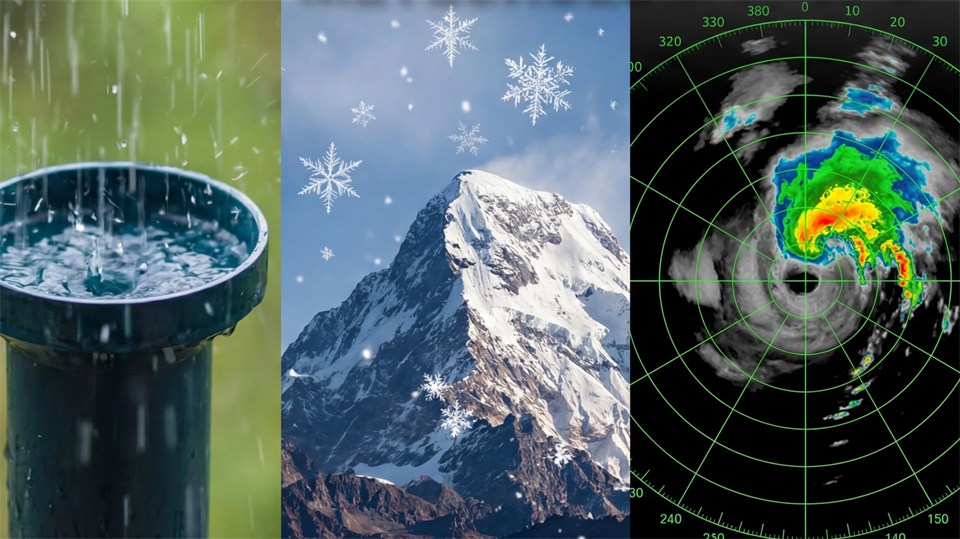


When we talk about the weather, precipitation is almost always mentioned. But what exactly is precipitation? Is it only rain, or does the concept cover more? Whether it’s gentle raindrops, falling snow, or heavy hail, precipitation plays a completely central role for Earth’s climate, nature, and our everyday lives. In this article, you’ll get an easy-to-understand introduction to what precipitation is, how it forms, and why it is so important for life on our planet.
Precipitation is a meteorological term that covers all liquid or solid matter that falls from the atmosphere down to Earth’s surface. The most well-known example is rain, but snow, sleet, hail, and even dew and frost are also considered precipitation, although the last two are often counted as special cases. In meteorology, the focus is typically on precipitation that falls from clouds, that is, rain, snow, sleet, and hail.
Precipitation is often measured in millimeters (mm), where 1 mm corresponds to one liter of water per square meter. Meteorologists use this unit of measurement to indicate how much water has fallen in an area over a given period.
To understand precipitation, we must begin with the large cycle that water on Earth is part of: the water cycle. Here, water evaporates from seas, lakes, and rivers up into the atmosphere, where it cools, condenses into clouds, and finally falls down as precipitation.
The sun’s heat causes water to evaporate from the sea, lakes, and plants. The water vapor rises, and when it reaches higher, colder layers of air, it begins to condense and form small water droplets. These droplets gather in clouds.
A cloud consists of millions of tiny water droplets or ice crystals. For these to become precipitation, they must grow large enough for gravity to pull them down toward the ground.
A lot happens in the clouds: Water droplets can collide and merge into larger droplets. If the temperature in the cloud is below freezing, water vapor can freeze into small ice crystals. These also grow, either by attracting more water vapor or by colliding with other ice crystals.
When droplets or ice crystals become large and heavy enough, they begin to fall toward the ground as precipitation. The form the precipitation takes depends on the temperature both in the cloud and on the way down through the atmosphere.
Precipitation comes in several forms, depending on temperature and conditions in the atmosphere. Here are the most common:
Rain occurs when water droplets in the clouds grow large enough to fall to the ground without freezing. This typically happens when the temperature in both the cloud and all the way down to the ground is above freezing (0°C). Raindrops can vary in size from very small to up to several millimeters in diameter. Heavy rain can lead to flooding, while gentle rain is often beneficial for plants and groundwater.
Snow forms when the temperature in the cloud and all the way down to the ground is below freezing. Water vapor freezes directly into ice crystals, which gather into hexagonal snowflakes. If the air on the way down to the ground is cold enough, the snow remains frozen, and we experience snowfall. Snow plays an important role in many ecosystems, especially in cold regions, and acts as a water reservoir that melts in the spring.
Sleet is a mixture of rain and snow. It typically occurs when snowflakes partially melt on their way down through a warmer layer of air, but do not completely become rain before they reach the ground. Sleet often occurs during transition periods between winter and spring or autumn and winter.
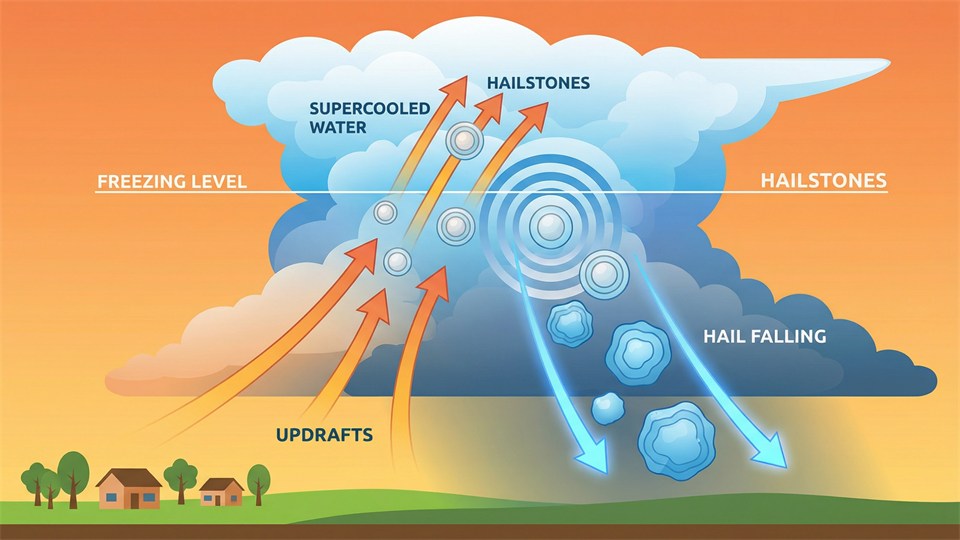
Hail consists of balls of ice, which form in powerful thunderclouds (cumulonimbus). Inside the cloud, small ice cores are thrown up and down by updrafts, so they repeatedly get new layers of ice. When the hailstones become heavy enough, they fall to the ground. Hail can vary from small balls of a few millimeters to large pieces of several centimeters and can cause damage to cars, roofs, and crops.
Although dew and frost do not fall from clouds, they are sometimes considered special forms of precipitation. Dew forms when the air becomes so cold at night that water vapor turns into water droplets on cold surfaces. Frost forms in the same way, but below freezing, so ice crystals form directly on the surfaces.
Precipitation is crucial for life on Earth. Here are some of the most important reasons:
Meteorologists measure precipitation with rain gauges, snow sticks, and radars. A rain gauge is a simple cylinder that collects rain, so you can read how many millimeters have fallen. Snow is often measured as depth in centimeters, but can also be converted to water content. Modern weather radars can "see" precipitation areas and help predict how much and what type of precipitation is on the way.
Weather forecasts are based on observations from many measuring stations and advanced computer models. Still, it can be difficult to predict exactly where and when precipitation will fall, because clouds and atmospheric movements are very complex.
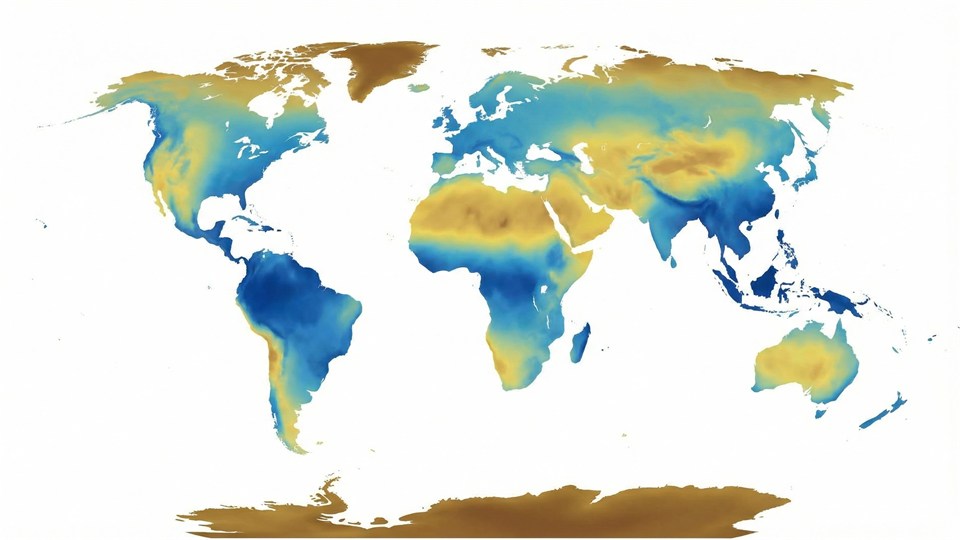
Precipitation varies greatly across the globe. In tropical rainforests, there can be over 3,000 mm per year, while deserts can get less than 50 mm. Coastal areas and mountains often get more precipitation than inland areas, because moist air rises, cools, and releases water when it meets high hills or mountains.
In cold regions, large amounts of precipitation fall as snow, creating ice caps and glaciers. In temperate areas, precipitation alternates between rain, snow, and sleet depending on the season. Understanding these patterns is crucial for agriculture, urban planning, and for being able to predict natural disasters.
We encounter precipitation every day – from the light morning dew on the grass to the heavy rain showers that can stop traffic and flood basements. In the winter months, snowfall can give snow days off from school, while hail can surprise in the middle of summer. Farmers depend on adequate precipitation for their crops to grow, and cities often have to adapt to too much or too little precipitation with drainage systems and water reservoirs.
A concrete example: When it rains 10 mm in one day, it corresponds to 10 liters of water per square meter – that can quickly become many thousands of liters on a roof or a field!
Precipitation is one of the most important weather phenomena on Earth. Whether it falls as rain, snow, sleet, or hail, it helps shape our landscapes, determine our climate, and give life to plants, animals, and people. Understanding precipitation is therefore not only relevant for meteorologists, but for everyone interested in nature and the weather.