

This article provides a practical overview of offensive play in American football. We start with purpose and concepts, go in-depth with running and passing plays, look at option concepts, pre-snap formations and motion, blocking principles, and finish with advanced pass concepts as well as examples of how coaches combine everything into a gameplan.
Offensive football is about moving the ball efficiently, creating first downs, and scoring points. Plays are called via a playcall, which specifies formation, personnel, protection, and the actual concepts (run or pass). Modern offenses often use packaged plays, where multiple options are built in: the QB can change the play (audible), change protection, or read a specific defender (key) after the snap.
The run is the foundation for many offenses: they control the clock, keep the defense honest, and make play-action dangerous. The two main schools are zone and man/gap. Zone focuses on blocking areas and creating cutback lanes; man/gap creates a specific hole via pulling blockers and double teams.
Passing plays range from quick quick game (3-step) to deep concepts (5-/7-step). The goal is to attack specific zones in the defense and create mismatches. The QB typically reads high-low, progression, or a specific defender.
In option plays, a defender is left unblocked and forced to choose – the QB reads him and decides. In RPO (Run-Pass Option) a run block is combined with a quick pass option. If the box is too heavy, the QB throws quickly outside; if it’s light, the ball is given to the RB. Read-option lets the QB keep the ball if the edge crashes.
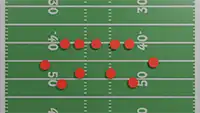
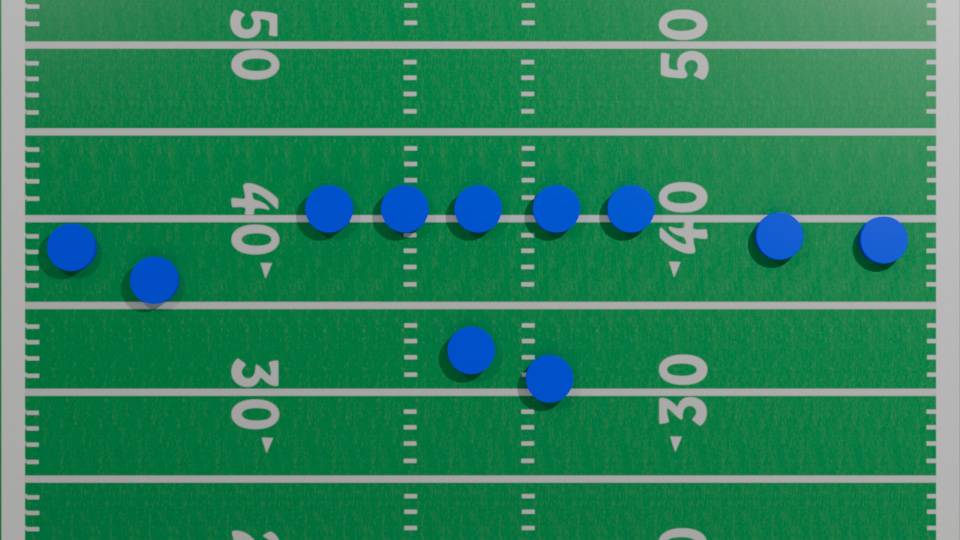
Formation determines the starting point: personnel (e.g. 11 = 1 RB, 1 TE), splits, stacks/bunch, and alignments. Pre-snap motion is used to reveal man vs. zone, get favorable matchups, and change the strength side. Shifts require everyone to be set for a moment before the snap.
In zone the line works laterally and doubles up to the 2nd level; RB reads holes. In man/gap a hole is created via down-blocks, pull, and kick-out. The choice matches the roster and the opponent’s fronts. Protections in pass (slide/half-slide/man) determine who is responsible for extra rushers (rule: hot or site-adjust on WR).
A good gameplan builds on your own strengths and the opponent's weaknesses. Typically, the first 10–15 plays are scripted to test reactions. On 3rd & short, power/counter and quick game can dominate; on 3rd & long, screens, draws, and flood variants are planned against Cover 3. In the red zone near the goal, condensed splits, rub concepts, and heavier personnel (12/13) are used together with play-action.