

This article provides a clear overview of American football: the field, scoring system, downs, the most important positions, typical formations, and defensive coverages. At the top, you'll find a table of contents with internal links, so the reader can quickly jump to relevant sections.
Table of Contents
- The Field
- Points and Scoring Methods
- Game Flow
- Positions – Offense
- Positions – Defense
- Special Teams
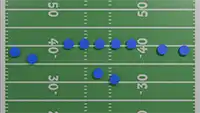
- Offensive Formations (basics)
- Defensive Fronts and Coverages
- Beginner's Guide: 5 Things to Watch For
- Mini‑Glossary
- Diagrams (SVG)
- Conclusion
The Field
The field is 120 yards long (100 yards of playing field + two end zones of 10 yards each) and about 53 1/3 yards wide. Hash marks and yard lines help referees and players with positioning. Touchdowns are scored in the end zones, while field goals are kicked through the uprights behind the end zone.
Points and Scoring Methods
- Touchdown (6): The ball is carried/caught in the end zone.
- Extra point (1–2): Kick (1) or 2‑point conversion from short distance.
- Field goal (3): Kick through the uprights in regular play.
- Safety (2): The defense scores by stopping the offense in its own end zone.
Game Flow – Downs, the Chain, and Time
To understand American football, it's important to know how the game actually flows – that is, how a team moves the ball down the field and tries to score points. The core concepts here are downs, the chain, and timing.
What is a "down"?
A "down" is essentially an attempt or play. The offense always has four attempts – called 1st down, 2nd down, 3rd down, and 4th down – to move the ball at least 10 yards forward. If they succeed, they get a new set of four downs, and the process starts over from the new spot on the field.
An example: If the offense starts at its own 25-yard line, they must reach at least the 35-yard line within four attempts to keep the ball. When they succeed, it's "1st down" again, but this time from the new position.
The Chain – the Visual Marker
For spectators (and players), the 10 yards needed for a new first down are shown with two orange markers connected by a chain – hence it's just called "the chain." One marker stands where the series started (line to gain), and the other stands where the ball must reach to achieve a new first down.
A third marker shows the current "line of scrimmage" – the spot where the ball starts each play. Referees and chain crew move the markers after each play, so you can always see how far is left.
How Time Works
A game is divided into four quarters of 15 minutes each (at the professional level). The clock runs during normal play, but stops in certain situations:
- After incomplete passes
- If a player runs out of bounds
- For penalties, timeouts, or after scores
After two quarters, there is halftime, where teams switch sides. If the game is tied after four quarters, overtime may occur, depending on tournament rules.
A Typical Play Sequence
- The offense lines up behind the line of scrimmage.
- The quarterback receives the ball (snap) from the center.
- The ball can be passed, run, or pitched to another player.
- The play stops when the ball carrier is tackled, goes out of bounds, or there is an incomplete pass.
- The new position of the ball determines which down it is now, and how many yards remain for a new first down.
What Happens on 4th Down?
If the team reaches 4th down and still needs yards for a new first down, they have three options:
- Punt the ball: Kick it deep towards the opponent to give them poor starting field position.
- Go for it anyway: Risky, because if it fails, the opponent gets the ball at the spot where the attempt ended.
- Field goal: If close enough, they can attempt a kick between the uprights for 3 points.
Example of a Series
Imagine it's 1st & 10 at your own 20-yard line:
- 1st down: Running back runs for 4 yards. Now it's 2nd & 6 from your own 24-yard line.
- 2nd down: Short pass gains 5 yards. Now it's 3rd & 1 from your own 29-yard line.
- 3rd down: Quarterback sneaks the ball 2 yards forward. New 1st down at your own 31-yard line.
- The process starts over with 1st & 10.
Why Is It Important to Understand This?
For a new spectator, it can seem confusing why the play stops all the time, and why there's so much talk about "3rd & 7" or "1st & goal." But understanding downs, the chain, and time is key to following the rhythm of the game and seeing the strategic choices coaches make along the way.
Positions – Offense
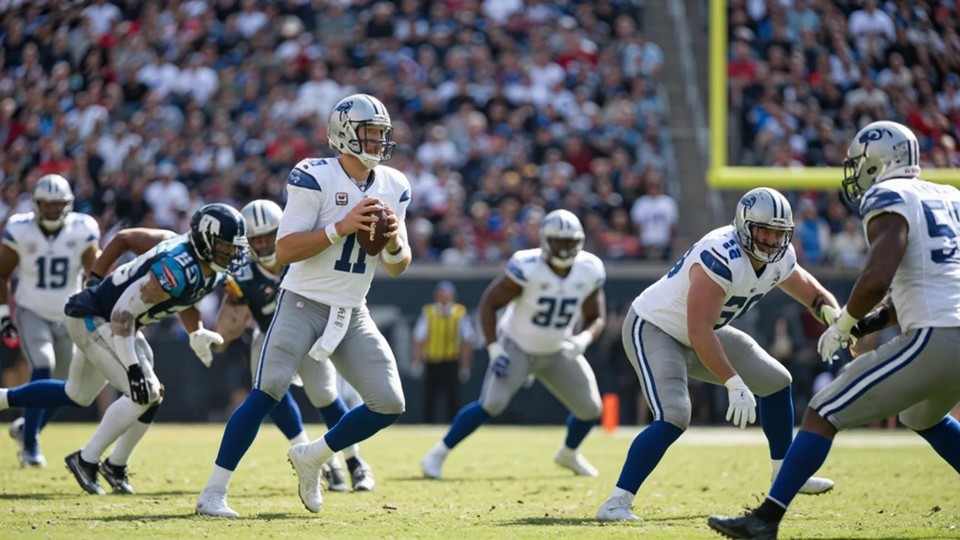
An offensive team (offense) consists of 11 players working together to move the ball down the field and score points. Each position has its own role, from throwing and running with the ball to blocking opponents. Here are the most important offensive positions and their tasks.
- QB (Quarterback): Leads the offense, hands off, passes, and can run.
- RB (Running Back): Runs with the ball, short passes, pass protection.
- WR (Wide Receiver): Runs routes and catches passes on the outside/slot.
- TE (Tight End): Hybrid: blocking + receiver.
- OL (Offensive Line – LT, LG, C, RG, RT): Blocking in run and pass plays.
Positions – Defense
The defensive team (defense) also has 11 players whose job is to stop the opponent's offense. This can be done by tackling the ball carrier, breaking up passes, or forcing turnovers. Each defensive position has a specific role in protecting the field and preventing scores.
- DL (Defensive Line): Stops the run and pressures the QB (edge + interior).
- LB (Linebackers): Versatile – run, blitz, and short pass coverage.
- DB (Defensive Backs): Cornerbacks + safeties for coverage and deep help.
Special Teams
Kickoffs, punts, field goals, and extra points. Kicker and punter handle the kicks; returner tries to create good starting positions. Special teams can determine field position and momentum in the game.
Offensive Formations (basics)
Offensive formations describe how the offense lines up before the ball is snapped. Different formations are used to exploit the team's strengths, confuse the defense, or create space for specific plays. Here are some of the most common offensive formations.
- 11 personnel: 1 RB, 1 TE, 3 WR – flexible standard.
- 12 personnel: 1 RB, 2 TE – more physical and play‑action friendly.
- Spread: 4–5 WR – stretches the field horizontally.
- I‑formation/Under center: Run-heavy with deep play‑action.
- Shotgun/Pistol: QB further back for quicker reads.
Motion and Shifts
Pre‑snap movement often reveals coverage (man/zone) and creates mismatches. After a shift, everyone must be set briefly before the snap.
Defensive Fronts and Coverages
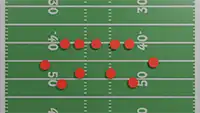
The defense can line up in many ways depending on the opponent's tactics. Fronts describe how the front defensive players are positioned, while coverages are about how the back players cover the opponent's receivers. Here are the most common defensive fronts and coverages.
- 4‑3: Four linemen, three linebackers – solid against the run and stable pass rush.
- 3‑4: Three linemen, four linebackers – flexible blitz and fronts.
- Nickel (5 DB) / Dime (6 DB): Against pass-heavy offenses and on long downs.
Coverages: Cover 1 (man + deep safety), Cover 2 (two deep zones), Cover 3 (three deep zones), Cover 4/Quarters (four deep). The choice depends on the opponent and situation.
Beginner's Guide: 5 Things to Watch For
- Down & distance: How far to the first down?
- Personnel: How many RB/TE are on the field?
- Safety‑shell: One or two deep safeties?
- Motion: What does movement reveal about coverage?
- Tempo: No‑huddle vs. controlled huddle.
Mini‑Glossary
- Line of scrimmage: The starting line for the play.
- Snap: The ball is handed from center to QB.
- Blitz: Extra pressure from LB/DB on the QB.
- Audible: QB changes the play at the line of scrimmage.
- Screen: Short pass with blockers in front of the receiver.
Conclusion
With knowledge of the field, scoring system, downs, positions, and the most common formations, it's much easier to understand the flow of a game. Use the table of contents to quickly look up specific topics, and return to the diagrams when you want to explain formations or coverages visually.