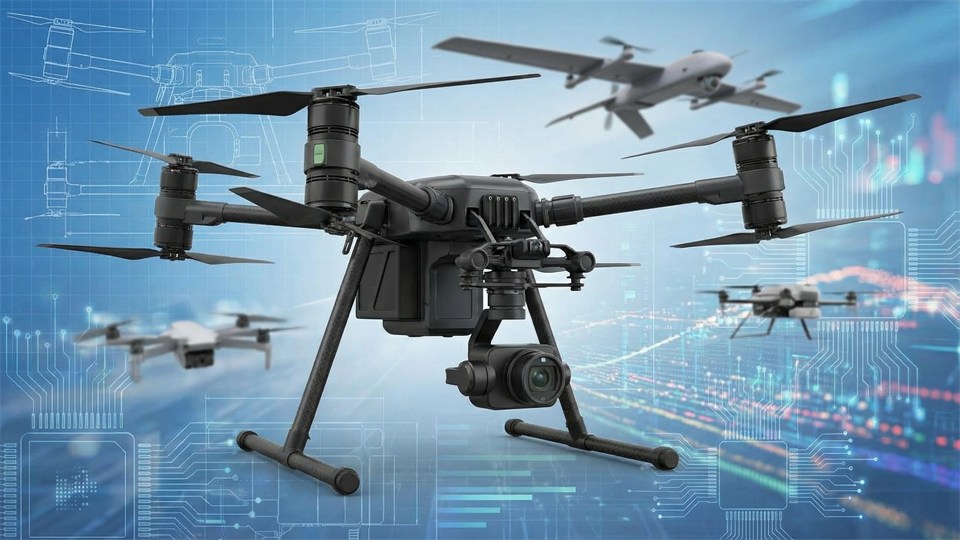


Drones have become indispensable in hobbies, business, and industry. They are used for everything from aerial photography to logistics and inspection of hard-to-reach areas. But what actually makes a drone fly? In this article, we review the most important technical components and principles behind modern drones, so you get a solid understanding – whether you are considering buying your first drone or are just curious.
Most consumer drones are of the multirotor type – typically with four rotors (called quadcopters). The rotors generate lift and make it possible for the drone to hover, fly forward, backward, and sideways, or rotate around its own axis. Control signals from the remote are translated into individual adjustments of the rotor speeds, which control the drone's movements.
Each rotor acts as a small propeller, pulling air downward and creating lift. To hover, the total lift from all rotors must balance the drone's weight. If one rotor speeds up and another slows down, the drone tilts in one direction – and can then move forward, backward, or sideways. The drone's stability is ensured by constantly adjusting the rotor speeds, which is automatically controlled by its built-in electronics.
A typical drone consists of several central elements, each with its own technical function:
The heart of any drone is the flight controller. It receives commands from the remote control and constantly reads data from the drone's sensors. For example, the accelerometer measures the drone's movements, while the gyroscope measures rotation. This data is used to constantly correct and stabilize the drone, so it does not tip over or lose direction – even if there is wind or small disturbances.
Each motor is individually controlled by an ESC, which ensures that the rotor speeds can be adjusted quickly and precisely. For example, if you want to fly forward, the ESC increases the speed of the rear motors, so the drone tips forward and moves in the desired direction.
The drone's sensors provide information about its position, altitude, movement, and orientation. The most important sensors are:
Some advanced drones have sensors on multiple sides, so they can automatically avoid obstacles.
The drone is typically controlled via a remote control (transmitter), which communicates with the drone through radio signals – often on the 2.4 GHz or 5.8 GHz band. Some drones can also be controlled via smartphone apps or programmed to fly autonomous routes.
The remote sends control commands (e.g., throttle, pitch, roll, and yaw) to the drone's receiver, which forwards them to the flight controller. Modern drones often have two-way communication, so you can receive live video or telemetry data (e.g., battery status and GPS position) directly on your controller or mobile device.
The battery is a crucial component for the drone's performance. Most drones use lightweight lithium-polymer (LiPo) batteries, which have high energy density and can deliver a lot of power quickly. The battery's capacity determines how long the drone can fly – typically between 10 and 30 minutes per charge for hobby drones. Professional models can fly longer with larger batteries and advanced energy management.
Many drones are equipped with a camera that can record video or take pictures from the air. The camera can either be fixed or mounted on a gimbal – a stabilized holder that counteracts the drone's movements and ensures smooth footage. Live video is often transmitted wirelessly to the pilot, so you can see exactly what the drone "sees" in real time (FPV – First Person View).
Modern drones can do much more than just respond to the pilot's commands. Thanks to advanced software and sensors, many drones have features such as:
These features make flying easier and safer – even for beginners.
Imagine a classic quadcopter with four rotors:
All these movements are controlled electronically – lightning fast and precisely.
A drone is an interplay of electronics, mechanics, and software. Thanks to advanced sensors, intelligent flight controllers, and precise motor control, modern drones can fly stably, perform complex tasks, and even navigate independently. Whether you are a technology enthusiast or just curious, it is fascinating to see how the technology behind a drone makes this technology so versatile and accessible to everyone.