

At the heart of the quantum computer we find the qubit – the quantum bit – which differs fundamentally from the classical bit we know from ordinary computers. While a classical bit can only be 0 or 1, a qubit can be both at the same time, thanks to the principles of quantum mechanics. But how does a qubit actually work, and what makes it so special?
A classical bit represents data as either 0 or 1 – one value at a time. It is similar to a switch that is either on or off. In contrast, a qubit can be in a superposition, where it is both 0 and 1 at the same time, until it is measured.
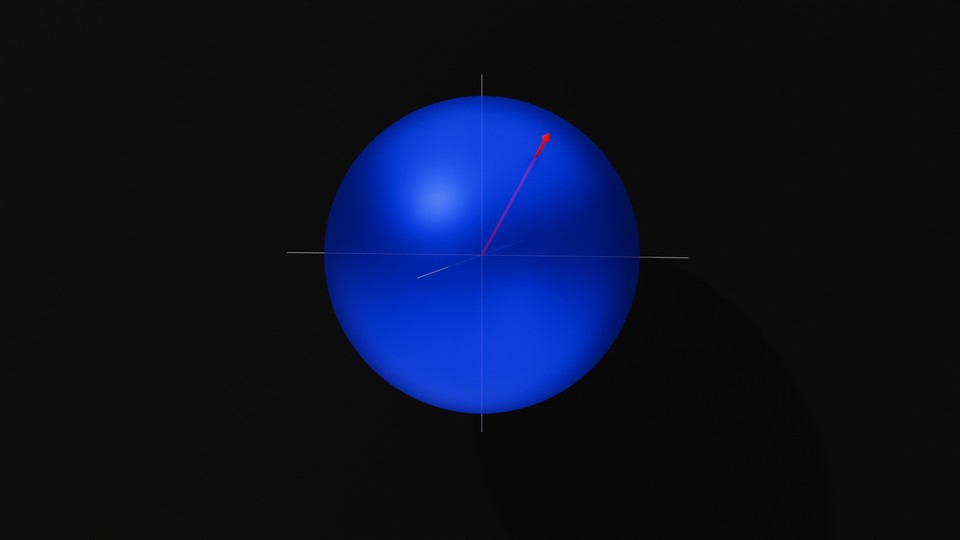
Mathematically, a qubit is described as a linear combination of 0 and 1:
|ψ⟩ = α|0⟩ + β|1⟩
Here, α and β are complex numbers representing probability amplitudes. When the qubit is measured, it "collapses" into one of the states with probabilities |α|² and |β|².
Superposition is the most well-known phenomenon in the quantum world. It means that a qubit can explore many possible solutions simultaneously. For example, 3 qubits can represent 8 states in parallel – not by switching quickly, but truly at the same time.
It is this property that makes quantum computers theoretically extremely powerful for certain types of tasks – especially those that require analysis of large amounts of combinations.
Entanglement or "entanglement" is another central phenomenon. When two qubits are entangled, their states are linked, no matter how far apart they are. If you measure one, the other is affected instantly.
Entanglement enables complex calculations and communication across the system. It is also used in quantum security and teleportation experiments.
An important consequence of quantum mechanics is that you cannot observe a qubit without disturbing it. When you measure a qubit, the superposition collapses, and you only get one classical result – either 0 or 1.
This means that quantum algorithms must be designed with care. The goal is to manipulate the states of the qubits so that the measurement most likely gives the correct answer – but you can never be completely certain.
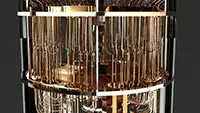
Qubits can be realized in several ways – all with advantages and disadvantages:
Common to all the technologies is that qubits are extremely sensitive. Small vibrations, heat, or electromagnetic noise can destroy their state – which is why quantum computers require special environments.
Today, qubits are used in experimental systems to test quantum algorithms and simulate small molecules. The most important areas of application in the future include:
But it requires thousands or millions of stable, error-corrected qubits to achieve practical advantage – and we are still at the beginning.
The qubit is the fundamental element in quantum computers and differs radically from the classical bit. With properties like superposition and entanglement, qubits can work in parallel and create entangled systems that perform calculations classical computers cannot handle efficiently.
Although the technology is still immature, understanding qubits opens the door to a new era of computing – a quantum era, where physics and information merge.