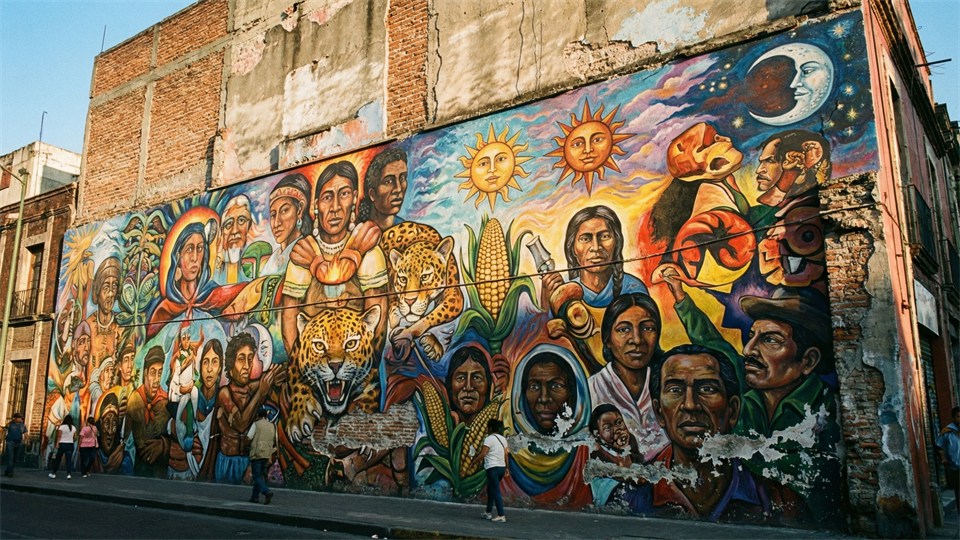


Throughout the 20th and 21st centuries, South America has been home to an exceptionally rich tradition of muralism – that is, murals created in public spaces. These colorful, often monumental works serve not only as art, but also as powerful social and political commentary. Many South American muralists have used the walls of the street to give voice to the people, challenge those in power, and highlight social inequalities. In this article, we take you on a journey through the history of muralism in South America, present key artists, and explore the social messages that adorn city walls from Mexico to Argentina.
Muralism, as an art form, has deep roots in Latin America. Already in pre-Columbian times, indigenous peoples decorated temples and public buildings with murals. But it was especially in the 20th century that muralism gained a political and social dimension. The Mexican muralists played a key role in this development, where art became a weapon against injustice and social inequality.
After the Mexican Revolution (1910-1920), an art movement emerged in which the state commissioned large murals for public buildings. The goal was to create a national identity and convey the ideals of the revolution to the entire population – including the poorest, who rarely visited museums. This approach quickly spread to the rest of Latin America, where muralism became a powerful tool for social and political messages.
Although Diego Rivera was Mexican, his works and ideas had enormous influence throughout South America. Rivera painted enormous murals filled with stories about the lives of workers, the conditions of rural people, and the struggle against oppression. His paintings are easily recognizable with their bright colors, monumental figures, and details that tell of both past and present. Rivera saw art as a tool to enlighten the population and create change, and his works can today be found on public buildings, universities, and factory halls.
Two of Rivera's contemporaries, David Alfaro Siqueiros and José Clemente Orozco, were likewise central figures. Siqueiros often worked with dramatic motifs, where the struggle between oppressors and the oppressed was placed at the center. He experimented with new techniques and materials, which made his murals lively and almost cinematic. Orozco, on the other hand, emphasized human suffering and existential themes. Both artists used their art to comment on revolution, social inequality, and hope for change.
In Brazil, Eduardo Kobra has distinguished himself as a contemporary muralist with great international recognition. Kobra's works are characterized by a kaleidoscopic use of colors and geometric patterns, often combined with portraits of historical figures or ordinary people. His gigantic murals can be found in both São Paulo, Rio de Janeiro, and several major cities abroad. Kobra uses his art to celebrate diversity, remind us of injustices, and honor hope and coexistence.
A common thread in South American muralism is the fight against social inequality, poverty, and political oppression. Many muralists depict the living conditions of workers and indigenous peoples, drawing attention to the struggles of marginalized groups for rights. In Chile, murals during the dictatorship were used as hidden protests, while in Argentina they often focus on lost generations and the fight for truth and justice after the abuses of military dictatorships.
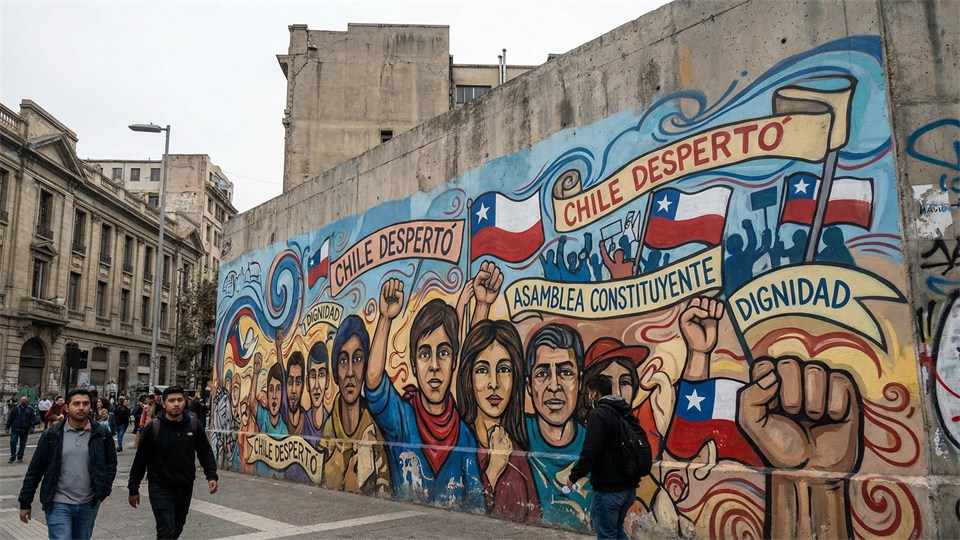
Muralism differs from traditional art by being directly accessible to everyone. The works are found in streets and squares, where all can see and interpret them. This makes muralism a popular medium, where artists not only decorate but communicate with society. The murals often become a gathering point for the local community and can serve as visual manifestos of local identity, political stance, or social dreams.
Today, South American muralists address a wide range of themes that go beyond class struggle. Environmental disasters, climate change, and urbanization are prominent in many new works. Artists like Inti from Chile and Clandestinos from Brazil use murals to question how we treat nature and how the growth of big cities affects people and the environment. At the same time, there is a strong focus on gender identity, LGBTQ+ rights, and the visibility of women in society.
Today's muralists often move in the intersection between classic muralism and modern street art. They use spray paint, stencils, and digital tools, and their works are shared on social media, which amplifies the reach of their messages. International festivals and collaborations have made muralism a global phenomenon, where South American artists inspire colleagues from all over the world.
Muralists use a wide range of techniques and materials. Traditionally, lime paint was used on wet walls so the colors would bind to the wall – a technique known from fresco. Later, acrylic, latex, and spray paint were introduced, which provided greater freedom and the ability to work quickly. Many muralists first create detailed sketches or digital drafts before transferring the motif to the wall. Large works often require scaffolding and collaboration between several artists, which strengthens the collective element in muralism.
Many South American murals are created in collaboration with the local community. Artists often involve residents in idea development, theme selection, and the painting process itself. This ensures that the work has local anchoring and reflects the values, wishes, and hopes found in the area. The collective approach makes muralism more than just decoration – it becomes a joint project that brings people together.
Muralism has had an enormous impact on many South American cities. The murals beautify otherwise gray and dreary areas and create visual identity for neighborhoods that often struggle with poverty or social exclusion. At the same time, the art functions as a mirror and a platform for dialogue about important social issues. Many murals have become landmarks for their city and attract tourists, which can lead to local pride and economic development.
In Colombia, muralism has played a role in the rebuilding of neighborhoods marked by violence and conflict. In the city of Medellín, large mural works have become part of the city's transformation from dangerous to cultural center. In Bolivia and Peru, murals are used to celebrate the culture and rights of indigenous peoples, which strengthens their position in society and counteracts discrimination.
South American muralists have left a clear mark on public spaces. Their colorful, often magnificent works are both art, political commentary, and social appeal. Whether they fight for workers' rights, the environment, equality, or local identity, the muralists show how art can become a popular voice and a force for change. Next time you see a mural – in South America or elsewhere – stop and think about the stories and messages hidden in the colors.