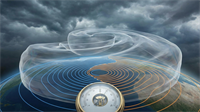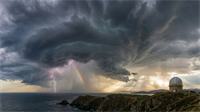
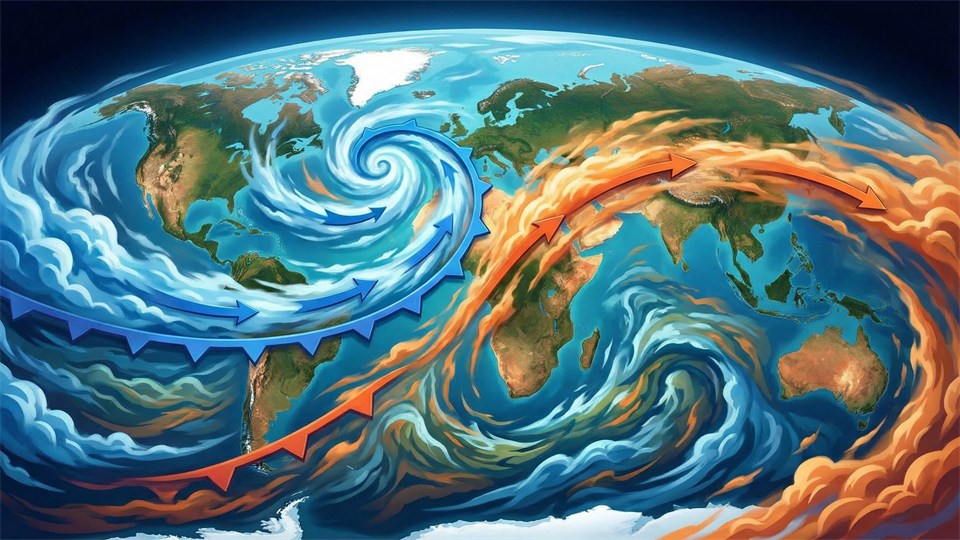


Have you ever wondered why the weather can suddenly change from sunshine to rain in just a few hours? Or why it sometimes gets very windy when a rain shower approaches? The answer is often found in a concept meteorologists call a weather front. This invisible boundary between different air masses plays a crucial role in the changeability of the weather. In this article, we explain what a weather front is, how it forms, and how it affects the weather we experience.
A weather front is an interface between two air masses with different temperatures, humidities, and densities. When these air masses meet, it can lead to significant weather phenomena such as rain, wind, clouds, and sometimes even thunderstorms. Weather fronts often move across the country and are one of the main causes of changes in the weather.
Imagine the atmosphere as a big puzzle, where the pieces (the air masses) don't always fit together perfectly. When a cold, heavy air mass collides with a warm, light air mass, a "seam" forms – that's the weather front. Here, there is an exchange of energy and moisture, which triggers cloud formation and precipitation.
There are several types of weather fronts, each with their own characteristics and effects on the weather. The four most important are:
A warm front occurs when a warm air mass moves in over a colder air mass. The warm air is lighter and therefore slides up over the cold air. This creates a broad area of clouds and often prolonged, gentle rain. The sky typically first becomes covered by thin clouds (cirrus clouds), which gradually become thicker and darker as the front approaches. The temperature usually rises when a warm front passes.
A cold front forms when a cold air mass pushes in under a warm air mass and forces it upwards. Cold air is heavier than warm air, so this movement happens quickly and can be very pronounced. It often brings heavy showers, wind, and sometimes thunderstorms. After the front passes, it usually clears up, and the temperature drops.
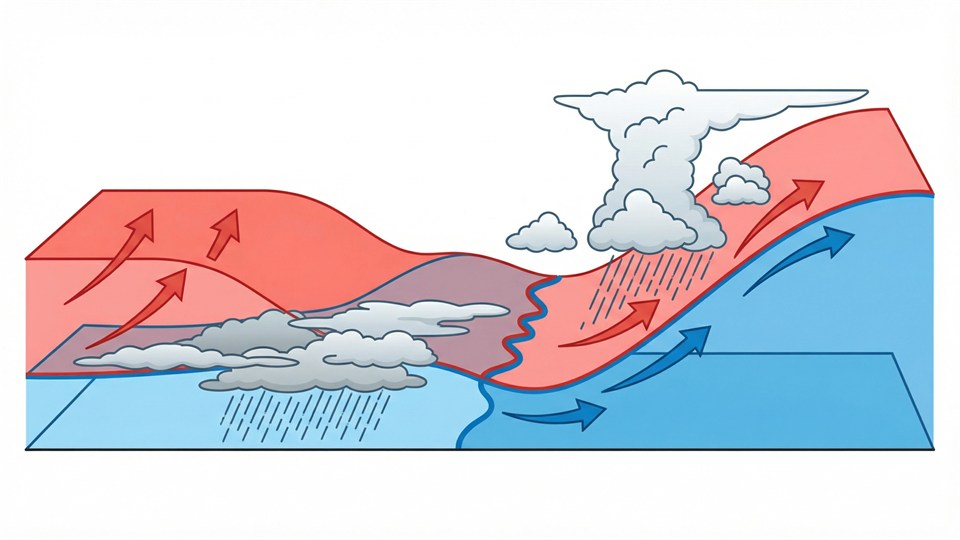
A stationary front occurs when a warm and a cold air mass meet, but neither is strong enough to displace the other. The front therefore becomes almost stationary and can bring several days of overcast weather and rain in the same area.
An occluded front forms when a cold front catches up with a warm front. The warm air gets "squeezed" and lifted up from the ground, which can bring severe weather with both rain and wind. Occlusions are often seen in connection with low-pressure systems.
Weather fronts arise because the Earth is heated unevenly by the Sun. Areas near the equator receive more solar energy and become warmer, while areas closer to the poles are colder. This creates large air masses with different temperatures and humidity. As they move, for example due to the Earth's rotation or wind patterns, they meet and form fronts.
To understand the formation of fronts, you can think about how oil and water behave in a glass: They do not mix, but form a clear boundary. In the same way, warm and cold air rarely mix quickly; instead, they meet in a front, where exchange and mixing occur over time. It is this "battle" between air masses that creates much of the weather we experience.
Along a weather front, exciting things often happen:
A concrete example is when a cold front passes: First you often experience warm, humid weather, which is quickly replaced by dark clouds, heavy rain, and gusts of wind, after which the air becomes clearer and cooler.

Meteorologists use special symbols on weather maps to show where fronts are located:
By looking at a weather map, you can quickly see which fronts are on the way, and thus predict upcoming weather changes.
Let's look at a couple of concrete scenarios:
We often experience such changes in Denmark and many other countries with changeable weather.
Understanding weather fronts makes it easier to predict the weather. Without fronts, the weather would be much more stable, but also more monotonous. It is precisely fronts that make our weather exciting, but also challenging to predict. Fronts are central to the formation of precipitation, wind, temperature extremes, and much more.
For farmers, fishermen, pilots, and everyone who works outdoors, it is important to be able to read and understand fronts – it can make the difference between a successful or unsuccessful day.
Weather fronts are the invisible lines where the battle between warm and cold air takes place. They are responsible for many of the weather phenomena we experience in everyday life. By understanding what a weather front is and how it works, you get a better insight into why the weather changes and how meteorologists can predict upcoming weather. Next time you see the clouds gathering or feel the wind picking up, you can think that it is probably a weather front at play!