


Football is a ball game with 11 players on each team, playing 2 halves of 45 minutes each. It is a low-scoring sport in contrast to, for example, handball and basketball, and it is the largest spectator sport in the world.
In this article, we provide an introduction to football. More advanced topics such as playing systems are placed in separate articles, which can be found at the bottom of this article.

FIFA's requirements for football pitches are, however, more restrictive. For international matches, the length of the pitch must be between 100 and 110 meters and the width must be between 64 and 75 meters. The most common size among the larger clubs is 105x68 meters.

The outer rectangle around the goal is the penalty area. If a foul is committed against an attacking player in the penalty area, it will result in a penalty kick or an indirect free kick. Penalty kicks are taken from the penalty spot, while indirect free kicks are taken from the spot where the foul was committed (but not in the goal area).
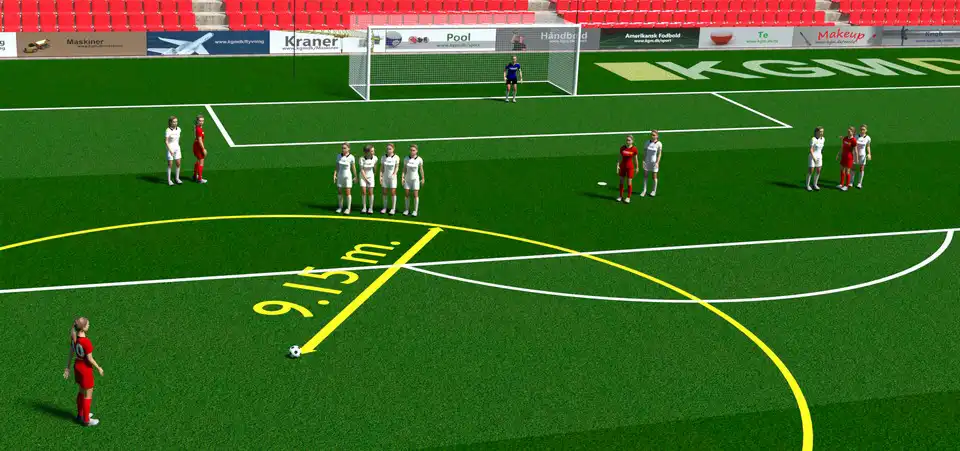
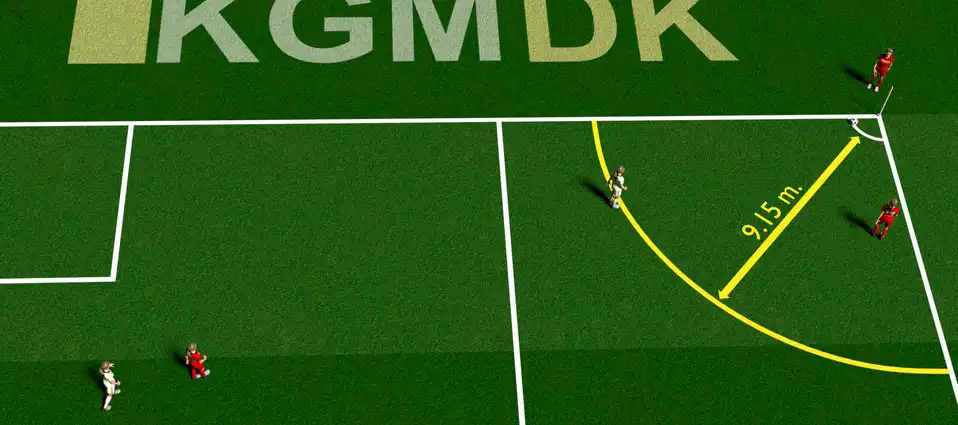
The arc at the edge of the penalty area is 9.15 meters from the penalty spot. It ensures that opponents keep their distance when a penalty kick is taken.
Penalty kicks and free kicks are described further down in the article.
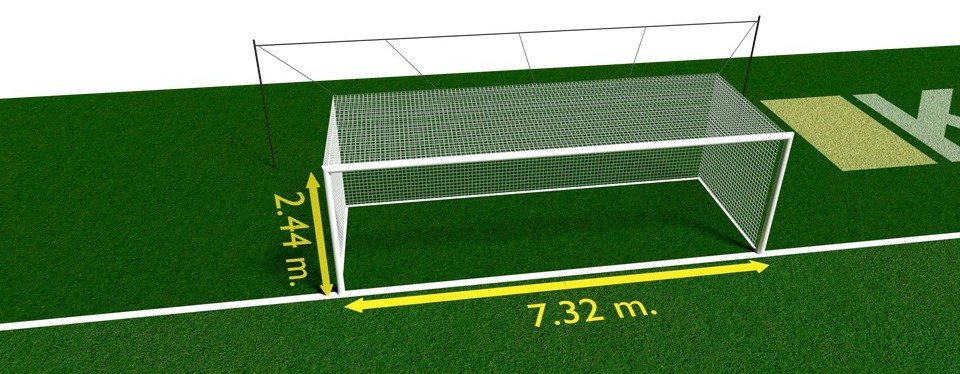
The goal shown above is a fixed goal. There are also goals that are not fixed, and which are produced with or without a counterweight placed in the rear part of the goal. The counterweight ensures that the goal cannot easily tip over, but it also makes it difficult to move around.
A free kick is awarded if the ball is deliberately touched with the hand or arm (contact with the shoulder is allowed). The arm is considered to go from the armpit down.
If the ball goes directly into the goal after contact with the hand/arm, a free kick is awarded, regardless of whether it is intentional or unintentional. The same applies if an opponent scores directly after the contact, or if a scoring chance is created. The rules regarding unintentional handball will most likely be changed as early as summer 2021, as they can result in some inappropriate penalties in the penalty area.
Furthermore, it is also a free kick for handball if the player makes themselves unnecessarily wide or has their arms above shoulder height.
A free kick should not be awarded if the ball comes directly from one's own head or from an opponent's head from close range. However, this does not apply to the above situations. The same applies if a player falls and uses their arms to cushion the fall.
An indirect free kick differs from a direct free kick in that the ball may not be kicked directly into the goal. If the ball is kicked directly into the goal without touching other players, a goal kick is awarded to the opposing team.
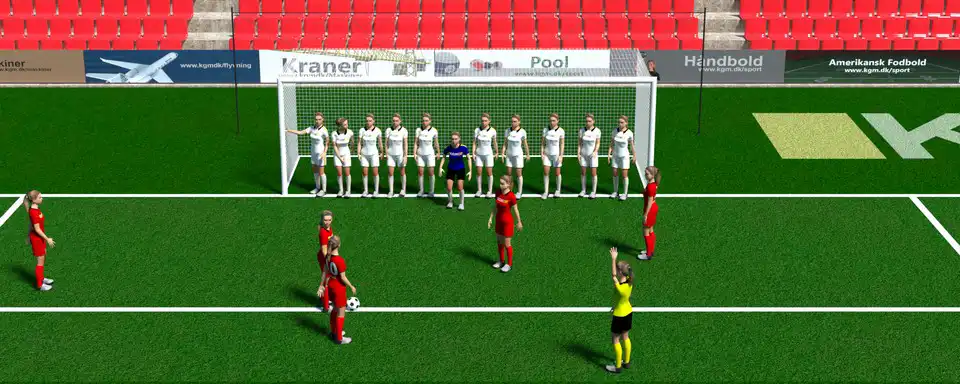
An indirect free kick is awarded for 'obstruction', which means blocking the path of an opponent without physical contact. In addition, it can be awarded for offensive behavior or for dangerous play.
The goalkeeper can commit an indirect free kick by holding the ball for more than 6 seconds and by touching the ball with arms or hands on a back pass or after having put the ball into play themselves, without other players having touched it in the meantime.
The referee indicates that it is an indirect free kick by holding one arm in the air.
An indirect free kick committed in the penalty area does not result in a penalty kick. Instead, the ball is placed at the spot where the foul was committed, but it is not placed in the goal area. If the foul was committed in the goal area, the ball is moved out to the line parallel to the goal line closest to where the foul was committed, as shown in the image above.
Opponents must not stand closer than 9.15 meters from the ball unless they are standing on the goal line, as shown above.
A penalty kick is awarded when a foul that would normally result in a free kick is committed in the penalty area.
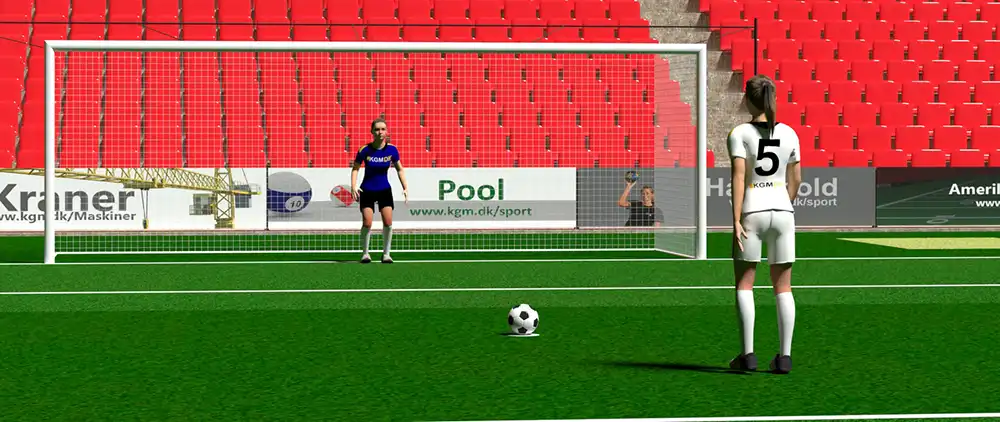
A penalty kick is taken from the penalty spot, which is 11 meters from the goal, and the ball must be kicked forward. If it is kicked backward, an indirect free kick will be awarded to the opponents. Once the kick has been taken, the kicker may not touch the ball again until it has been touched by another player or has gone out of play.
The goalkeeper must stand on the line and may only leave the line after the ball is in play. Because the kick is taken only 11 meters from the goal, the goalkeeper would gain a very big advantage by moving forward, and therefore the rule to stay on the line is now enforced much more strictly than before.
All other players except the kicker and the goalkeeper must stand outside the penalty area and outside the arc at the edge of the penalty area. The arc ensures that no players are closer than 9.15 meters from the ball.
Neither teammates nor opponents may enter the area before the ball is in play. If opponents enter too early and a goal is not scored, the kick must be retaken. If a teammate enters the area too early, the kick must be retaken if a goal is scored, and an indirect free kick is awarded to the opponents if no goal is scored.
A throw-in is awarded when the whole ball has crossed the sideline, and it is given to the opponents of the player who last touched the ball.
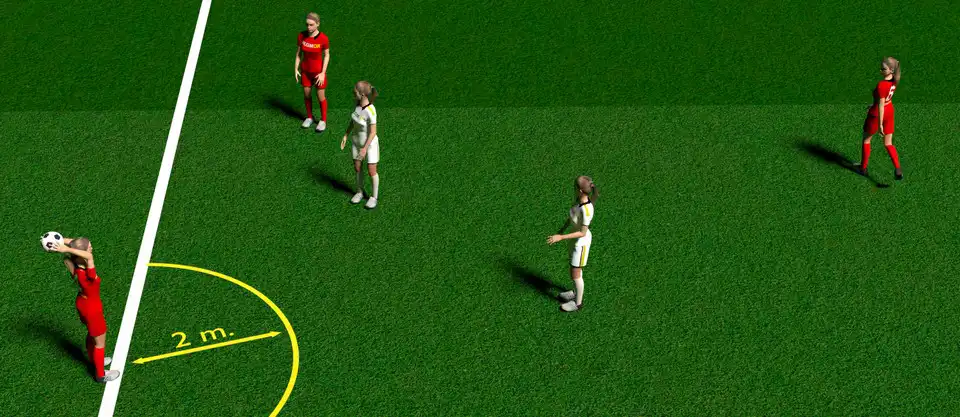
The player taking the throw-in must face the field (may not have their back to it), and both feet must be on the sideline or on the ground behind the sideline until the ball is released. The ball must be released over the head, and the thrower may not touch the ball again until it has touched another player.
If the throw-in is taken incorrectly, the opponents are awarded the throw-in. A goal cannot be scored directly from a throw-in. If the ball goes directly into the opponents' goal, it results in a goal kick, and if the throw-in goes into the thrower's own goal, a corner kick is awarded.
Opponents must stand at least 2 meters from the thrower, and it is allowed to throw the ball at an opponent on purpose in order to be able to touch the ball again. However, it must not be done with excessive force. If an opponent moves closer than 2 meters or otherwise interferes with the thrower, an indirect free kick is awarded.A corner kick is awarded when the whole ball has crossed the goal line and was last touched by the defending team. A goal can be scored directly from a corner kick, but an own goal cannot be scored. If the ball goes directly into one's own goal, a corner kick is awarded to the opponents.
A goal kick is taken from the small quarter circle at the corner flag, and the ball must be stationary when the kick is taken. The flag must not be moved or removed. A kick is considered taken when the ball moves, and it does not have to leave the quarter circle.
Opponents must stand at least 9.15 meters from the ball until it is in play. As with throw-ins, it is allowed to kick the ball at an opponent with the intention of being able to touch the ball again.It is not an offense in itself for a player to be in an offside position. It is only if the player actively participates in play that a punishable offside offense can occur.

A player cannot be offside on their own half of the field.
A player is in an offside position if any part of the body except the hands and arms is closer to the opponent's goal than both the ball and the second-last opponent. The last opponent will usually be the goalkeeper, but if the goalkeeper is further out than two or more outfield players, then it requires two outfield players to avoid an offside position.
An offside offense can only be committed at the moment a teammate plays the ball and the player actively participates in play while being in an offside position.
In the image above, the red player in front of the goal is in an offside position. The offside line is defined by the foremost white defender's foot, as arms do not count. However, the head of the red player does count. If the ball in this situation is played to the red player, offside should be called.
 Football boots
Football boots have undergone major changes, and just as with the ball, new production methods have also made it possible to produce football boots that are lighter and more flexible than before. As with the football, the classic colors have also been abandoned for football boots. Thirty years ago, almost all football boots were black, but today black boots are in the minority.
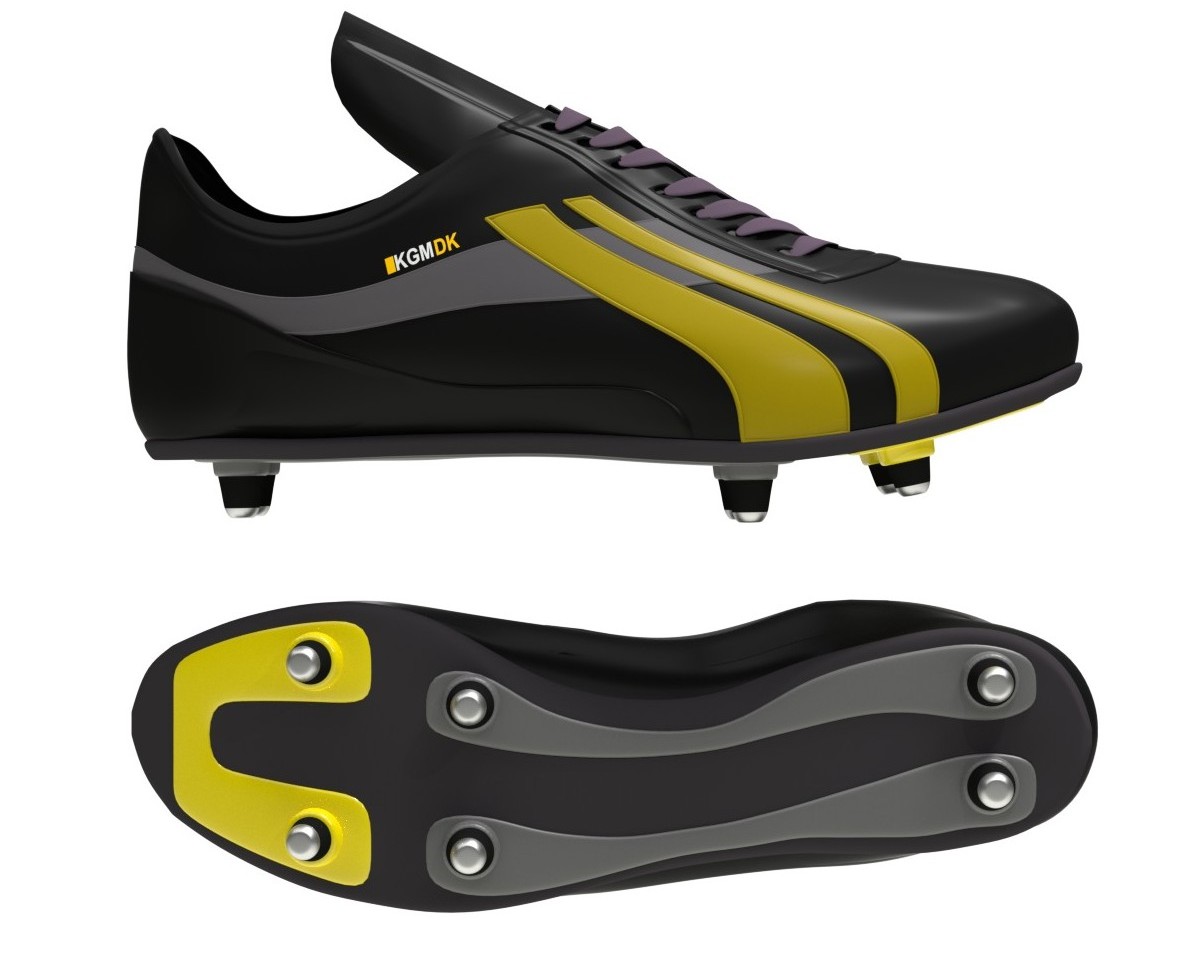
Besides size and fit, the studs on the football boots are the most important parameter, and you should always choose which type of football boot you need before you start looking at new football boots. The choice of studs depends almost exclusively on the surface you will be playing on. To make the choice easier, the terms FG, AG, SG, TF, and IN are used.
FG (Firm Ground) is made for dry grass pitches, and it is the best all-round choice if you are not going to use them on artificial grass. The studs can be either fixed studs or screw-in studs.
AG (Artificial Grass). For use on artificial grass pitches, many short studs distributed across the entire sole are needed. TF (Turf) is a variant that is specifically made for artificial grass.
SG (Soft Ground). Soft Ground boots are designed specifically for very wet or muddy pitches. They have very long metal studs, which are good for gripping the soft surface, but which will be uncomfortable on a harder surface. These boots should only be acquired as a supplement to other football boots.
Besides the surface, the choice of football boots also depends on playing style and playing position. Defenders will generally need a more durable and protective football boot, while attackers and wingers will benefit more from lighter and more flexible boots.
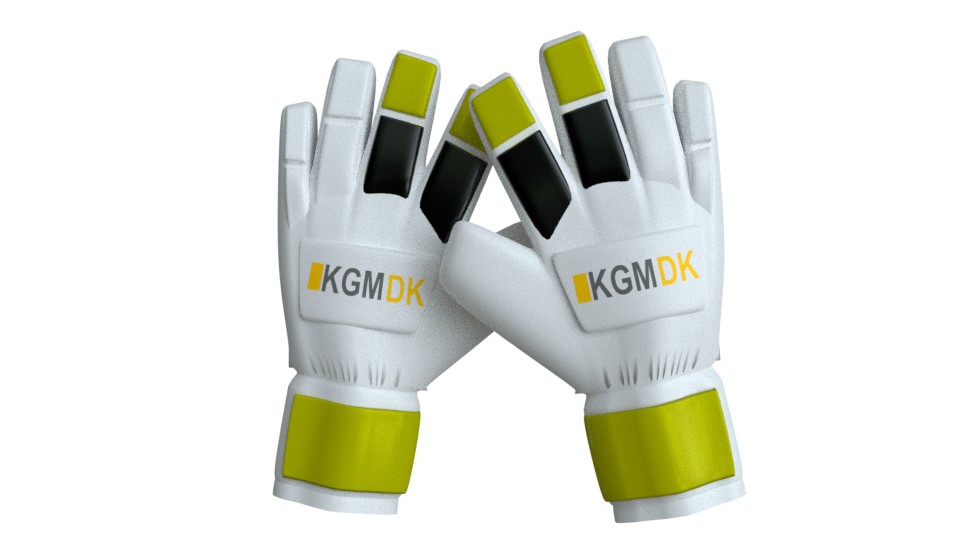
Flat Cut is the classic cut, where the seams are on the outside of the glove. Seams on the outside mean there is plenty of room for the fingers and completely clean contact surfaces with the ball.
In gloves with Rollfinger Cut, the latex is rolled around the fingers, which provides a large gripping surface and a tight fit to the fingers.
Negative Cut has over time become the most commonly used goalkeeper glove. Here, the seams are on the inside, which gives a very close ball contact.