

Handball is a game with two teams of 7 players each, played on a court that is 40 meters long and 20 meters wide.
In senior handball, the game is played in 2x30 minutes, and in case of a tie, an additional 2x5 minutes of extra time is usually played.
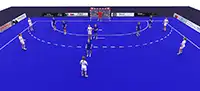
A handball court is 40 meters long and 20 meters wide.
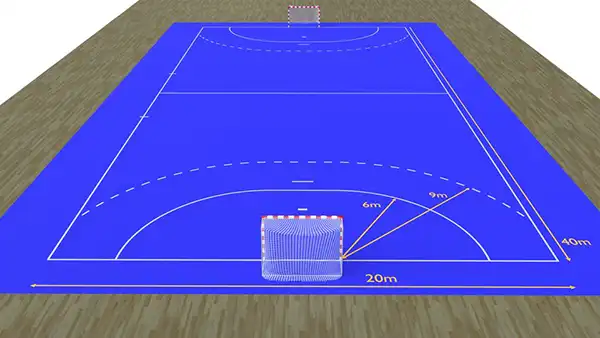
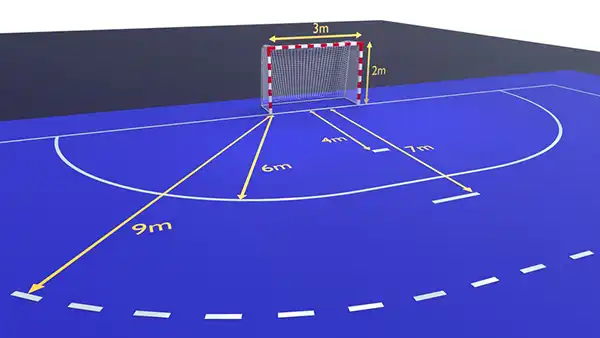
The goal line is the solid line 6 meters from the goal. Only the goalkeeper is allowed in this area.
If a defender defends with a foot on or inside the goal area line and deprives the opponents of an obvious scoring chance, the attacking team is awarded a penalty throw. Otherwise, a free throw is given.
If one of the attacking players steps into the goal area with the ball in hand, a violation is called and the opposing team is awarded a goal throw. The same applies if the player does not have the ball in hand but gains an advantage by stepping into the goal area.
The free throw line is the dashed line 9 meters from the goal. This line limits where the attacking team can take a free throw. A free throw cannot be taken inside the opponents' free throw line. In these cases, the ball is moved to the nearest point on the line.
Teammates may not cross the opponents' free throw line before the free throw is taken.
For penalty throws, the penalty throw line (7m) and the goalkeeper's restriction line (4m) are used.
The player executing the penalty throw may step up to the penalty throw line but not touch it. The goalkeeper may also step up to the restriction line but not touch it.
Each team has 7 players on the court at a time. One goalkeeper and six outfield players.
Unlike, for example, football, players in handball can be substituted at any time. The substitution must take place via the substitution lines shown at the top of the article.
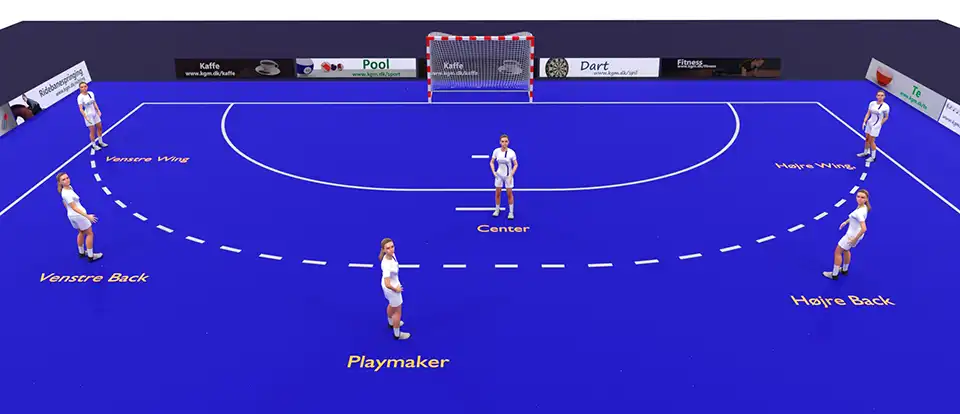
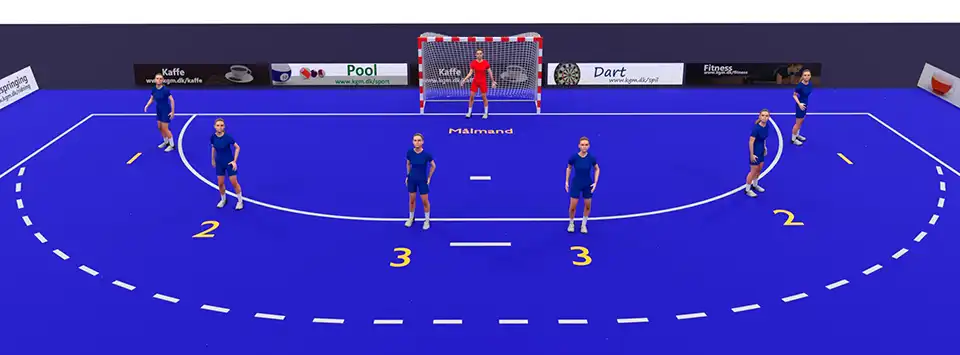
The defensive formations are briefly described below, but they are described in more detail in a separate article, which is linked at the bottom of the document.
Defensive players are often referred to by numbers as shown in the figure below.
Inside the goal area, the goalkeeper may touch the ball with both legs and arms and move freely with the ball without being restricted by rules such as too many steps or double dribbling. Outside the goal area, the goalkeeper is subject to the same rules as the outfield players.
The goalkeeper may not take the ball from the goal area if it is rolling or lying still outside the goal area.
During a penalty throw, the goalkeeper may not move further forward than the restriction line (4 meters from the goal) before the ball has left the hand of the player taking the throw.
Handballs are made in 3 sizes for men, women, and juniors.
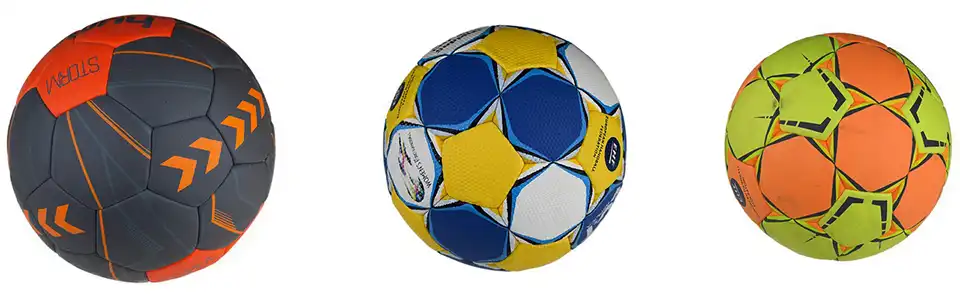
A free throw is awarded if the ball hits an opponent's foot. If the action is intentional by the opponent, it also results in a 2-minute suspension.
A player may take a maximum of 3 steps before the ball must either be passed or dribbled. After dribbling, a maximum of 3 steps may be taken. After that, the ball must be passed. If the player dribbles again, a double dribble is called.
It is also not allowed to pull the ball out of the hands of a player who has control of the ball.
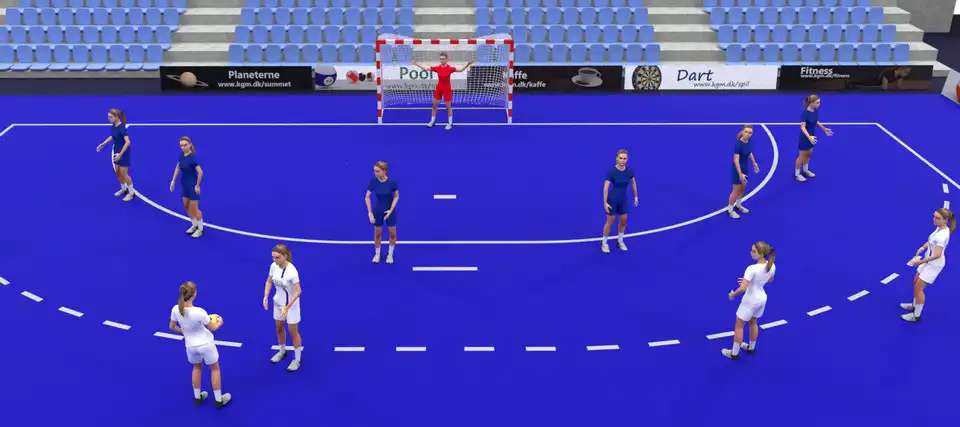
The free throw must be taken from the spot where the offense occurred. A free throw cannot be taken from one's own goal area or inside the opponents' free throw line. In these cases, the ball is moved to the nearest point on the line.
Teammates may not cross the opponents' free throw line before the free throw is taken.
Opponents must position themselves at least 3 meters from the player taking the free throw.
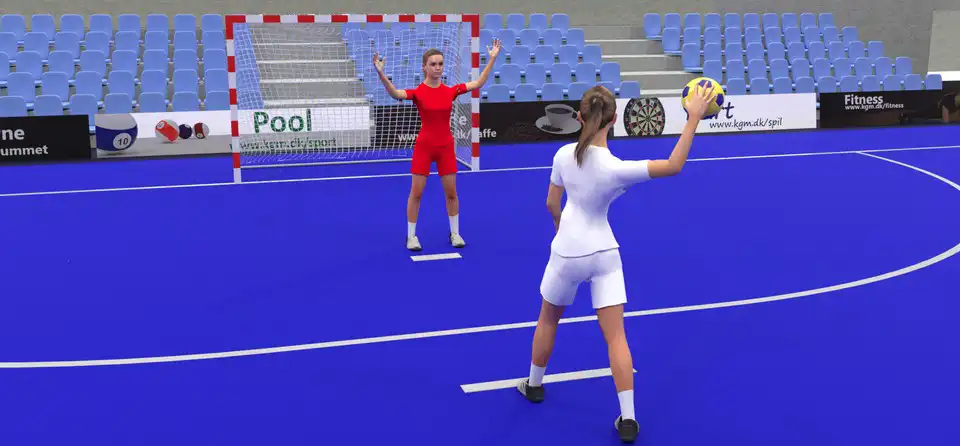
The penalty thrower must stand behind the penalty throw line and at most 1 meter behind the line when the penalty throw is taken.
 /
/
The penalty throw must be taken no later than 3 seconds after the referee's signal. Once the ball has been thrown, the penalty thrower and teammates may only touch the ball again after it has touched an opponent or the goalposts.
Teammates must position themselves at least 3 meters behind the goal line.
Opponents must position themselves at least 3 meters behind the goal line and at least 3 meters from the penalty throw line.
A throw-in is awarded if the entire ball crosses the sideline, or if a player from the defending team is the last to touch the ball before it crosses the goal line.
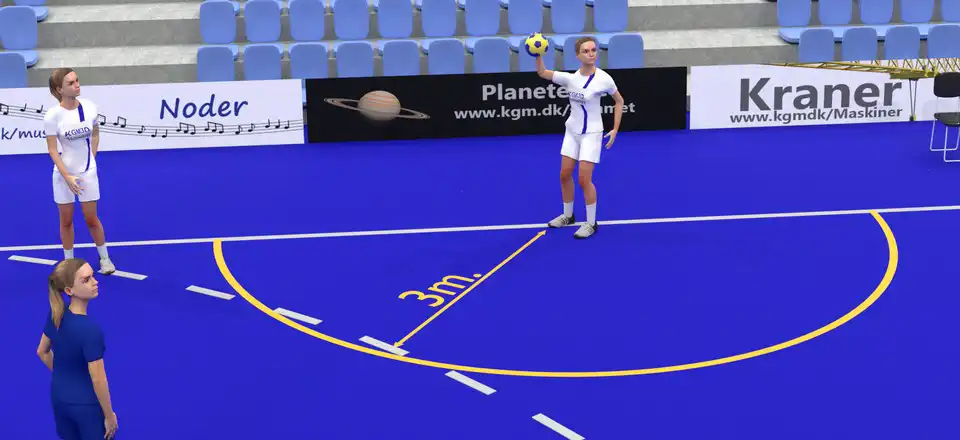
A throw-in is also awarded if the ball hits the ceiling or other objects above the court.
The player taking the throw-in must stand with one foot on the sideline. The throw-in is taken from the spot where the ball crossed the sideline or in the corner if the ball crossed the goal line.
Opponents may not stand closer than 3 meters from the throwing player. However, they may stand outside the line to their own goal area if it is within 3 meters.
If one of the attacking players steps into the goal area with the ball in hand, a violation is called and the opposing team is awarded a goal throw. The same applies if the player does not have the ball in hand but gains an advantage by stepping into the goal area.
A goal throw is also awarded if an opponent touches a ball rolling in the goal area, or if the ball crosses the end line and the goalkeeper or an opponent was the last to touch the ball.
The goal throw is taken by the goalkeeper throwing the ball out of the goal area. Opponents may stand just outside the goal area, but they may not touch the ball until it has left the goal area.