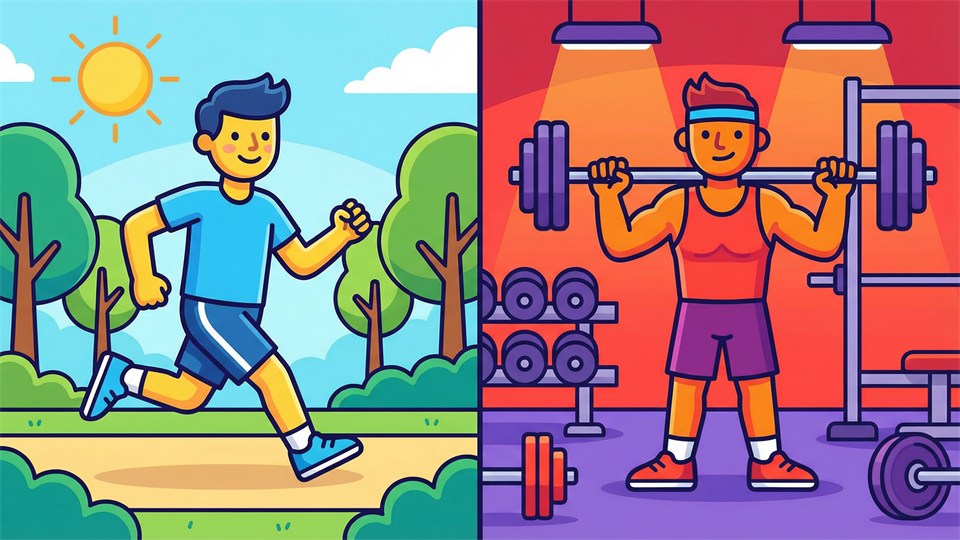
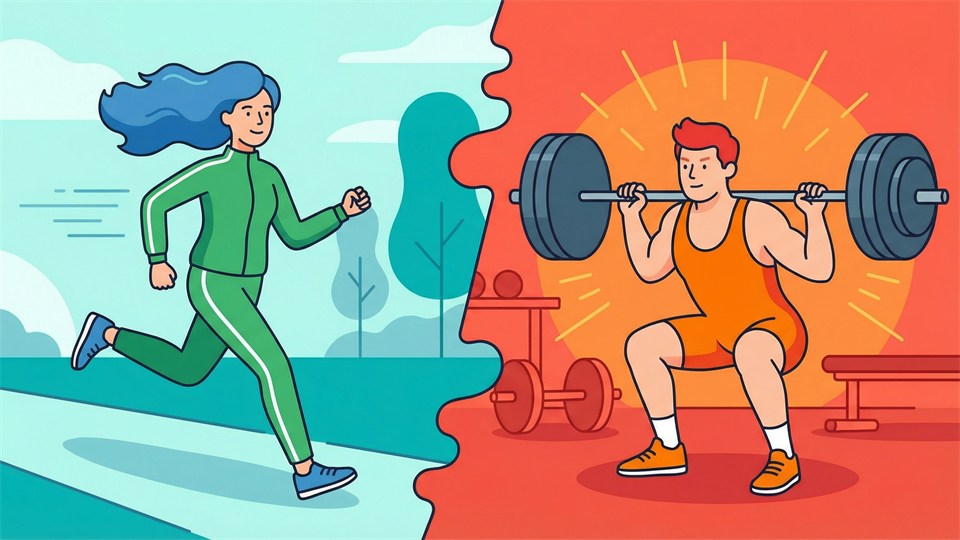


Do you want to lose weight, but are unsure whether to choose cardio or strength training? These two types of exercise are often compared when the goal is weight loss. But what is actually most effective – and should you choose one or the other, or can the two be combined for the best result? In this article, we take a closer look at how cardio and strength training affect weight loss, what the differences are, and how you can find the right balance for you.

Cardio (aerobic exercise) covers activities where you get your heart rate up for an extended period. Examples include running, cycling, swimming, dancing, and rowing. The purpose is to train the heart and lungs and burn calories by moving the large muscle groups.
Strength training is about training the muscles by exposing them to resistance. This can be with weights, resistance bands, or your own body weight (e.g. squats, push-ups, or pull-ups). The goal is to increase muscle strength and mass as well as improve body composition.
One of the biggest differences between cardio and strength training is how many calories you burn while you exercise. Cardio typically burns more calories per minute than strength training, especially if the intensity is high. For example, 30 minutes of running burns significantly more than 30 minutes of traditional strength training.
If you only look at calorie consumption during the workout itself, cardio is often the winner. That’s why many people choose running, cycling, or fitness classes when they want to lose weight quickly.
But the picture changes when we look at the so-called afterburn and muscle mass. Strength training gives a higher afterburn because the body needs energy to repair and build muscles after the workout. This means you burn extra calories in the hours after lifting weights.
Additionally, strength training increases your muscle mass. Muscles use more energy than fat, even at rest. The more muscle mass you have, the higher your overall metabolism – and you burn more calories throughout the day.

Several studies have examined what works best for weight loss. The conclusion is often that the overall calorie deficit is the most important factor – regardless of which type of exercise you choose. This means you lose weight if you burn more calories than you consume, whether it happens through cardio, strength training, or a combination.
But strength training has a special advantage: You maintain or increase your muscle mass during weight loss, which means you primarily lose fat and not muscle. Many people experience becoming "leaner" and stronger, even if the scale doesn’t drop dramatically.
Cardio is effective for burning calories here and now, but cannot alone prevent loss of muscle mass if you are in a large calorie deficit. That’s why many experts recommend combining the two types of exercise.
You run, cycle, or swim 4-5 times a week. Result: Rapid weight loss, but risk of losing muscle mass. You get better fitness, but don’t necessarily change your body shape significantly.
You do strength training 3-4 times a week and do little or no cardio. Result: Slower weight loss on the scale, but you maintain or build muscle, and your body becomes firmer.
You do strength training 2-3 times a week and cardio 2 times. Result: You burn calories, maintain muscle mass, and get both a strong and healthy body. Most experts recommend this balance.
The most important thing is that you choose a form of exercise you can stick with over time. If you hate running, you won’t get much out of forcing yourself onto the pavement several times a week. On the other hand – if you love lifting weights, strength training can be the perfect solution. You can also alternate between periods with more cardio or more strength, depending on what motivates you.
For beginners, it is recommended to combine the two types of exercise. Start, for example, with 2 strength training sessions and 2-3 short cardio sessions per week. Adjust along the way, depending on what you enjoy most.
Both cardio and strength training can contribute to weight loss, but they do so in different ways. Cardio burns a lot of calories during exercise, while strength training maintains muscle mass and increases your metabolism at rest. The best solution for most people is to combine both types of exercise and focus on a sustainable calorie deficit through a healthy diet.
Remember, motivation and consistency are more important than the "perfect" form of exercise. Find your own balance and enjoy the progress – both on the scale and in the mirror.