

High up in Earth's atmosphere are some of the planet's fastest air currents, known as jet streams. Although we cannot see them with the naked eye, they have a major influence on weather, climate, and air traffic. In this article, you will get an easy-to-understand introduction to what jet streams are, how they form, and why they are so important for life on Earth.
A jet stream is a narrow, powerful band of wind that moves very quickly – often between 150 and 400 km/h – in the upper part of the atmosphere, typically at an altitude of 8-12 kilometers. Jet streams are found primarily around the poles and the equator, where they wind around the entire Earth from west to east. Jet streams are therefore not winds we feel at the ground level, but they are crucial for how weather systems move and develop.
Jet streams arise due to differences in temperature and air pressure between different latitudes on Earth. The sun heats the equator more than the poles, creating large temperature differences across the globe. These differences cause the air to move in large circulation patterns, and where warm and cold air masses meet, strong wind bands – jet streams – are formed.
There are two main types of jet streams:
These jet streams move in winding paths that can change position and strength depending on the season and weather conditions.
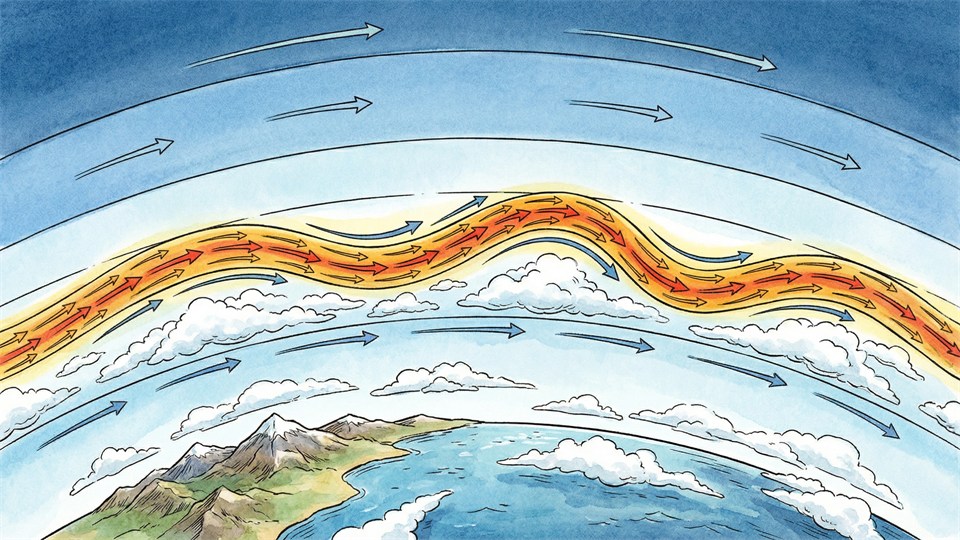
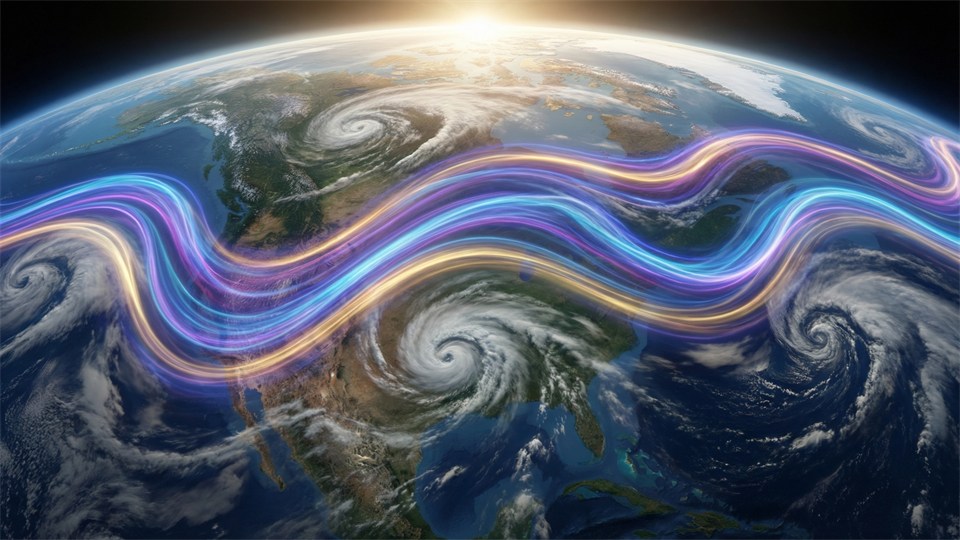
Jet streams are not as uniform as rivers, but more like winding bands that can meander and wave around the entire Earth. They are typically a few hundred kilometers wide, but only a few kilometers thick. Wind speed is highest at the center of the jet stream and decreases toward the edges.
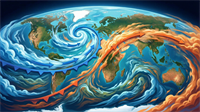
The jet streams move from west to east, which means they "run clockwise" in the northern hemisphere and "counterclockwise" in the southern. However, their path can swing north or south in large waves, called Rossby waves. These waves are very important for whether the weather in an area becomes warm and dry or cold and wet.
Jet streams act as a kind of "border guard" between different air masses and determine where weather systems such as low and high pressure move. If the jet stream lies far to the north, warmer air can be drawn up over an area, and conversely, a more southerly jet stream can bring cold air with it.
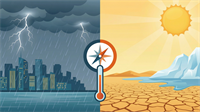
The position of the jet stream can therefore determine whether we get mild or cold winters, warm or cool summers, and how much precipitation falls.
Jet streams are not only interesting for meteorologists. They also play a major role in air traffic. Aircraft flying from west to east – for example, from the USA to Europe – can use the jet stream as a kind of "tailwind" and save both time and fuel. Conversely, flying west can take longer if you fly against the jet stream.
Pilots and air traffic controllers therefore keep a close eye on the position and strength of the jet stream when planning routes. At the same time, jet streams can cause turbulence, which can make the flight uncomfortable or, in rare cases, dangerous.
Researchers are currently investigating how climate change affects jet streams. When the temperature difference between the poles and the equator changes, it can cause the jet stream to wave more or shift position. Some studies suggest that this can lead to more extreme weather – for example, longer droughts or more intense storms.
Understanding jet streams is therefore important for being able to predict future weather and adapt society to changing climate conditions.
Meteorologists use several methods to measure and monitor jet streams:
This data is used to make weather forecasts and predict how weather systems will move in the coming days.
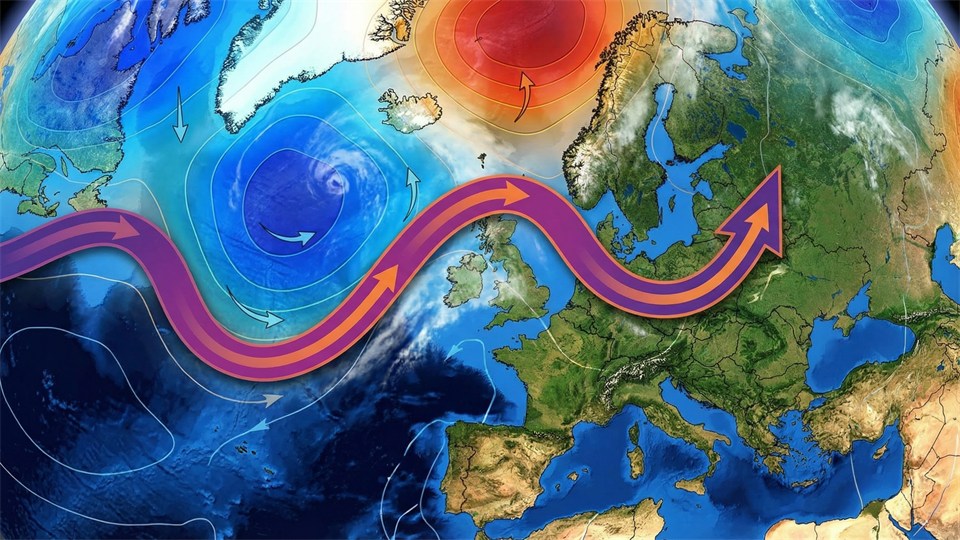
Jet streams are powerful but invisible air bands that tie together the planet's weather and climate. They control where wind, rain, and high pressure move, and therefore have great significance for everything from seasons to air travel. With climate change and more advanced technology, it is becoming increasingly important to understand the behavior of jet streams. Next time you experience a sudden change in weather or a fast flight, it may very well be the jet stream at play.